Key takeaways
- ✓Nothing in Queensland law requires a town planner to prepare or lodge a development application. You can do it yourself.
- ✓The research half of the job is genuinely accessible. The advocacy half is where self-prepared applications fail.
- ✓The three commonest DIY failures are missing an overlay, misidentifying the use, and answering the wrong benchmark.
- ✓An information request is not a rejection, but it costs weeks and is usually caused by an avoidable gap.
- ✓Doing the research yourself and buying only the advocacy is often the best value split.
DIY Planning Report vs Hiring a Planner in QLD
You'll usually hear this called a development application, or DA — that's the formal name for council approval under the Planning Act 2016. A question worth answering directly at the start: nothing in Queensland law requires you to engage a town planner. An owner can prepare and lodge their own development application, and plenty do successfully.
Get a council-ready planning report in 5 minutes — no planner, no waiting.
Get your report →The short answer
Nothing in Queensland law requires a town planner. You can prepare and lodge your own development application. The research half — zone, overlays, category of assessment — is genuinely accessible. The advocacy half, arguing against performance outcomes, is where self-prepared applications fail.
What the law requires, and what it does not
The Planning Act 2016 sets out how development applications are made and assessed. It does not require a particular profession to prepare them. Your council's assessment manager assesses what is in front of them against the assessment benchmarks, and it does not matter who typed it.
What is required is that the application is properly made — the right form, the right fee, the owner's consent where needed, and the required supporting material. Councils publish what they expect, and the DA Form 1 process is the same whether a planner or an owner lodges it. How to lodge a DA in QLD walks through the mechanics.
So the question is not permission. It is capability, and specifically capability at two quite different tasks.
The two halves of the job
Spend 5 minutes, not 3 weeks
instantDA generates a council-ready planning report for Queensland development applications. No town planner. No waiting.
Get your report →The research half. Establish what your land is: the zone and any precinct or local plan, every overlay affecting the premises, the category of assessment for your particular proposal, and which codes and benchmarks apply. This is document work. The information is public, the mapping is online, and a careful person with a few hours can do it.
The advocacy half. Take your proposal and demonstrate, benchmark by benchmark, that it complies — and where it does not meet an acceptable outcome, argue that it achieves the performance outcome above it. That is written persuasion against a technical standard, and it is where the professional value sits.
The split matters commercially, because it tells you what to buy. If your proposal complies with every acceptable outcome, you barely need the second half. If it does not, that is the part worth paying for.
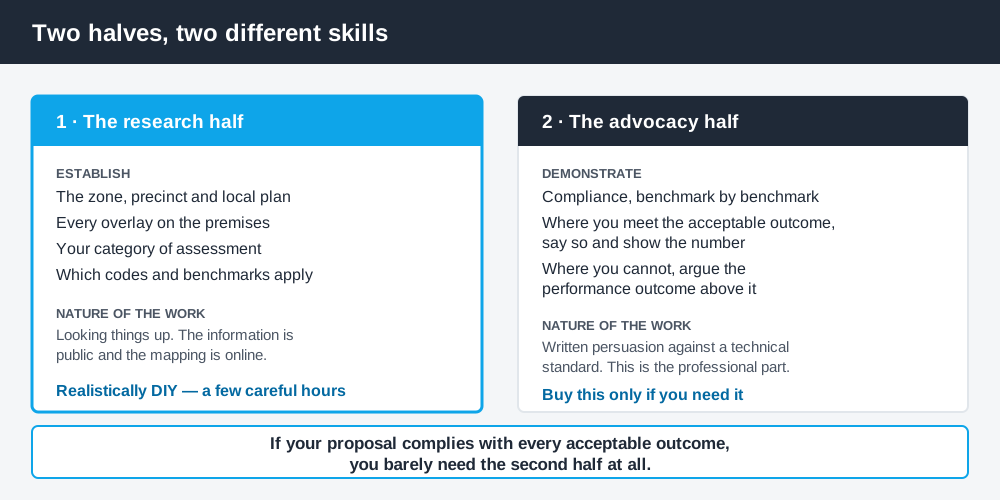
Figure 1: One half is public information. The other is a written argument.
The three mistakes that sink DIY applications
Missing an overlay. This is the most common and the most expensive. Overlays sit above the zone and carry their own assessment tables, and they can lift your category of assessment from accepted to code, or code to impact. A proposal built around the zone code alone, in a property with a flood hazard or character overlay over it, is answering the wrong question entirely. Check every overlay layer on your council's mapping, not just the obvious ones.
Misidentifying the use. Queensland schemes define uses precisely, and the definition determines which table of assessment applies. A "home business" and a "home based business", a "dual occupancy" and a "secondary dwelling", a "shed" and a "domestic outbuilding" — these are not interchangeable, and choosing the wrong one produces an assessment against the wrong benchmarks. When in doubt, match your proposal to a defined use term in the scheme's administrative definitions rather than to ordinary English.
Answering the wrong benchmark. Codes are structured as performance outcomes with acceptable outcomes beneath them. If you meet the acceptable outcome, say so and show the number. If you cannot, you must address the performance outcome directly — and a response that simply restates the acceptable outcome you failed is not an answer. This is the single most common reason self-prepared applications attract an information request.
- ✓Every overlay layer checked, not just the obvious ones
- ✓The use matched to a defined term in the scheme
- ✓Each benchmark answered individually
- ✓Performance outcomes addressed where acceptable outcomes are not met
- ✓Drawings that match the text
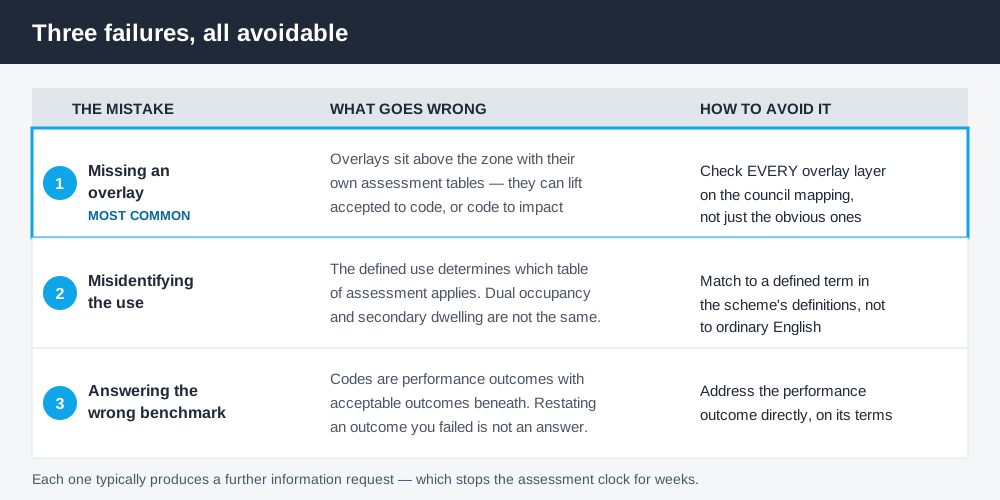
Figure 2: Each one is avoidable, and each one costs weeks.
What going wrong actually costs
Not usually refusal. Usually delay.
The typical outcome of a weak self-prepared application is a further information request from the assessment manager, which stops the clock while you produce what was missing. That is weeks, sometimes months on a busy council, and it is the reason DIY applications so often take far longer than budgeted rather than costing more.
The second-order costs are worse if you have a construction loan drawing interest, a contract subject to approval, or a builder holding a slot.
And the genuine failure case: if the proposal was never going to comply, no amount of drafting fixes it. That is the argument for doing the research first, properly, before you commit to anything — because the research tells you whether the advocacy is worth attempting.
The split that usually works best
Do the research yourself, or buy it cheaply. Pay for the advocacy only if you need it.
Establish your zone, your precinct, every overlay and your likely category of assessment. If the answer is that the work is accepted development, you are finished and you have spent nothing. If it is code assessable and complies with every acceptable outcome, a competent owner or a building designer can commonly prepare the application. If it relies on performance outcomes, or is impact assessable, buy a planner for that part — and brief them with the research already done, which reduces their discovery time and your bill.
If you'd rather buy the research than spend a weekend on planning scheme mapping, an instantDA planning report sets out your zone, your overlays and your likely category of assessment for your address for $169, against the $800–$1,500 a town planner typically charges for a preliminary opinion. It is the research half, not the advocacy half, and it is honest about that distinction. You can start a report in a few minutes.
For the DIY route, start with your council's planning scheme and its mapping, use Queensland Globe for lot, plan and state-mapped layers, and read the state's guidance on local planning schemes to understand how the documents fit together. A pre-lodgement meeting with your council is also worth the fee — it is the cheapest point at which to find out your approach needs to change.
For a fuller comparison of buying research versus buying representation, instantDA vs a town planner works through when each is the right call. And confirm your conclusions with your council before you commit money, because schemes are not uniform across Queensland.
Frequently asked questions
Can I lodge my own development application in Queensland?
Is a self-prepared planning report accepted by councils?
What is the most common mistake in a DIY planning report?
What happens if my application is incomplete?
When should I stop doing it myself?
Do I still need a building certifier if I do the planning myself?
Ready to generate your report?
Skip the writing. Get a council-ready planning report in 5 minutes.
Get your report