Key takeaways
- ✓A planning report tells you what your land allows. A town planner argues a case for what you want to do with it.
- ✓They answer different questions, so the honest comparison is sequence, not substitution.
- ✓For most homeowners the first question is whether approval is needed at all, and that is a research question.
- ✓If your proposal is impact assessable, contested, or relies on performance outcomes, engage a planner.
- ✓Neither replaces confirming your position with your council before you commit money.
instantDA vs a Town Planner: Which Do You Need?
You'll usually hear this called a development application, or DA — that's the formal name for council approval under the Planning Act 2016. When people compare an instantDA planning report with engaging a town planner, they usually frame it as cheap versus expensive. That is the wrong axis, and it leads to bad decisions in both directions: paying for professional advocacy you did not need, or trying to argue a difficult case with a research document.
Get a council-ready planning report in 5 minutes — no planner, no waiting.
Get your report →The short answer
They answer different questions. A planning report tells you what your land allows — zone, overlays, likely category of assessment. A town planner takes a proposal and builds the case for it. For most homeowners the first question is research, and the second only arises if the answer is that approval is needed.
What each one is for
An instantDA planning report is a research document about your address. It pulls together the zone, the precinct or local plan, every overlay affecting the premises, and what your council's scheme means for the kind of project you have in mind. It costs $169 and you have it in minutes. It answers: what does my land allow, and is my project likely to be accepted, code assessable or impact assessable?
A town planner is a professional you engage. They can do the same research, and they can also do things a document cannot: form a judgement about how your particular council assesses this kind of proposal, negotiate at a pre-lodgement meeting, write a planning justification against performance outcomes, prepare and lodge the application, manage an information request, negotiate conditions, and appear if the matter goes to the Planning and Environment Court.
The distinction is between finding out and advocating. A report finds out. A planner advocates.
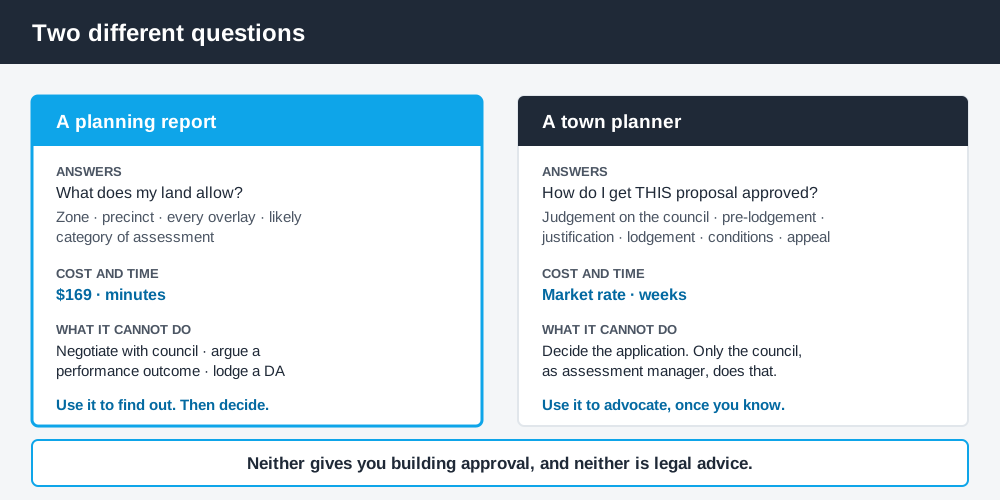
Figure 1: Different questions, not competing answers to the same one.
When the report is enough
Spend 5 minutes, not 3 weeks
instantDA generates a council-ready planning report for Queensland development applications. No town planner. No waiting.
Get your report →For a large share of Queensland homeowners, the honest answer to "do I need a planner" is no, and the report exists to establish that quickly.
You are working out whether you need approval at all. A shed, a deck, a carport, a fence. The answer is in the thresholds and your scheme, and it is a research question.
You are checking a property before you buy it. You want to know the zone, the overlays and whether your intended use is realistic before you go unconditional. Ordering a preliminary opinion from a planner for every property you inspect is not practical.
Your proposal is straightforward and complies. If the work is accepted development, or code assessable and meets every acceptable outcome, the application is a documentation exercise rather than an argument.
You want to brief a planner properly. Turning up knowing your zone, your overlays and your likely category makes every quote you receive cheaper and more accurate, because there is less discovery work to bill.
- ✓Is the question what my land allows, or how to argue for what I want
- ✓Is my proposal likely to be accepted or code assessable
- ✓Does it comply with every acceptable outcome
- ✓Is anyone likely to object
- ✓Is money already committed
When you need a planner
Be honest with yourself about these. Each one is a signal that you are past the research stage.
Your proposal is impact assessable. The assessment opens the whole planning scheme, the application must be publicly notified, and submitters can appeal to the Planning and Environment Court. That is a merits argument with a third party who can extend your timeline. It needs an advocate.
You are relying on performance outcomes. Where you cannot meet an acceptable outcome, you have to argue that your proposal achieves the performance outcome above it. That is written advocacy against a specific benchmark, and it is the part of the job that most rewards experience.
The site has serious constraints. Multiple overlays, a heritage listing, flood or bushfire hazard, or a state referral. Each brings its own benchmarks and often a specialist report to co-ordinate.
Money is already committed. A contract subject to approval, a construction loan, a settlement date. The cost of a planner is small against the cost of a delay.
You have received a notice, or been refused. A show cause notice, an enforcement notice, a refusal, or an information request you do not know how to answer. Get professional help.
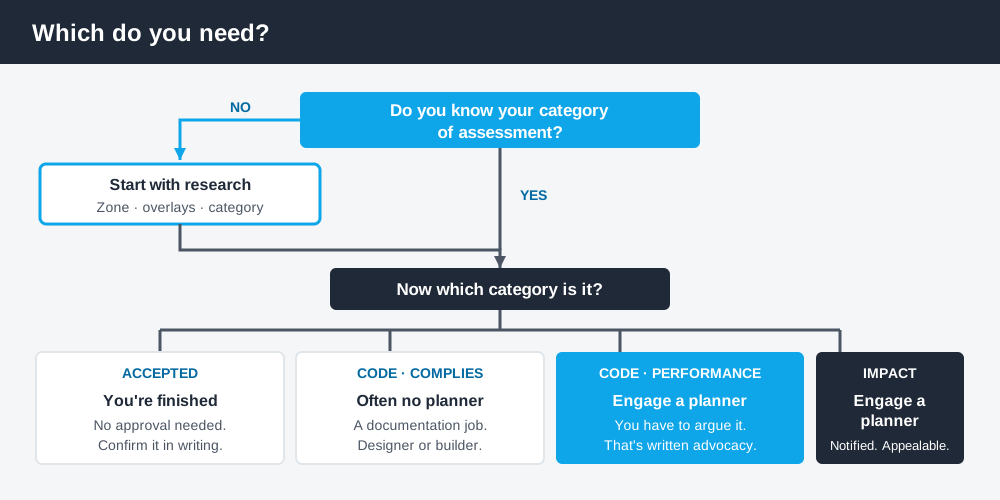
Figure 2: The category of assessment does most of the deciding.
What neither of them does
Worth being straight about the limits, because overclaiming here is how people get hurt.
Neither is a decision. Only your council, as assessment manager, decides your application. A report and a planner both produce views, however well-informed.
Neither replaces a building certifier. Building approval is a separate system under the Building Act 1975, and neither a planning report nor a town planner gives it to you. If your project needs a certifier, engage one.
Neither is legal advice. For enforcement matters, appeals or contract questions, that is a planning lawyer.
Neither substitutes for confirming with your council. Queensland schemes follow the Queensland Planning Provisions structure but are not uniform — each council layers its own codes, overlays and thresholds on top. Get anything you rely on confirmed.
How they fit together
The sequence that works is: research, then decide, then advocate if you have to.
Establish your zone, your overlays and your likely category of assessment. If the answer is that no approval is needed, you are finished, and you have spent very little. If the answer is that a straightforward code assessable application is required, you can often proceed with a designer or builder and no planner at all. If the answer is impact assessment, or an overlay you cannot get around, engage a planner — and brief them with what you already know, which costs them less time and you less money.
Against the $800–$1,500 a town planner typically charges for a preliminary opinion, an instantDA planning report is $169 and takes minutes rather than weeks. That is not an argument that it does the same job. It is an argument for finding out cheaply before you decide what to spend properly. You can start a report in a few minutes.
Alongside it, use your council's planning scheme maps for the zone and overlays and Queensland Globe for lot, plan and state-mapped layers. For the wider question of what professional help costs across the state, town planner fees in Queensland sets out the market, and is a town planner worth it in QLD works through the cases where the answer is clearly yes.
Frequently asked questions
Is an instantDA planning report a replacement for a town planner?
When do I definitely need a town planner in Queensland?
Can a planning report get my development approved?
Does a planning report cover building approval?
Is it worth getting a report before I buy a property?
Should I get a report before engaging a planner?
Ready to generate your report?
Skip the writing. Get a council-ready planning report in 5 minutes.
Get your report