Key takeaways
- ✓The question is not whether planners are good value in general. It is whether your project has an argument in it.
- ✓Compliant, code assessable proposals rarely need one. Impact assessable proposals almost always do.
- ✓The strongest case for a planner is knowing what your council will actually accept, which is not written down anywhere.
- ✓Where money is already committed, a planner is cheap insurance against delay.
- ✓Find out your category of assessment before you decide. It answers most of the question for you.
Is a Town Planner Worth It in Queensland?
You'll usually hear this called a development application, or DA — that's the formal name for council approval under the Planning Act 2016. Whether a town planner is worth the fee is not a question about planners. It is a question about your project, and specifically about whether there is an argument in it. Some Queensland projects contain no argument at all, and a planner adds cost without adding much. Others are nothing but argument, and trying to run them yourself is the expensive option.
Get a council-ready planning report in 5 minutes — no planner, no waiting.
Get your report →The short answer
It depends on whether your project has an argument in it. A compliant, code assessable proposal rarely needs a planner. An impact assessable proposal, or one relying on performance outcomes, almost always does. Establish your category of assessment first — it answers most of the question.
What a planner adds that research does not
Anyone careful can find their zone, their overlays and their category of assessment. That information is public. Four things are not.
Judgement about your particular council. Schemes tell you what the benchmarks are. They do not tell you which performance outcome arguments this council's officers have accepted before, how they read a particular overlay in practice, or what conditions they routinely impose. A planner who works that scheme weekly knows. Nobody can look it up.
Written advocacy. Where you cannot meet an acceptable outcome, you have to demonstrate that your proposal achieves the performance outcome above it. That is technical persuasion against a specific standard, and it is the part of the job most improved by experience.
Negotiation. Pre-lodgement meetings, information requests, condition negotiation. Being able to have a professional conversation with an assessment officer, in their language, changes outcomes.
Knowing when to change the design. The most valuable thing a good planner does is often to tell you that your proposal will not fly and that moving the building two metres solves it. That advice arrives before the money is spent.
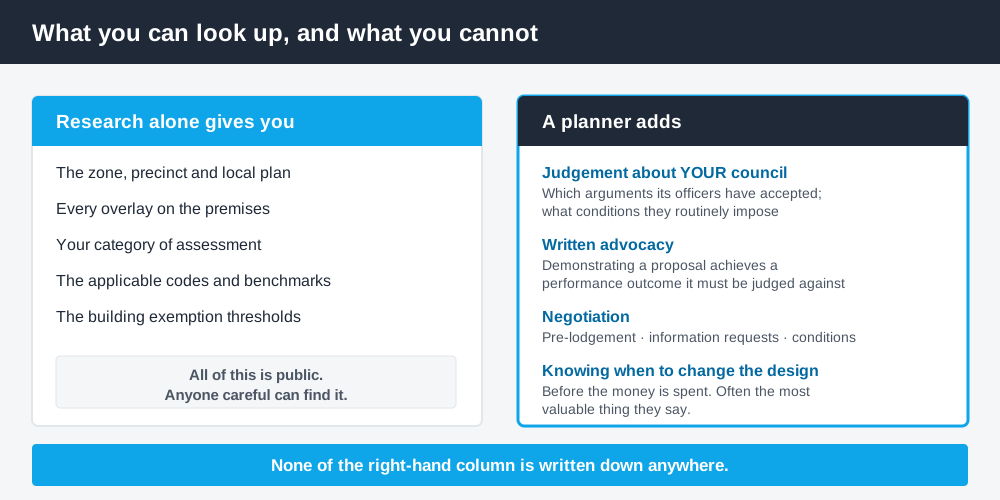
Figure 1: Research is available to anyone. The rest is not.
Five situations where the answer is yes
Spend 5 minutes, not 3 weeks
instantDA generates a council-ready planning report for Queensland development applications. No town planner. No waiting.
Get your report →1. Your proposal is impact assessable. Assessment opens the whole planning scheme, the application must be publicly notified, anyone may make a properly made submission, and a submitter can appeal to the Planning and Environment Court. That is a merits argument with a third party who can extend your timeline substantially. Engage someone.
2. You are relying on performance outcomes. You cannot meet an acceptable outcome — a setback, a height, a site cover figure — and must argue the performance outcome instead. This is the single clearest signal.
3. The site is heavily constrained. Several overlays, a heritage listing, flood or bushfire hazard, or a state referral to the State Assessment and Referral Agency. Each brings benchmarks and often a specialist report to co-ordinate, and co-ordination is a real skill.
4. Money is already committed. A contract subject to approval, a construction loan drawing interest, a builder holding a slot, a settlement date. A planner's fee is small against the cost of a three-month delay, and delay is what unrepresented applications generate.
5. Something has gone wrong. A refusal, a show cause notice, an enforcement notice, or an information request you cannot answer. At this point the question is not value for money — it is damage control, and you may want a planning lawyer as well.
- ✓Is it impact assessable
- ✓Does it fail any acceptable outcome
- ✓How many overlays apply
- ✓Is money already committed
- ✓Has anything gone wrong already
Where it is clearly no
Small exempt work. If your project is accepted development and inside the building exemption thresholds, there is nothing for a planner to argue. Confirm the exemption in writing and build. What you can build without council approval in QLD sets out the common thresholds.
Straightforward code assessable work that complies. Where the proposal meets every acceptable outcome, the application is a documentation exercise: state the benchmark, state your figure, attach the drawings. A competent building designer handles a great deal of this, and plenty of owners do it themselves.
You are still at the "is this even possible" stage. Commissioning professional advice before you know your zone and overlays is buying discovery work you could have done free.
You are comparing properties. Nobody engages a planner on every property they inspect. Get the cheap research on each and the professional advice on the one you buy.
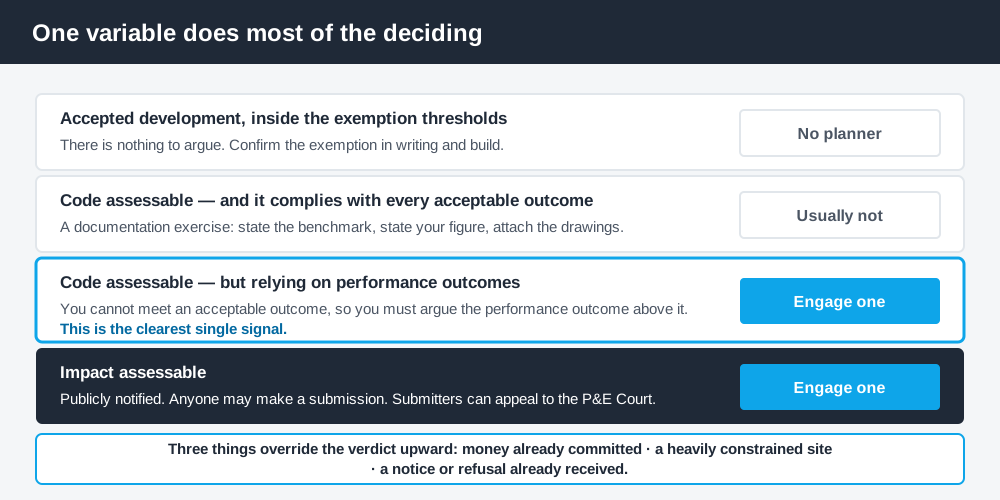
Figure 2: Most of the answer comes from one variable.
How to think about the money
The fee is not the number that matters. Three others usually dwarf it.
The cost of delay. An information request stops the assessment clock while you produce what was missing. On a project with a loan or a builder booked, weeks are expensive in a way a fixed fee is not.
The cost of a redesign. Discovering at assessment that your building has to move is far worse than discovering it at concept stage.
The cost of refusal. Reworking and relodging, or appealing, costs multiples of getting it right first time.
Against those, the sensible framing is: buy the research cheaply, find out whether there is an argument in your project, and buy advocacy only if there is. That sequence minimises what you spend without leaving you unrepresented where it counts. Town planner fees in Queensland covers what the market charges for each service.
Work out your side of the line first
Establish the zone, the precinct and every overlay on your council's planning scheme maps, then find your category of assessment in the tables of assessment. Use Queensland Globe for lot, plan and state-mapped layers, and the state's guidance on local planning schemes to understand how it all fits together.
A pre-lodgement meeting with your council is also worth its fee whichever way you go — it is the cheapest point at which to discover your approach needs to change.
If you'd rather read your zone, your overlays and your likely category of assessment in one document than spend a weekend on scheme mapping, an instantDA planning report does that for your address for $169, against the $800–$1,500 a town planner typically charges for a preliminary opinion. It tells you which side of the line you are on. It does not replace a planner once you know you are on the far side. You can start a report in a few minutes.
And whatever you conclude, confirm it with your council — schemes are not uniform across Queensland, and general guidance is no substitute for your own scheme, for your own address.
Frequently asked questions
Do I need a town planner for a development application in Queensland?
When is a town planner clearly worth the money?
When do I not need a town planner?
What does a planner know that I cannot look up?
Is it cheaper to do the research myself and hire a planner later?
How much does a town planner cost in Queensland?
Ready to generate your report?
Skip the writing. Get a council-ready planning report in 5 minutes.
Get your report