Key takeaways
- ✓There is no single state-wide lodgement system for council DAs. You lodge with your council, using its own portal, email or counter.
- ✓Work out your category of assessment before you prepare anything. Accepted development needs no DA at all.
- ✓The Development Assessment Rules run the process in five parts: application, referral, information request, public notification and decision.
- ✓The assessment manager has 10 business days to decide whether your application is properly made, and 35 business days to decide the application itself.
- ✓MyDAS2 is the state system, used where the state is assessment manager or a referral agency. It is not how you lodge a council DA.
How to Apply for Council Approval in QLD: Lodging a Development Application
You'll usually hear this called a development application, or DA — that's the formal name for council approval under the Planning Act 2016. Lodging one is not complicated, but it is sequential: several of the steps only make sense once the step before them is done, and doing them out of order is how applicants end up paying twice.
The process itself is set out in the Development Assessment Rules, made under section 68 of the Planning Act 2016. Those rules apply statewide, so the sequence and the deadlines are the same whichever council you deal with. What differs between councils is how you physically get the application to them, and what they want in the pack.
Get a council-ready planning report in 5 minutes — no planner, no waiting.
Get your report →The short answer
Confirm your category of assessment, prepare DA Form 1 with plans, a planning report, the fee and owner's consent, then lodge with your council through its portal, by email or in person. There is no state-wide lodgement system for council DAs. The assessment manager then has 10 business days to confirm it is properly made.
Step 1: find out whether you need a DA at all
Before anything else, establish your category. Under the Planning Act 2016 development is prohibited, assessable or accepted. Only assessable development needs a development application, and accepted versus code versus impact assessable explains how the categories work and where to find yours in your council's tables of assessment.
Two outcomes save you the whole exercise. If your proposal is accepted development, there is no DA to lodge. If it is accepted subject to requirements, there is still no DA — provided you actually comply with the stated requirements.
The other thing to settle here is whether you need a building approval as well, or instead. They are separate systems, and building approval versus development approval sets out which decision-maker you need.
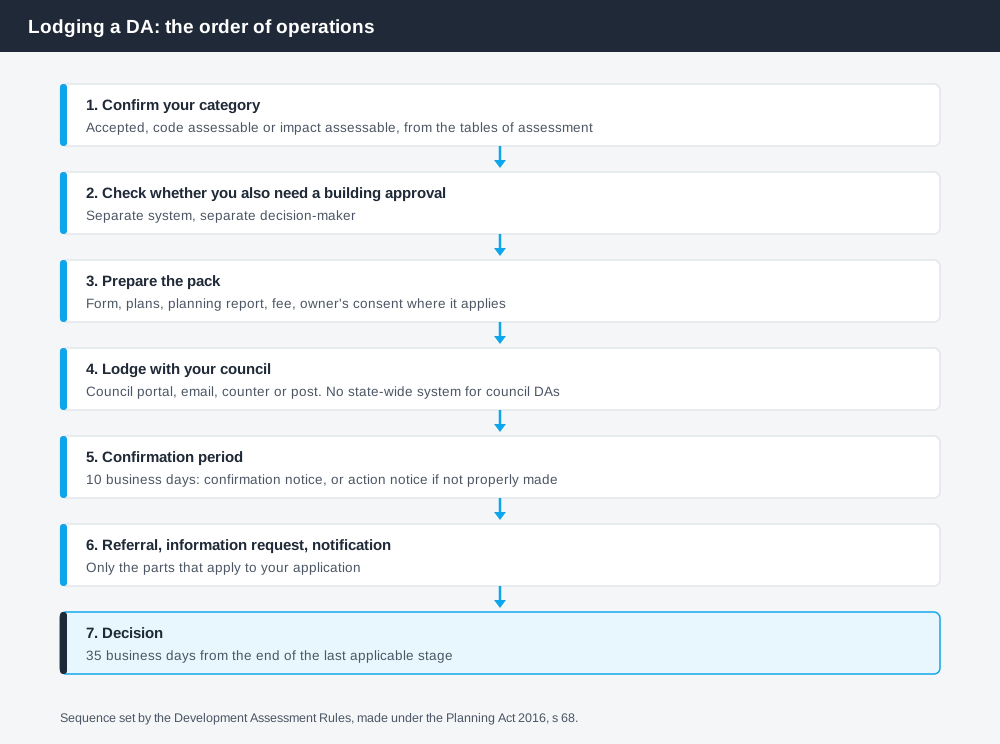
Figure 1: The order of operations. Doing step three before step one is the expensive mistake.
Step 2: prepare the application
Spend 5 minutes, not 3 weeks
instantDA generates a council-ready planning report for Queensland development applications. No town planner. No waiting.
Get your report →The pack has four mandatory elements under section 51 of the Planning Act 2016: the approved form, the documents that form requires, the fee, and the owner's written consent where you are not the owner and the application is for a material change of use or reconfiguring a lot.
For most planning applications the form is DA Form 1 — Development application details. Building work on its own uses DA Form 2 — Building work details, and a combination uses DA Form 1 plus parts 4 to 6 of DA Form 2. Download the current versions from the state's development assessment forms page rather than reusing an old copy.
Around the form sit dimensioned plans, a planning report addressing the applicable assessment benchmarks, and any technical reports triggered by overlays or scale. What documents council needs for your DA covers the full list.
Step 3: lodge with your council
This is where people expect a state portal and do not find one.
There is no single state-wide lodgement system for council development applications. You lodge with the assessment manager, which for most applications is your local council, using whatever channels that council offers. In practice that means one of an online lodgement portal, email to a planning address, delivery at a customer service centre, or post.
MyDAS2 is the state's online system, and it is genuinely useful — but it is for applications where the state is the assessment manager or a referral agency, and for preparing applications. It is not the front door for an ordinary council DA. Some councils encourage applicants to prepare in MyDAS2 and then send the package to the council.
Development.i is a third thing again, and the one most commonly misunderstood. It is a development information and tracking tool, deployed separately by individual councils, and each instance only covers that council's area. It is for finding and following applications, not lodging them. Lodging and tracking with your council online explains which tool does what.
- ✓Confirm your assessment manager is the council
- ✓Check that council's lodgement page for accepted channels
- ✓Confirm the fee amount and how to pay it
- ✓Ask whether documents have file naming or size rules
- ✓Keep proof of lodgement and the date
Step 4: the confirmation period
Once the application is received, the assessment manager has 10 business days — the confirmation period — to determine whether the application is properly made.
If it is, and the application requires referral or public notification, you receive a confirmation notice. If it is not properly made, you receive an action notice setting out what must be fixed. You have 20 business days, or a longer agreed period, to comply and notify the assessment manager. Fail to do that and the application is taken never to have been made, unless the assessment manager accepts it anyway.
Step 5: referral, information request, notification, decision
The Development Assessment Rules break the rest into parts, and not every part applies to every application.
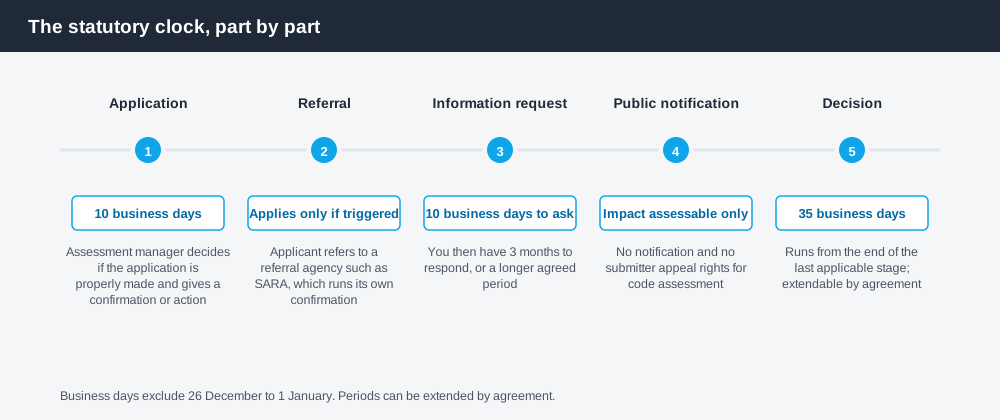
Figure 2: The statutory clock, part by part.
Referral applies where the proposal triggers a referral agency, most often the State Assessment and Referral Agency. The applicant refers the application, and the referral agency runs its own confirmation process.
Information request. The assessment manager, or a referral agency, may ask for further information. It must be made within 10 business days, and you then have three months to respond, or a longer agreed period. You can elect on DA Form 1 not to receive one — which prevents anyone asking, so only do it if the pack is genuinely complete.
Public notification applies to impact assessable applications. It does not apply to code assessment.
Decision. The assessment manager must assess and decide the application within 35 business days — the decision period — running from the end of the last applicable stage. That period can be extended by agreement, and it absorbs up to 10 business days of any time the assessment manager took to make an information request.
One counting quirk worth knowing: the DA Rules count in business days, and exclude the days between 26 December and 1 January. Applications lodged in December run slower than the calendar implies.
How long it really takes
The statutory periods are not the elapsed time. Between an information request and your response sits however long you take to produce what was asked for — up to three months — and that time is yours, not council's. How long council approval takes in QLD works through realistic end-to-end timelines.
The single biggest lever on elapsed time is the quality of the lodgement. An application that avoids an information request entirely can be decided in weeks. One that triggers a request, and then a second round, routinely runs past six months.
What to do next
An instantDA planning report gives you the planning assessment your lodgement needs — your zone, your overlays and a benchmark-by-benchmark response written against your council's scheme — for $169. A town planner preparing the same document typically charges $800–$1,500.
Start with a planning report, or go straight to creating your report.
Frequently asked questions
Where do I lodge a development application in Queensland?
What is MyDAS2 and do I need it?
How long does council take to confirm my application?
What is the decision period for a Queensland DA?
Do I have to publicly notify my application?
Can I lodge without a planning report?
Ready to generate your report?
Skip the writing. Get a council-ready planning report in 5 minutes.
Get your report