Key takeaways
- ✓Development in Queensland is prohibited, assessable or accepted. Only assessable development needs a development application.
- ✓Accepted development subject to requirements still needs no DA, but only while you comply with the stated requirements.
- ✓Code assessment is bounded. If the proposal complies with the assessment benchmarks, the assessment manager must approve it.
- ✓Impact assessment opens the whole planning scheme, requires public notification, and gives submitters appeal rights.
- ✓Your category depends on the use, the zone, any overlay and the scale, and is found in the council's tables of assessment.
When Do You Need Council Approval in QLD? Accepted vs Code vs Impact
You'll usually hear this called a development application, or DA — that's the formal name for council approval under the Planning Act 2016. Whether you need one at all, and how hard it will be to get, comes down to a single question with a precise legal answer: what category is your development on your land?
Get a council-ready planning report in 5 minutes — no planner, no waiting.
Get your report →The short answer
Under the Planning Act 2016, development is prohibited, assessable or accepted. Accepted development needs no approval; accepted development subject to requirements needs none only if you meet the stated requirements. Assessable development needs a DA, assessed as code assessment against benchmarks or impact assessment against the whole scheme with public notification.
The three categories of development
Section 44 of the Planning Act 2016 puts every proposal into one of three boxes. Prohibited development cannot be applied for at all — there is no DA you could lodge and no approval available. Assessable development requires a development approval before you can lawfully carry it out. Accepted development requires no development approval.
Nothing sorts itself. Categories are set by a categorising instrument under section 43 — either the Planning Regulation 2017, or a local categorising instrument, meaning the council's planning scheme, a temporary local planning instrument (TLPI), or a variation approval. Those same instruments set the assessment benchmarks your proposal will be measured against, and specify which category of assessment applies.
There is a useful default in section 44: if no categorising instrument categorises your development at all, it is accepted development. In practice that default is narrower than it sounds, because schemes categorise comprehensively.
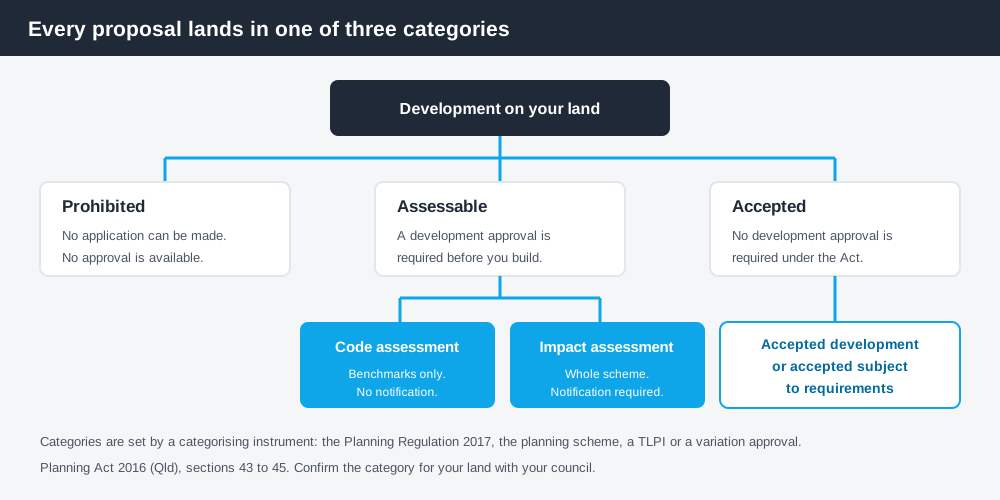
Figure 1: How the Planning Act 2016 sorts development.
Accepted, or accepted subject to requirements?
Spend 5 minutes, not 3 weeks
instantDA generates a council-ready planning report for Queensland development applications. No town planner. No waiting.
Get your report →This is the distinction people get wrong most often, and it is the one that costs money.
Accepted development in its plain form is exactly what it sounds like. No development application, no assessment, no conditions from council under the Planning Act. You build.
Accepted development subject to requirements also needs no development application — that part is genuinely the same. What differs is that the categorising instrument attaches stated requirements, usually a nominated code or a set of acceptable outcomes in the scheme. You self-assess against them. If your proposal complies, you proceed without a DA. If any part of it does not comply, it stops being accepted development and falls into the assessable category the scheme nominates, and you now need an approval you did not budget for.
Nobody checks your self-assessment at the front end. That is the trap. You find out you were wrong when a neighbour complains, or when you sell and a buyer's solicitor asks for the approval that does not exist. Unlawful development can attract enforcement action, and retrospective approvals are slower and dearer than the original DA.
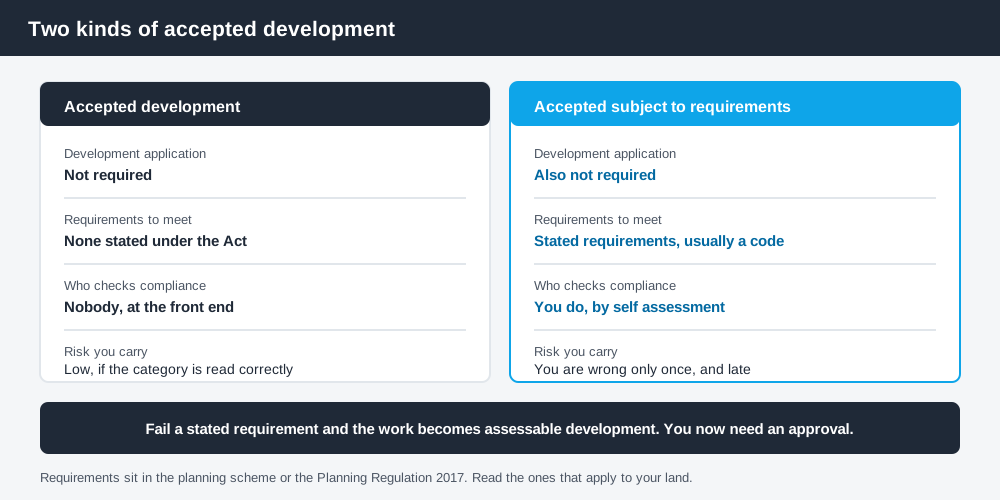
Figure 2: Same paperwork at the front. Very different consequences at the back.
Code assessable: bounded discretion
Once you are in the assessable box, section 45 of the Act gives you one of two categories of assessment.
Code assessment must be carried out only against the assessment benchmarks in a categorising instrument for the development, plus any matters prescribed by regulation. That word "only" is doing the work. The assessment manager is not weighing whether your proposal is a good idea, whether the neighbours like it, or whether the suburb needs it.
The decision rules in section 60 follow from that. Where the development complies with all the relevant assessment benchmarks, the assessment manager must approve it. Where it does not, they may approve it with conditions that bring it to compliance or to an acceptable outcome, or refuse it if compliance cannot be achieved. It is a bounded discretion, not an open one.
There is no public notification for code assessment, and no submitter appeal rights. Your job as applicant is narrow and technical: demonstrate compliance with each benchmark, and where you cannot meet an acceptable outcome, argue the performance outcome above it.
Impact assessable: the whole scheme, and the neighbours
Impact assessment is a different animal. It is carried out against the relevant assessment benchmarks and having regard to any other relevant matter — the whole planning scheme to the extent it is relevant, including the strategic framework, plus state planning instruments, planning need, amenity and the submissions the public makes.
Impact assessable applications must be publicly notified. The minimum notification period is 15 business days for most applications, and 30 business days where the application includes a variation request. Anyone may make a properly made submission. Someone who does becomes a submitter, and a submitter can appeal the decision to the Planning and Environment Court.
That is why the category matters commercially as much as legally. Code assessment is a compliance exercise with a defined end point. Impact assessment is a merits argument with a third party who can extend your timeline by appealing. If notification is in your future, public notification in QLD sets out what you have to do.
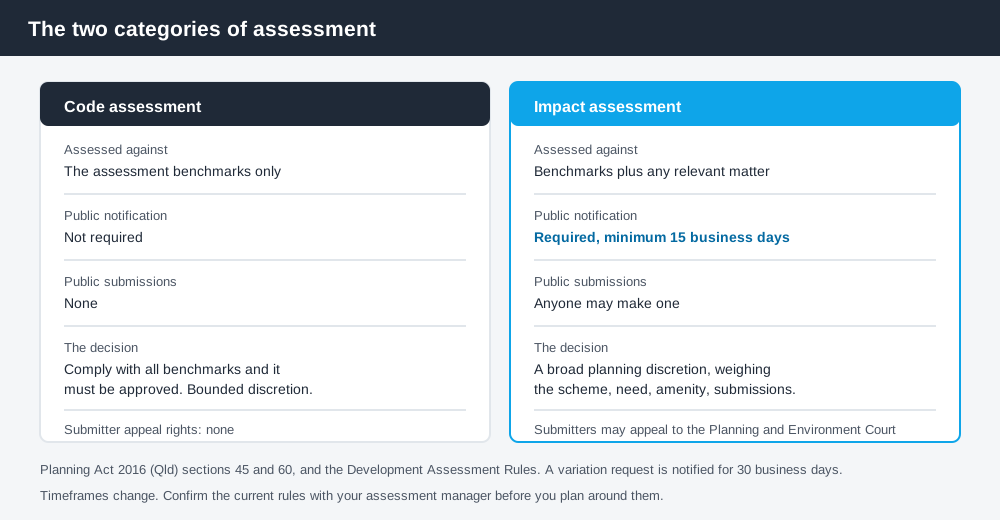
Figure 3: The two categories of assessment, side by side.
How to find your category
The category is not a property of the thing you want to build. It is a property of that thing on that land. A dual occupancy can be code assessable in one zone and impact assessable one street away.
Queensland planning schemes follow the Queensland Planning Provisions structure, so the mechanics are recognisable from council to council. They are not uniform: each council layers its own zone codes, local plans, overlays and thresholds on top, so never carry an answer from one scheme into another.
The method is the same everywhere. Establish what the development actually is — for a change of use, that means matching it to a defined use term, which material change of use in QLD explains. Identify the zone and any precinct, any local plan, and every overlay affecting the premises. Check the Planning Regulation first, since it can make development accepted or assessable regardless of what the scheme says. Then read the relevant table of assessment for that aspect of development, and apply any overlay table on top.
- ✓Identify the use, or the type of building or operational work
- ✓Find the zone and precinct
- ✓Find every overlay affecting the land
- ✓Check the Planning Regulation 2017
- ✓Read the zone table of assessment
- ✓Apply the overlay tables last
Where two parts of the scheme give different answers, the higher category prevails. Accepted subject to requirements beats plain accepted, code assessment beats both, and impact assessment beats everything.
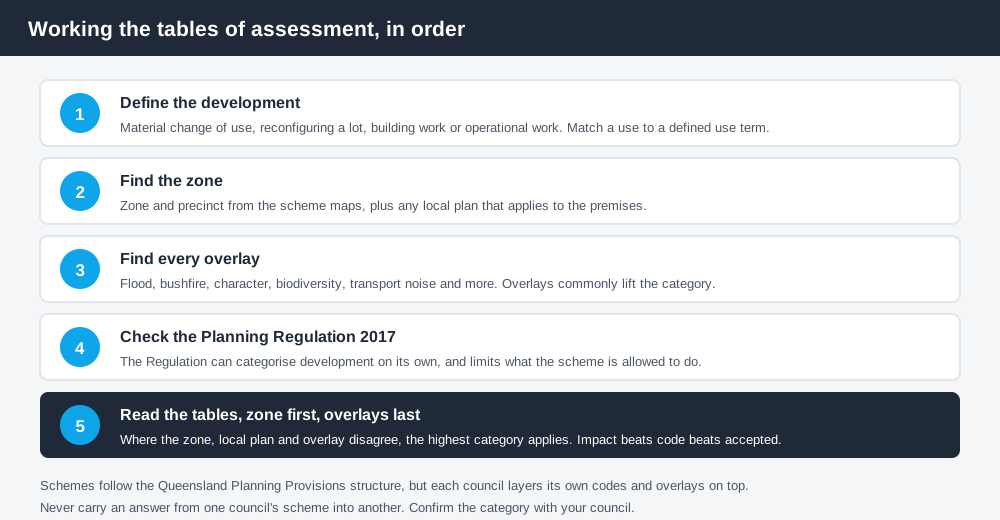
Figure 4: Work the tables in this order, and apply overlays last.
What to do next
Start with the mapping. Your council's planning scheme maps show the zone and overlays, Queensland Globe gives you lot and plan details and a wide range of state layers, and your council's development.i portal shows what has been applied for and decided nearby. The state's guide to local planning schemes explains how the documents fit together.
If you'd rather read your zone, your overlays and your likely category of assessment in one document than work through a scheme yourself, an instantDA planning report does that for your address for $169 — against the $800–$1,500 a town planner typically charges for a preliminary opinion. You can start a report in a few minutes.
For the broader question of what triggers approval in the first place, do I need council approval in QLD is the place to start. Then confirm your category with your council before you commit. Getting it wrong is not a paperwork problem — it decides whether your build is lawful.
Frequently asked questions
What is accepted development in QLD?
What is the difference between accepted development and accepted development subject to requirements?
What is the difference between code assessable and impact assessable?
Does code assessable development get advertised to neighbours?
How long is public notification for an impact assessable application?
How do I find out my category of assessment?
Ready to generate your report?
Skip the writing. Get a council-ready planning report in 5 minutes.
Get your report