Key takeaways
- ✓Public notification applies to impact assessable applications only. Code assessable applications are never notified.
- ✓The applicant does the notifying, not the council: a sign on the premises, notice to every adjoining owner, and a published notice.
- ✓The minimum notification period is 15 business days, rising to 30 where the application includes a variation request.
- ✓A properly made submission gives you submitter status, which is what carries appeal rights to the Planning and Environment Court.
- ✓Getting notification wrong is one of the few procedural errors that can require the whole exercise to be done again.
Public Notification in QLD: Signs, Submissions and What Neighbours Can Do
The sign on the fence is the most visible part of Queensland's planning system, and one of the least understood. Half the people who see one assume council put it there. Most assume every application gets one. Neither is right.
Public notification is a defined stage that applies to a specific category of application, is carried out by the applicant, and produces a specific legal consequence for anyone who responds to it. Whether you are the applicant putting the sign up or the neighbour reading it, the mechanics are worth knowing precisely — because the rights involved are time-limited and they expire quietly.
Get a council-ready planning report in 5 minutes — no planner, no waiting.
Get your report →The short answer
Public notification applies only to impact assessable applications. The applicant must place a notice on the premises, notify the owners of every adjoining lot, and publish a notice as the confirmation notice states. The minimum period is 15 business days, or 30 with a variation request. A submission gives you submitter status.
Which applications get notified
Only impact assessable ones.
Under the Planning Act 2016, assessable development is assessed either as code assessment or impact assessment. Code assessment is carried out only against the assessment benchmarks in a categorising instrument. It has no public notification stage and no submitter appeal rights — your neighbours have no formal say, because there is nothing for them to have a say about beyond compliance with published benchmarks.
Impact assessment is assessed against the benchmarks and having regard to any other relevant matter, which is why the public is invited in. Accepted versus code versus impact assessable explains how your application lands in one category or the other.
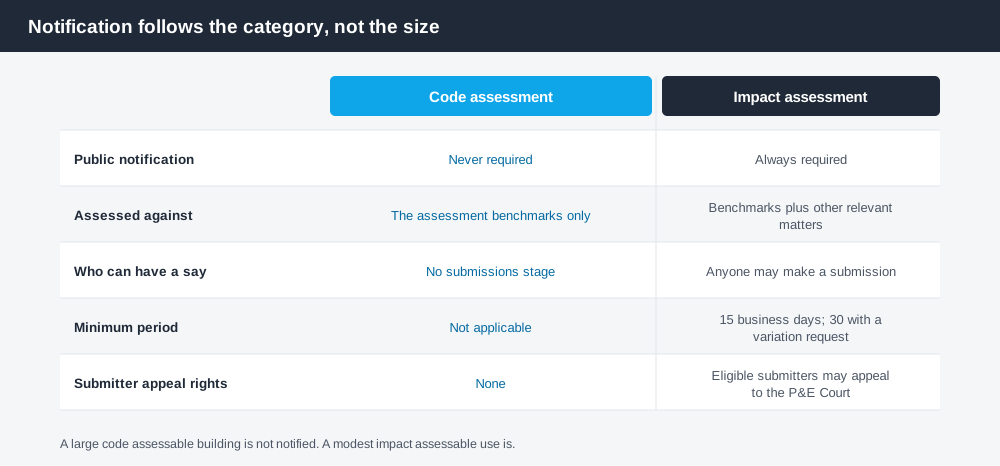
Figure 1: Notification is a consequence of the category, not of the size of the project.
That surprises people. A large code assessable building is not notified; a modest impact assessable use is. The trigger is the category in the council's tables of assessment, not the scale of what is proposed.
What the applicant must actually do
Spend 5 minutes, not 3 weeks
instantDA generates a council-ready planning report for Queensland development applications. No town planner. No waiting.
Get your report →This is the applicant's job, not the council's. The Development Assessment Rules require public notice to be given three ways.
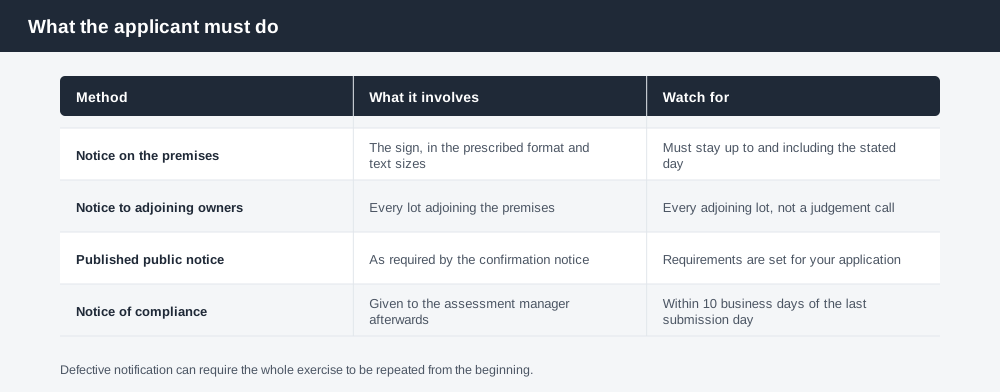
Figure 2: Three methods, all required, all the applicant's responsibility.
A notice on the premises — the sign — which must remain in place through to and including the stated day by which submissions must be received.
Notice to the adjoining owners of all lots adjoining the premises. Every adjoining lot, not a judgement call about who is affected.
A published public notice complying with the requirements stated in the confirmation notice. Those requirements are set for your application, which is one reason the confirmation notice is worth reading carefully rather than filing.
The Rules also prescribe how notice must be given, down to minimum text heights and the information each section of the sign must contain. Applications requiring social impact assessment carry additional obligations, including notice to owners of lots within 1500 metres and notice on the assessment manager's website.
- ✓Tell the assessment manager your intended start date before you start
- ✓Use the prescribed sign format and text sizes
- ✓Notify every adjoining lot owner
- ✓Publish the notice as the confirmation notice requires
- ✓Keep the sign up to and including the stated day
- ✓Give notice of compliance afterwards
Notice of compliance
After the period ends, the applicant must give the assessment manager notice of compliance with the public notice requirements, within 10 business days from the day after the last day a submission may be made, or a longer agreed period.
This is the step that gets skipped. Without it the assessment manager cannot move to the next stage, and the application sits. Worse, defective notification — a sign that came down early, an adjoining owner missed — can require notification to be carried out again from the beginning, adding a month or more. Notification is one of the few parts of the process where a procedural slip has a genuinely expensive remedy.
How long the period runs
The minimum notification period is 15 business days. Where the application includes a variation request, the minimum is 30 business days.
Notification must also start within 20 business days of the preceding stage ending. And the whole sequence is counted in business days excluding the days between 26 December and 1 January, so a notification period spanning the holidays is longer in calendar terms than it looks. How long council approval takes puts this in the context of the full timeline.
Making a submission
If you are the neighbour, this is your moment, and it is narrower than most people realise.
The assessment manager must accept a submission if it is a properly made submission, and may accept one even if it is not. That second limb is genuinely useful — a submission that misses a formal requirement is not automatically thrown out — but it is discretionary, and you should not rely on it.
A properly made submission must be received within the notification period, and must comply with the requirements stated in the public notice, which normally include being in writing, being signed by each person making it, stating each person's name and address, and stating the grounds of the submission.
Impact assessment is carried out against the assessment benchmarks and having regard to other relevant matters, so effective submissions speak that language: amenity, traffic, overshadowing, noise, character, the strategic framework, the zone purpose. Objections about the applicant personally, about property values, or about a use being generally undesirable carry very little weight.
You may amend a submission before the stated day, and you may withdraw it at any time before the application is decided.
What a submission gets you
Standing, and that is not a small thing.
Someone who makes a properly made submission — or one the assessment manager accepts — becomes a submitter. Under the Planning Act 2016 an eligible submitter may appeal a decision to approve an impact assessable application to the Planning and Environment Court, and may appeal a provision of the approval, or a failure to include one.
That right does not exist for people who did not make a submission. If you skip the notification period, you have no route to appeal later, however strongly you feel afterwards. Appealing a council decision in QLD sets out the forums and the deadlines.
The decision notice must also state the name and address of each principal submitter and describe the matters raised in submissions and how the assessment manager dealt with them. Your decision notice explained covers what to look for.
After submissions close, the assessment manager has up to 10 business days, or a longer agreed period, to consider them before the decision stage runs.
What to do next
If your proposal is heading for impact assessment, the submissions you receive are shaped by how well the application answers the concerns in advance. An instantDA planning report works through your zone, overlays and applicable codes benchmark by benchmark for $169 — against $800–$1,500 for a town planner preparing the same document.
Start with a planning report, or go straight to creating your report.
Frequently asked questions
Which development applications need public notification in Queensland?
Who puts up the sign?
How long is the notification period?
What makes a submission properly made?
What does making a submission actually achieve?
What happens if notification is done incorrectly?
Ready to generate your report?
Skip the writing. Get a council-ready planning report in 5 minutes.
Get your report