Key takeaways
- ✓The decision notice states whether the application is approved, approved in part or refused, and whether the approval is a preliminary approval, a development permit, or both.
- ✓Every condition must say who imposed it. Conditions required by a referral agency name that agency, and the assessment manager cannot simply remove them.
- ✓If the application was refused, the notice must give reasons — and if it was approved despite not complying with a benchmark, it must explain why.
- ✓You have 20 business days to make change representations, which can produce a negotiated decision notice without going to court.
- ✓A negotiated decision notice restarts the appeal period from the day after it is given.
Your Council Decision Notice Explained: Reading a QLD Development Approval
The decision notice is the document your whole application was for, and it is routinely skim-read. People check the first line — approved or not — file it, and discover eighteen months later that condition 14 required something they never did.
It is worth twenty minutes. The content of a decision notice is prescribed by the Planning Act 2016, which means you know in advance what must be in it, and the absence of something that should be there is itself informative. More urgently, the notice starts a short clock: a window in which you can negotiate changes without litigating, and after which your appeal rights close.
Get a council-ready planning report in 5 minutes — no planner, no waiting.
Get your report →The short answer
A decision notice states whether your application is approved, approved in part or refused, whether the approval is a preliminary approval or a development permit, and every condition with its source. It must give reasons for a refusal. You then have 20 business days to appeal, or to make change representations.
What must be in it
Section 63 of the Planning Act 2016 prescribes both who gets the notice and what it must say. The assessment manager must give it to the applicant, to each referral agency, to the local government where the assessment manager is not the local government, and — where no negotiated decision notice is given — to each principal submitter.
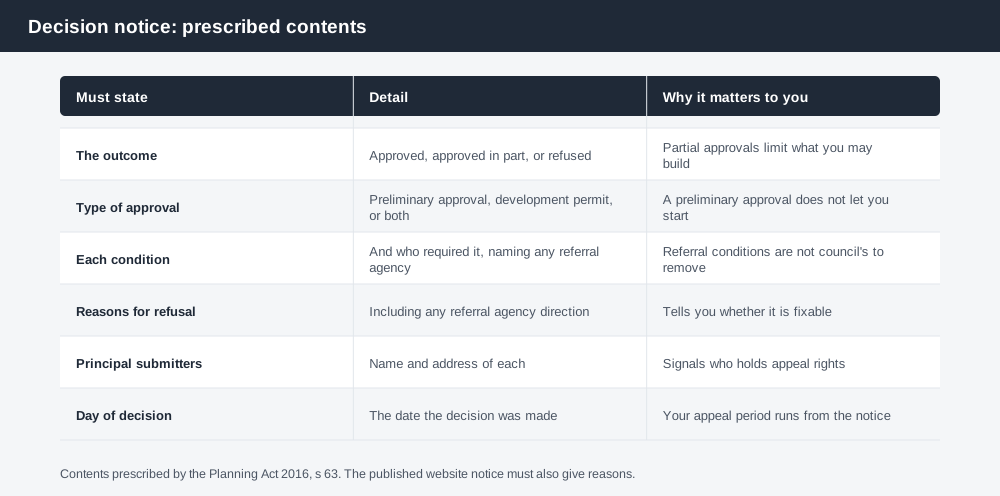
Figure 1: What the notice must contain, and what each item tells you.
The notice must be in the approved form and state whether the application is approved, approved in part or refused; if approved in part, the extent of the approval; and whether the approval is a preliminary approval, a development permit, or both. That distinction is not cosmetic — a preliminary approval does not authorise you to start work.
Where conditions are imposed, the notice must state each condition and, for each one, whether it was imposed directly by the assessment manager or required to be imposed under a referral agency's response, naming the agency. For infrastructure conditions it must state the provision of the Act under which the condition was imposed.
Where the application is refused, the notice must state the reasons for the refusal, and whether the assessment manager was directed to refuse by a referral agency and whether the refusal was solely because of that direction.
It must also state the name and address of each principal submitter, and the day the decision was made — which is the date your clock runs from.
The published notice
Spend 5 minutes, not 3 weeks
instantDA generates a council-ready planning report for Queensland development applications. No town planner. No waiting.
Get your report →There is a second obligation people miss. Where the assessment manager is a local government, the chief executive or a prescribed entity, and the application involved a material change of use, reconfiguring a lot or certain building work, the assessment manager must publish a notice about the decision on its website.
That published notice must describe the development, describe the assessment benchmarks that applied, and give the reasons for the decision. For impact assessment it must also describe the matters raised in submissions and how the assessment manager dealt with them. And where an application was approved despite not complying with a benchmark, it must state the reasons why.
For anyone planning a similar proposal, those published reasons are a direct window into how a council reads its own scheme.
Reading the conditions
Conditions are where approvals become expensive, and the source of each one determines what you can do about it.
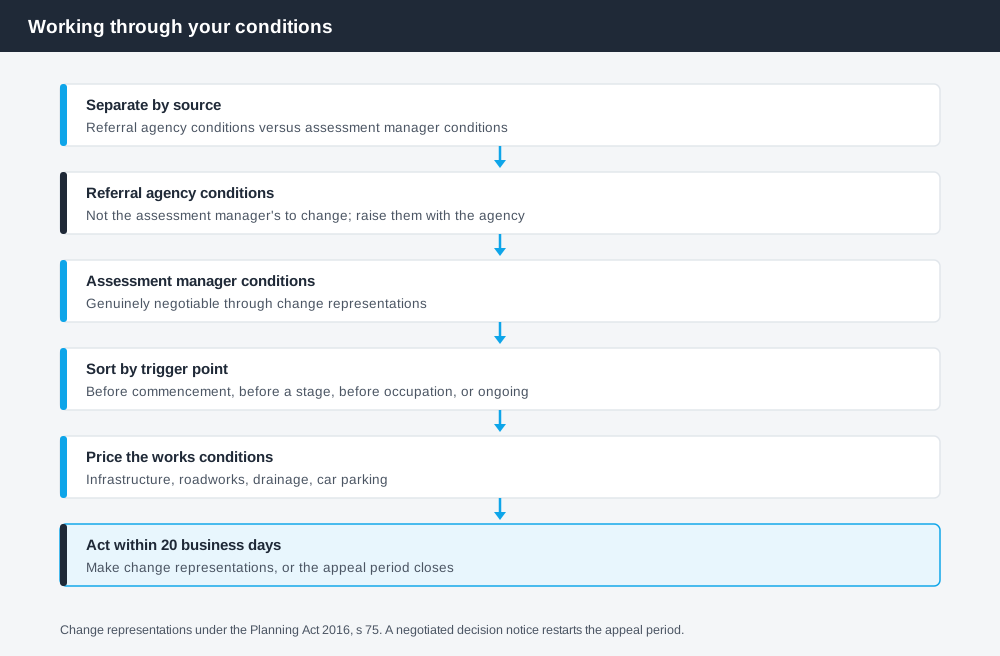
Figure 2: Work through conditions by source, then by trigger point.
Sort them three ways.
By source. A condition imposed under a referral agency's response is not the assessment manager's to remove. If you want it changed, the conversation is with that agency. Conditions imposed directly by the assessment manager are the ones that are genuinely negotiable.
By trigger point. Conditions that must be satisfied before you start work, before a particular stage, before occupation, or on an ongoing basis. The ongoing ones — hours of operation, landscaping maintenance, waste management — are the ones that get forgotten and later enforced.
By cost. Infrastructure contributions, road works, drainage upgrades and car parking provisions can change a project's viability. Price them before you accept the approval, not after.
- ✓Identify which conditions came from a referral agency
- ✓List every condition with a trigger before commencement
- ✓List every ongoing operational condition
- ✓Price the infrastructure and works conditions
- ✓Diarise the currency period
- ✓Check whether the approval is a preliminary approval or a development permit
The 20 business day window
This is the part with a deadline, so deal with it first.
Under section 229 of the Planning Act 2016 the general appeal period is 20 business days after a notice of the decision is given to you. Miss it and, subject to the court's power to extend, the decision stands.
But litigation is not the first move. Section 75 lets the applicant make change representations to the assessment manager during the appeal period, asking to change a matter in the approval. You cannot use it to change a matter stated because of a referral agency's response, or a condition imposed under a ministerial direction.
Two mechanics make it workable. If you need more time to prepare the representations, you may — once — give the assessment manager a notice suspending the appeal period. And where the assessment manager agrees with your representations, it gives a negotiated decision notice under section 76, at which point the appeal period starts again the day after that notice is given.
So the sensible sequence is: read the notice immediately, identify the conditions you cannot accept, make change representations well inside the 20 business days, and keep the appeal option alive behind them. Appealing a council decision in QLD covers what happens if negotiation fails.
Refusals, and approvals you did not want
A refusal notice must give reasons, and those reasons are the roadmap. Frequently the refusal is narrower than it reads — a single benchmark that could not be demonstrated, not a rejection of the concept. Re-lodging an amended application is often faster and cheaper than appealing.
An approval loaded with unacceptable conditions is a different problem and often the more expensive one. Conditions are appealable in their own right: the appeal can be against a provision of the approval, not only against a refusal.
After the notice
Two things to diarise the day it arrives. First, the appeal period. Second, the currency period — the time within which the approval must be acted on before it lapses, which when your approval expires explains.
And if the application was impact assessable, remember that submitters receive the notice too and have their own appeal rights. Public notification in QLD sets out how submitter status arises.
What to do next
Most conditions trace back to how well the application addressed the assessment benchmarks in the first place. An instantDA planning report works through your zone, overlays and applicable codes before you lodge, for $169 — against $800–$1,500 for a town planner preparing the same document.
Start with a planning report, or go straight to creating your report.
Frequently asked questions
What must a Queensland decision notice contain?
What is the difference between a preliminary approval and a development permit?
Can I get a condition changed without going to court?
Which conditions cannot be negotiated with the council?
How long do I have to appeal a decision notice?
Does council have to publish the reasons for its decision?
Ready to generate your report?
Skip the writing. Get a council-ready planning report in 5 minutes.
Get your report