Key takeaways
- ✓Approvals do not expire on a single date. Each part of an approval has its own currency period.
- ✓If no period is stated: 6 years for a material change of use, 4 years for reconfiguring a lot, 2 years for everything else.
- ✓The approval itself may state a different period. The stated period always wins over the default.
- ✓What stops the clock differs by part: the first change of use happening, the plan being given to council, or development substantially starting.
- ✓You can apply to extend before it lapses. Once an approval has lapsed there is nothing to extend.
When Does Your Council Approval Expire in QLD?
Approvals expire, and the way they expire catches people out because it is not one deadline. A single development approval can contain several parts, each with its own clock, each stopped by a different event.
The consequence of missing one is absolute. A lapsed approval is not a late approval; it is no approval, and the only route back is a fresh application, assessed against whatever the planning scheme says by then rather than what it said when you were approved.
Get a council-ready planning report in 5 minutes — no planner, no waiting.
Get your report →The short answer
Each part of a Queensland development approval has its own currency period. Where none is stated, the defaults are 6 years for a material change of use, 4 years for reconfiguring a lot, and 2 years for any other part — measured to the first use starting, the plan being lodged, or development substantially starting.
The default periods
Section 85 of the Planning Act 2016 is headed "Lapsing of approval at end of currency period", and it sets three defaults — but only where the approval itself does not state a period.
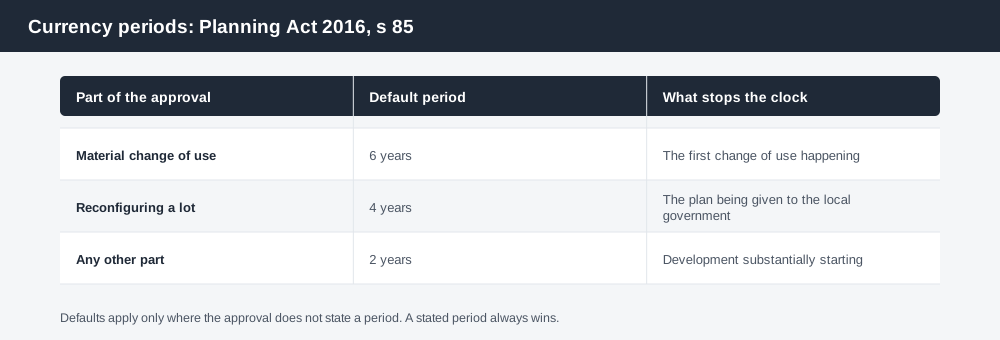
Figure 1: Three parts, three periods, three different stopping events.
Material change of use — 6 years. The part lapses if the first change of use does not happen within the stated period, or if none is stated, six years after the approval starts to have effect.
Reconfiguring a lot — 4 years. The part lapses if a plan for the reconfiguration that must be given to the local government for approval under the Land Title Act is not given within the stated period, or if none is stated, four years after the approval starts to have effect.
Any other part — 2 years. The part lapses if the development does not substantially start within the stated period, or if none is stated, two years after the approval starts to take effect.
If part of a development approval lapses, any monetary security given for that part must be released.
Two things people get wrong
Spend 5 minutes, not 3 weeks
instantDA generates a council-ready planning report for Queensland development applications. No town planner. No waiting.
Get your report →First: the stated period beats the default. Every one of those defaults applies only where the approval does not state a period. Councils routinely state shorter or longer periods in conditions, particularly for staged development. Read your decision notice rather than assuming six years — your decision notice explained sets out what it must contain.
Second: the parts run separately. An approval covering a material change of use and operational work has two clocks running at different speeds. It is entirely possible for the operational work part to lapse while the change of use part is still alive, which produces an approval you cannot actually build.
What stops each clock
This is where the wording repays attention, because the three tests are genuinely different.
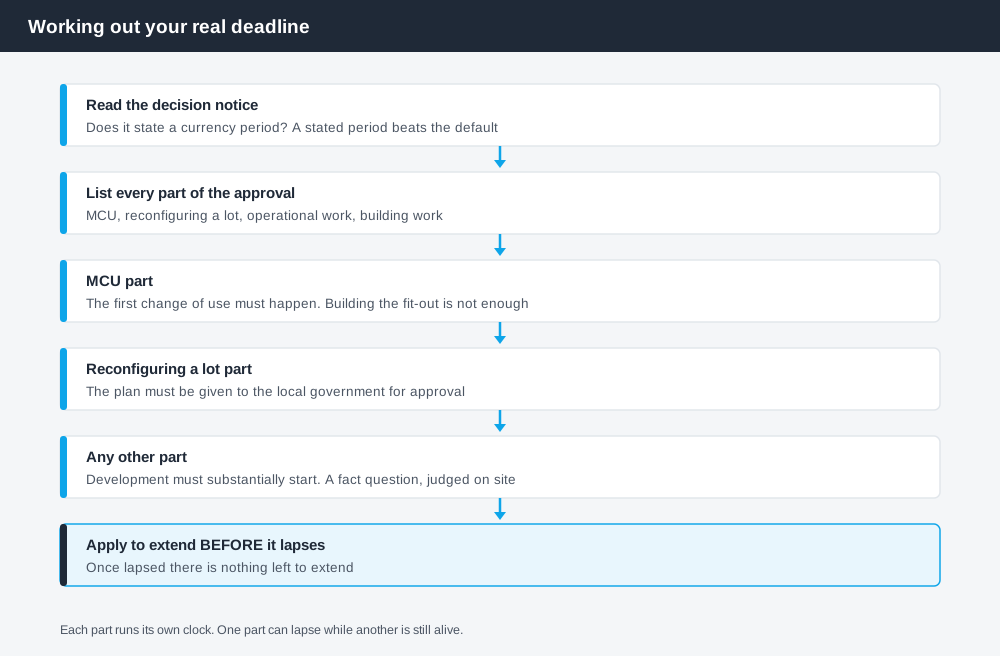
Figure 2: What each part needs before its period ends.
For a material change of use, the trigger is the first change of use happening. Not applying for a building approval, not starting construction — the use actually starting on the premises. If your approval is to operate a childcare centre and you have built the building but not opened, the question of whether the use has started is live and worth advice on. Material change of use in QLD explains what a change of use is.
For reconfiguring a lot, the trigger is the plan being given to the local government for approval. Surveying is not enough; lodging is.
For any other part, the trigger is development substantially starting. That is a fact question, judged on what has actually happened on site. Site clearing and a delivery of materials will not usually satisfy it. Where a project might land near the line, get advice rather than assuming — the consequence of guessing wrong is total.
Extending before it lapses
You can apply to extend a currency period, and the timing rule is unforgiving: you must do it before the approval lapses. Once it has lapsed, there is nothing left to extend.
An extension application is made to the assessment manager, which assesses and decides it. Extensions are common and frequently granted, particularly where the delay is explicable and the planning scheme has not changed materially in the meantime. What extensions are not is automatic — the assessment manager can refuse, and a refusal or a deemed refusal of an extension application is itself appealable.
- ✓Diarise each part's currency period separately
- ✓Read the conditions for any stated period that overrides the default
- ✓Apply to extend at least a few months before the deadline
- ✓Explain the delay and any change in circumstances
- ✓Expect the scheme to be considered as it now stands
- ✓Do not rely on a verbal assurance from anyone
Apply early. An extension application lodged the week before expiry leaves no room for an information request.
It also helps to say plainly why the extension is needed. Assessment managers deal with extension applications regularly and the ones that go smoothly tend to have an ordinary explanation attached — finance took longer than expected, a tenant had to be found, a contractor went under, the project was staged from the start and this stage was always going to be later. What causes hesitation is an application that says nothing, on a site where the scheme has since changed, because the assessment manager is then being asked to extend an approval it might not grant today. Where that is your situation, address it directly rather than hoping it goes unnoticed.
What happens if it lapses
The approval is gone. To do the same development you lodge a fresh development application, pay a fresh fee, and — this is the expensive part — you are assessed against the planning scheme as it exists now, not as it existed when you were approved.
Schemes change. Zones are amended, overlays are added, codes are tightened. A proposal that was code assessable when first approved can be impact assessable by the time you re-apply, which means public notification, submissions and submitter appeal rights that did not previously exist.
That gap between "approved once" and "approvable again" is the real cost of a lapsed approval, and it is why the currency period deserves a diary entry rather than a mental note.
Changing an approval rather than losing it
If your plans have moved on, changing the existing approval is usually better than letting it lapse and starting again. A change application keeps the approval alive and keeps you assessed under the framework you were approved under, and changing an approval you already have sets out how minor changes and other changes work.
The sequence that works: decide well before the deadline whether you are building it, changing it or extending it. All three are manageable. Doing nothing is the only option with no remedy.
What to do next
Whether you are extending, changing or re-applying, the planning assessment is the same work. An instantDA planning report covers your zone, your overlays and your council's applicable codes for $169 — against $800–$1,500 for a town planner preparing the same document. Confirm your currency period with your council before relying on any date.
Start with a planning report, or go straight to creating your report.
Frequently asked questions
How long does a development approval last in Queensland?
What stops the currency period running?
Can my approval state a different period?
Can I extend my development approval?
What happens if my approval lapses?
Do different parts of one approval expire separately?
Ready to generate your report?
Skip the writing. Get a council-ready planning report in 5 minutes.
Get your report