Key takeaways
- ✓Queensland splits change applications in two: a minor change, and a change other than a minor change — commonly called an other change.
- ✓The test for a minor change starts with whether the change results in substantially different development.
- ✓A change that would newly require referral, add referral agencies, or newly require public notification is not a minor change.
- ✓An other change is assessed much like a fresh application, with the cost and timeline that implies.
- ✓Changing an approval keeps it alive. Letting it lapse and re-applying puts you under whatever the scheme says by then.
Changing an Approval You Already Have in Queensland
Plans change after approval more often than not. The builder finds a cheaper roof pitch, the client wants the deck two metres wider, the site conditions turn out differently once excavation starts. Queensland has a proper process for this, and it is much better than the alternative of building something other than what was approved.
What determines the cost and the timeline is not how big the change feels to you. It is a legal test with defined limbs, and the difference between falling inside it and outside it is the difference between a few weeks and something close to a fresh application.
Get a council-ready planning report in 5 minutes — no planner, no waiting.
Get your report →The short answer
Queensland has two kinds of change application: a minor change, and a change other than a minor change. A minor change must not result in substantially different development, and must not newly trigger referral, add referral agencies or newly require public notification. Anything else is an other change, assessed much like a fresh application.
Two categories, one test
Under the Planning Act 2016 you change an approval by making a change application to the responsible entity — normally the assessment manager that gave the approval.
Which path the application takes depends on whether the change is a minor change as the Act defines it. Get inside that definition and the process is comparatively light. Fall outside it and you are on the other change path.
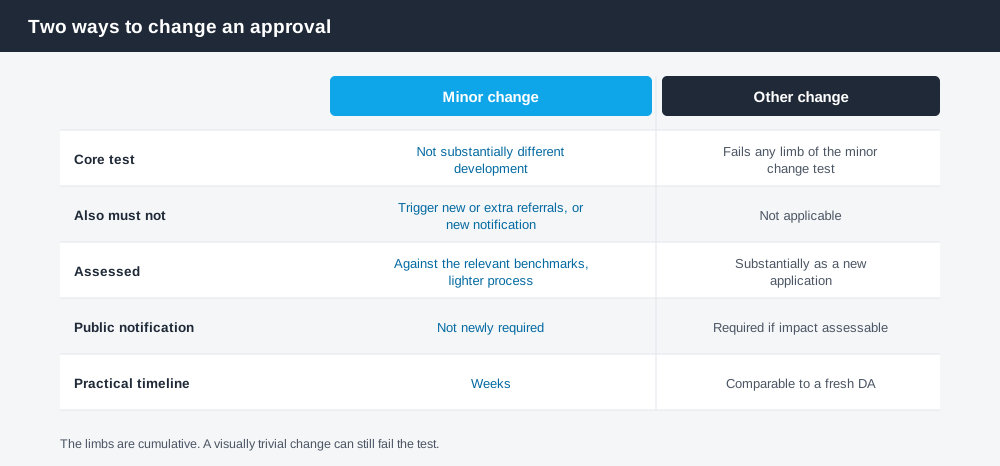
Figure 1: Two paths, and what each one costs you.
The definition of a minor change is technical, and it is worth reading in full rather than paraphrasing from memory, because more than one limb has to be satisfied. The first and most important is that the change must not result in substantially different development. On top of that, the change must not cause outcomes such as prohibited development being included, referral being required where there were no referral agencies, referral to extra referral agencies, a referral agency having to assess against something it did not previously have to, or public notification being required where it was not required before.
Because these limbs are cumulative, a change can be visually trivial and still fail. Moving a driveway a few metres is a small change to a plan; if it newly triggers a state-controlled road referral, it is not a minor change.
What "substantially different" means in practice
Spend 5 minutes, not 3 weeks
instantDA generates a council-ready planning report for Queensland development applications. No town planner. No waiting.
Get your report →The Act does not resolve every case, and departmental guidance and the courts have done a lot of the work. The safest framing is that the question looks at the nature and scale of the development as approved compared with the development as changed — whether, in substance, it is still the same development.
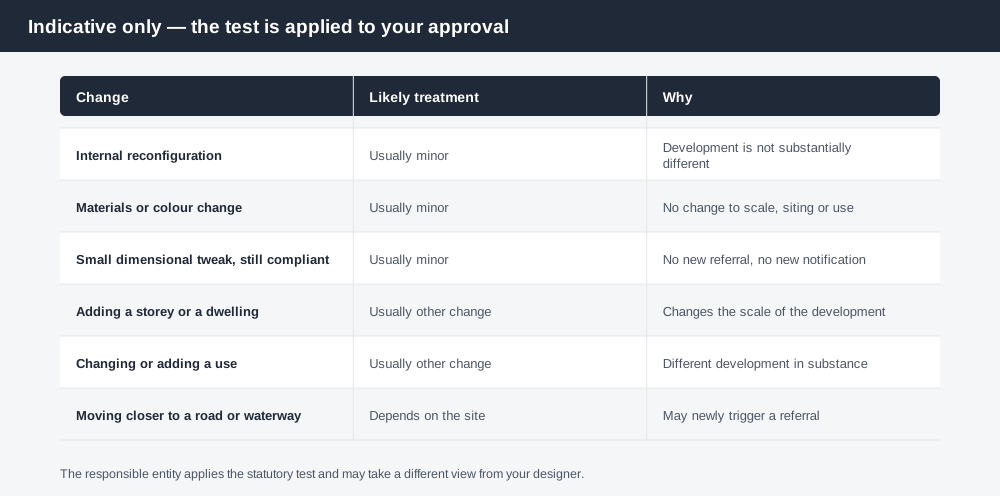
Figure 2: Indicative only. The test is applied to your approval, not to a category.
Changes that are usually comfortable: minor internal reconfiguration, small dimensional adjustments that keep every setback and height compliant, a materials or colour change, correcting a drafting error on the approved plans.
Changes that usually are not: adding storeys or dwellings, expanding the footprint into a setback, changing the use itself, adding a use, or extending the site to include additional land.
Changes that depend entirely on the site: anything that moves the development closer to a boundary, a road, a waterway or mapped vegetation. Those are the ones that quietly trigger a referral or an overlay and convert a minor change into an other change. Accepted versus code versus impact assessable explains why category shifts of this kind matter so much.
These examples are indicative. The responsible entity applies the statutory test to your approval, and it is entitled to reach a different view from your designer's.
Who decides
The responsible entity for a change application is normally the assessment manager that gave the original approval, and the Act sets out the rules for who that is in cases where it is not so obvious — where the approval came from a court, or a different entity, or where the change touches another party's interests.
Where the change touches a matter that came from a referral agency's response, that agency has to be brought back in. Conditions imposed at a concurrence agency's direction are not the responsible entity's to change unilaterally, which is the same principle that applies to your original decision notice. Your decision notice explained shows how to identify which conditions those are.
What happens on the other change path
An other change application is assessed substantially as a new application would be, against the relevant assessment benchmarks, following the Development Assessment Rules. That means the familiar sequence: a confirmation stage, possible referral, a possible information request, public notification if the changed development is impact assessable, and a decision period. How to lodge a DA in QLD sets out that sequence.
The realistic implication is cost and time. If your change is going to be an other change anyway, the calculation shifts: sometimes the better answer is to design the change properly rather than trimming it to try to squeeze inside the minor change definition. A change trimmed to fit that still fails the test has cost you the trimming and the time.
- ✓Identify every limb of the minor change test, not just the first
- ✓Check whether the change newly triggers a referral
- ✓Check whether the change would newly require public notification
- ✓Check whether any condition affected came from a referral agency
- ✓Confirm the currency period has not passed
- ✓Ask the responsible entity's view before lodging
Changing versus letting it lapse
There is a strategic reason to change rather than start again, and it is about which version of the planning scheme you are assessed under.
An approval that lapses is gone, and a fresh application is assessed against the scheme as it stands then. Schemes tighten. Overlays get added. A proposal that was code assessable can become impact assessable, which introduces notification, submissions and submitter appeal rights that did not previously exist. When your approval expires sets out the currency periods and how to extend them.
Keeping an existing approval alive and changing it is very often the cheaper route, even where the change application itself is not trivial.
Before you lodge
Talk to the responsible entity first. Most councils will give an informal view on whether a proposed change looks like a minor change, and that view — while not binding — tells you which budget and timeline you are working to. It costs a phone call.
And keep the approved plans and the changed plans clearly distinguishable, with the changes marked. Assessors comparing two undated sets of drawings generate information requests.
What to do next
A change application still needs a planning assessment against your council's benchmarks. An instantDA planning report covers your zone, your overlays and the applicable codes for $169, against $800–$1,500 for a town planner preparing the same document. Confirm the change pathway with your council before lodging.
Start with a planning report, or go straight to creating your report.
Frequently asked questions
Can I change a development approval in Queensland?
What is a minor change?
What happens if my change is not minor?
Is a small change always a minor change?
Can I change a condition that a referral agency required?
Should I change the approval or let it lapse and re-apply?
Ready to generate your report?
Skip the writing. Get a council-ready planning report in 5 minutes.
Get your report