Key takeaways
- ✓There is no statewide template. The codes that apply to your land and proposal determine the structure.
- ✓Identify the applicable codes first. Everything else follows from that list.
- ✓Respond to each relevant benchmark specifically, and say plainly where you comply and where you do not.
- ✓Where an acceptable outcome is not met, argue the performance outcome directly rather than avoiding it.
- ✓The most common failure is a report that contradicts the drawings.
How to Write a Planning Report for a DA in QLD
A planning report is the written argument that connects your proposal to the rules the council will judge it against. Under the Planning Act 2016 those rules are the assessment benchmarks — the performance outcomes and acceptable outcomes in the codes that apply to your land and your proposal. Learn more about the different names for planning reports.
There is no statewide template, which is a good thing: a template would be wrong for most sites. What there is instead is a method.
Get a council-ready planning report in 5 minutes — no planner, no waiting.
Get your report →The short answer
Identify the codes that apply to your land and proposal, then respond to each relevant assessment benchmark in turn — stating where the proposal meets the acceptable outcome, and where it does not, arguing the performance outcome directly. Keep the report consistent with the drawings.
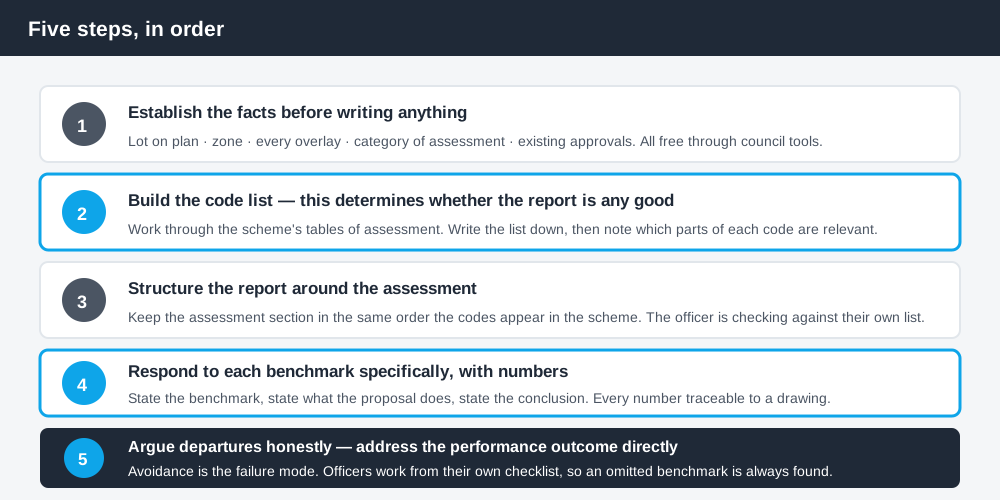
Figure 1: Five steps, in order.
Step one — establish the facts before you write anything
You cannot write the report until you know what applies.
- ✓The lot on plan, confirmed rather than assumed
- ✓The zone, and any precinct or local plan
- ✓Every overlay, and whether each covers the part of the lot you are developing
- ✓The category of assessment for what you propose
- ✓Any existing approvals on the land
Your council's interactive mapping, property or parcel report and planning enquiry service will produce all of these at no cost. If the category of assessment comes back as accepted development, stop — there is no application, and no report to write. Accepted versus assessable development in QLD explains how the categories work.
Step two — build the code list
Spend 5 minutes, not 3 weeks
instantDA generates a council-ready planning report for Queensland development applications. No town planner. No waiting.
Get your report →This is the step that determines whether the report is any good, and it is the step people skip.
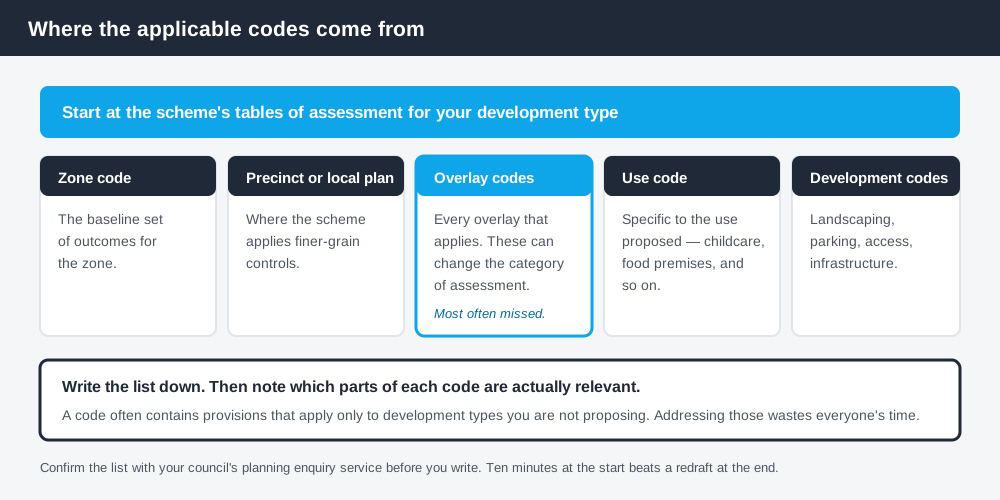
Figure 2: Where the applicable codes come from.
Work through the scheme's tables of assessment for your development type. They will identify which codes apply, drawing from several layers.
- ✓The zone code
- ✓Any precinct or local plan code
- ✓Every applicable overlay code
- ✓Any use code specific to the proposed use
- ✓Development codes covering matters like landscaping, parking, access or infrastructure
Write the list down. Then, for each code, note which parts are actually relevant — a code often contains provisions that apply only to development types you are not proposing.
Step three — structure the report around the assessment
A workable structure that assessing officers can follow:
- ✓Introduction — what is proposed, in one paragraph
- ✓The site and surrounds — lot details, existing use, neighbouring context
- ✓Planning framework — zone, overlays, category of assessment, applicable codes
- ✓The proposal — described precisely, with reference to the drawings
- ✓Assessment — a response to each applicable code, benchmark by benchmark
- ✓Conclusion — a short statement of why approval is appropriate
Keep the assessment section in the same order as the codes appear in the scheme. An officer is checking your report against their own list; matching the order makes their job faster, and a faster assessment is a better assessment for you.
Step four — respond to each benchmark, specifically
This is the core of the document, and specificity is everything.
For each relevant benchmark, do three things: state it, state what the proposal does, and state the conclusion. Not in the abstract — with numbers.
Weak: "The proposal provides appropriate setbacks."
Better: "The acceptable outcome requires a minimum side setback of X metres. The proposal provides Y metres to the eastern boundary and Z metres to the western boundary, as shown on drawing A-02. The acceptable outcome is met."
The difference is not tone. It is that the second version can be verified against the drawings in ten seconds, and the first cannot be verified at all.
Step five — argue departures honestly
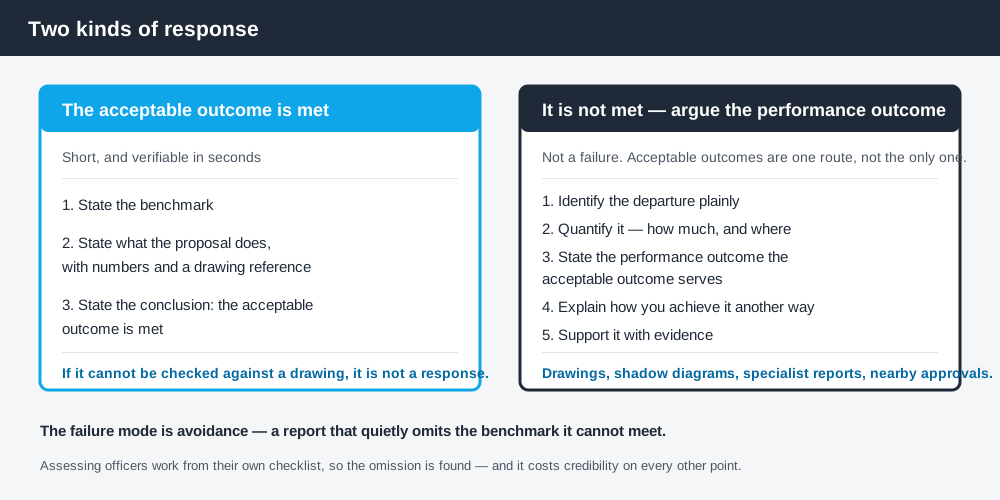
Figure 3: Two kinds of response.
Where the proposal does not meet an acceptable outcome, you have not failed — acceptable outcomes are one way of satisfying a performance outcome, not the only way. What you must do is address the performance outcome directly.
- ✓Identify the acceptable outcome that is not met, and say so plainly
- ✓Quantify the departure — how much, and where
- ✓State the performance outcome the acceptable outcome serves
- ✓Explain how the proposal achieves that performance outcome by other means
- ✓Support it with evidence: drawings, shadow diagrams, an acoustic or traffic report, or the pattern of nearby approvals
The failure mode here is avoidance — a report that quietly omits the benchmark it cannot meet. Assessing officers work from their own checklist, so the omission is found, and it costs credibility on every other point in the report.
The mistakes that generate information requests
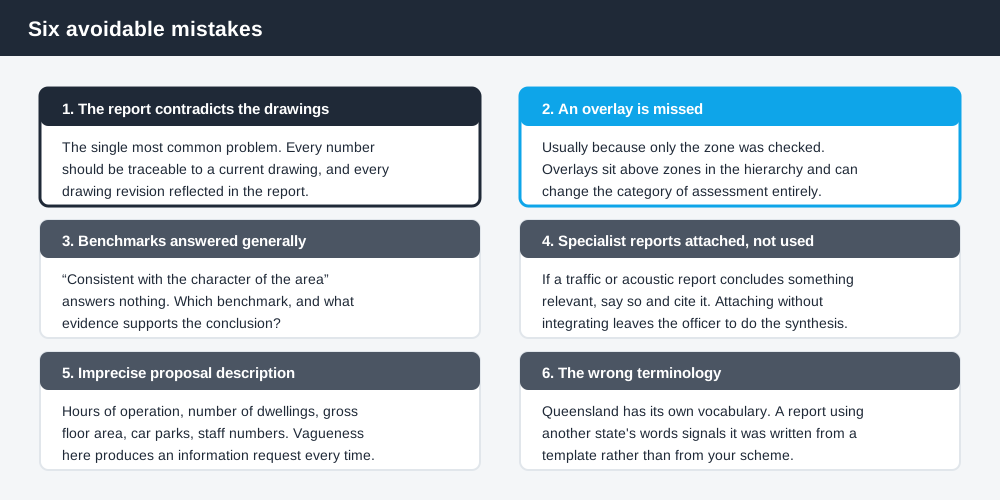
Figure 4: Six avoidable mistakes.
The report contradicts the drawings. The single most common problem. Every number in the report should be traceable to a drawing, and every drawing revision should be reflected in the report.
An overlay is missed. Usually because only the zone was checked. Overlays sit above zones in the assessment hierarchy and can change the category of assessment entirely.
Benchmarks are answered generally. "The proposal is consistent with the character of the area" answers nothing. Which benchmark, and what evidence?
Specialist reports are attached but not used. If a traffic report concludes something relevant, the planning report should say so and cite it. Attaching a document without integrating it leaves the officer to do the synthesis.
The proposal description is imprecise. Hours of operation, number of dwellings, gross floor area, number of car parks, staff numbers — vagueness here produces an information request every time.
The wrong terminology. Queensland has its own: development application, assessment manager, assessment benchmarks, accepted development, code assessable, impact assessable, material change of use, reconfiguring a lot, operational works. A report using another state's vocabulary signals that it was written from a template rather than from your scheme.
Ten mistakes that delay council approval in QLD covers the wider set, including the procedural ones.
Before you lodge
- ✓Every benchmark in every applicable code has a response
- ✓Every number in the report matches the current drawings
- ✓Departures are identified, quantified and argued
- ✓The proposal description is precise enough to be conditioned
- ✓The council's own application checklist has been worked through
That last one matters. Councils publish application checklists, and they are the definitive statement of what that council expects. What supporting information a DA needs in QLD covers the wider document set.
Queensland's planning schemes follow the Queensland Planning Provisions structure, but each council layers its own codes, overlay names, definitions and checklists on top. They are not uniform. A structure that worked for one council is a starting point for the next, not a template.
What to do next
Start with the code list. If you cannot confidently say which codes apply to your proposal, writing the report is premature — that is the research problem, and it is worth solving first.
If you'd rather see your zone, your overlays and your likely category of assessment set out in one document than work through a planning scheme yourself, an instantDA planning report does that for your address for $169 — against the $800–$1,500 a town planner typically charges for a preliminary opinion. You can start a report in a few minutes.
If you want to see how the structure reads in practice, a planning report example for QLD walks through one.
Then confirm the applicable codes with your council's planning enquiry service before you write. A ten-minute call at the start is worth more than a redraft at the end.
Frequently asked questions
Is there a template for a planning report in Queensland?
What are assessment benchmarks?
How do I find which codes apply to my proposal?
What if my proposal does not meet an acceptable outcome?
What is the most common mistake in a planning report?
How long should a planning report be?
Ready to generate your report?
Skip the writing. Get a council-ready planning report in 5 minutes.
Get your report