Key takeaways
- ✓Four things make an application properly made: the approved form, the documents the form requires, the fee, and owner's consent where it applies.
- ✓Relevant plans are the most common failure point. They must be to scale, dimensioned, and show levels, north point and setbacks.
- ✓A planning report is not named in the Act but is how you demonstrate compliance with the assessment benchmarks. Councils expect one.
- ✓Technical reports are triggered by overlays, scale and site constraints rather than being required across the board.
- ✓Missing documents do not usually mean refusal. They mean an information request or an action notice, and both cost you weeks.
What Documents Does Council Need for Your DA in Queensland?
You'll usually hear this called a development application, or DA — that's the formal name for council approval. The form itself takes an afternoon. The documents that go with it are the actual work, and they are what decides whether your application moves or stalls.
There is no single national list, because part of it is set by the state, part by the form, and part by your council's planning scheme. But the structure is predictable, and once you see how the requirements are layered you can work out your own list before you lodge rather than after council tells you.
Get a council-ready planning report in 5 minutes — no planner, no waiting.
Get your report →The short answer
A Queensland council needs the approved DA form, the documents that form requires, the fee, and owner's written consent where the applicant is not the owner. In practice: dimensioned plans to scale, a planning report addressing the relevant assessment benchmarks, and any technical reports triggered by overlays or scale.
The four things that make an application properly made
Section 51 of the Planning Act 2016 is short and strict. A development application must be made in the approved form to the assessment manager, and must be accompanied by the documents required under the form and the required fee. Where the applicant is not the owner and the application is for a material change of use or reconfiguring a lot, the owner's written consent must come with it.
Meet those and you have a properly made application. Miss one and the assessment manager may not be able to accept it at all.
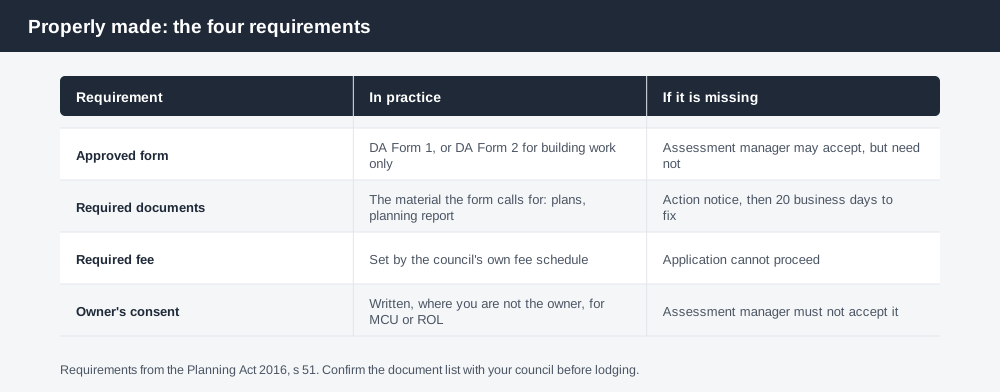
Figure 1: The four requirements, and what happens when one is missing.
Owner's consent is the one that catches builders and designers most often. If you are lodging for a client, you are not the owner, and a signed consent has to be in the pack. DA Form 1 explained sets out where it sits on the form.
Relevant plans: where most applications fail first
Spend 5 minutes, not 3 weeks
instantDA generates a council-ready planning report for Queensland development applications. No town planner. No waiting.
Get your report →The phrase councils use is relevant plans, and the state's DA Forms guide sets out what they have to show. This is the most common reason an application comes back.
- ✓Drawn to a stated scale
- ✓North point on every plan
- ✓Dimensions and setbacks to each boundary
- ✓Existing and proposed levels
- ✓Site cover and building height
- ✓Car parking layout and access
- ✓Existing structures marked as retained or demolished
- ✓Consistent between plans
That last item matters more than it sounds. Where the site plan shows a 6 metre setback and the elevation implies 4.5, an assessor cannot assess either. Internal inconsistency generates an information request as reliably as a missing document.
Plans do not have to be architectural drawings for smaller proposals, but they do have to be measurable. Hand sketches without dimensions will not survive the confirmation period.
The planning report
Nothing in the Planning Act says "lodge a planning report". What the framework requires is enough information for the assessment manager to assess the proposal against the assessment benchmarks — the codes in your council's scheme that apply to your land.
A planning report is how that is normally provided, which is why council lodgement pages ask for one and why applications without one attract information requests. It works through each applicable code, addresses the acceptable outcomes and performance outcomes in turn, and justifies anything that does not comply. What goes in a planning report sets out the standard sections.
Technical reports: triggered, not universal
This is where applicants over-prepare or under-prepare, both expensively. Technical reports are not a standing requirement. They are triggered by what applies to your land and how large the proposal is.
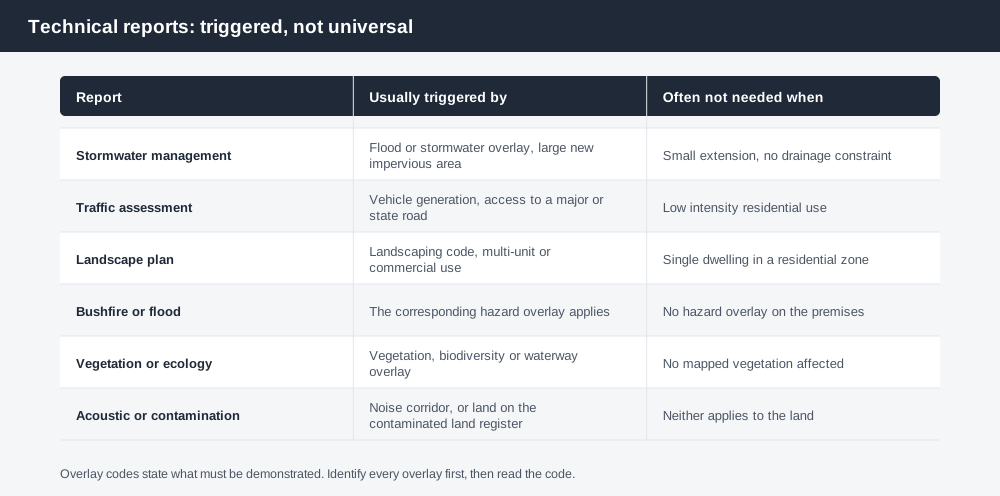
Figure 2: What triggers each report, and when you can leave it out.
A stormwater management plan is usually triggered by significant new impervious area, a flood or stormwater overlay, or drainage constraints. A traffic assessment follows from vehicle generation, parking demand, or access onto a state-controlled or major road. A landscape plan tends to attach to multi-unit, commercial and higher-intensity uses, or wherever a landscaping code applies. Bushfire, flooding, vegetation, acoustic, contamination and heritage reports are each triggered by the corresponding overlay.
The practical method is the same in every scheme: identify every overlay affecting the premises, then read what each overlay code requires you to demonstrate. If no overlay applies and the scale is modest, you may need nothing beyond plans and a planning report.
What happens when something is missing
Two different mechanisms, at two different stages, with two different costs.
If the application is not properly made — wrong form, no fee, no owner's consent — the assessment manager must give you an action notice before the end of the 10 business day confirmation period. You then have 20 business days, or a longer agreed period, to fix it and notify them. If you do not, and the assessment manager does not accept the application anyway, it is taken never to have been made.
If the application is properly made but thin, you get an information request instead. Under the Development Assessment Rules that must be made within 10 business days, and you then have three months to respond, or a longer agreed period. What to do when council asks for more information covers how to respond well.
Neither is fatal. Both are slow. An information request commonly adds a month or more to a straightforward application, which is the real argument for over-documenting rather than under-documenting at lodgement.
Building work is a separate pack
Queensland keeps building approval and development approval apart, and the documents follow that split. Structural drawings, engineering certification, energy efficiency compliance and the QBCC paperwork belong to the building approval, decided by a private certifier or council under the building framework — not to your DA. Building approval versus development approval explains which one you need and when you need both.
Sending building documentation to the planning team, or planning documentation to your certifier, is a common and avoidable source of delay.
Confirm the list before you lodge
Queensland's planning schemes follow the Queensland Planning Provisions structure, but each council layers its own codes, overlays and lodgement requirements on top. They are not uniform. Several councils publish supporting-information checklists; where yours does, that checklist is the list. Where it does not, a pre-lodgement enquiry costs nothing and is far cheaper than an information request.
What to do next
An instantDA planning report covers the planning half of that document pack — zone, overlays, applicable codes and a benchmark-by-benchmark assessment written against your council's scheme — for $169. A town planner preparing the equivalent typically charges $800–$1,500.
Start with a planning report, or go straight to creating your report.
Frequently asked questions
What makes a development application properly made in Queensland?
Do I need a planning report with my DA?
What do the plans have to show?
Do I need a traffic or stormwater report?
What happens if I forget a document?
Does my building approval paperwork go with the DA?
Ready to generate your report?
Skip the writing. Get a council-ready planning report in 5 minutes.
Get your report