Key takeaways
- ✓An information request is a normal stage of the process, not a signal that your application is in trouble.
- ✓It must be made within 10 business days, and it can only ask for things within that authority's jurisdiction.
- ✓You have three months to respond, or a longer period you agree. That time is yours, and it does not count against council.
- ✓You may respond fully, partly, or not at all. Responding partly or not at all means the application is assessed as it stands.
- ✓Missing the response deadline lapses the application. A lapsed application can be revived within a short window, and not after.
Council Asked for More Information: Responding to an Information Request in QLD
An information request arriving in your inbox reads worse than it is. It is not a refusal, it is not a warning, and it does not mean the assessment officer dislikes your proposal. It is a formal stage of the development assessment process, and a large share of Queensland applications go through one.
What it does do is move the clock onto your side of the table. Understanding that shift — and what the request can and cannot ask for — is the difference between a three-week detour and a five-month one.
Get a council-ready planning report in 5 minutes — no planner, no waiting.
Get your report →The short answer
An information request asks for further material after your DA is lodged. Under the DA Rules it must be made within 10 business days, and only within that authority's jurisdiction. You have three months to respond, or a longer agreed period. Full, partial and nil responses are all valid; missing the deadline lapses the application.
Who can ask, and when
Both the assessment manager and any referral agency may make an information request, and they run on separate but parallel timing.
The Development Assessment Rules — made under section 68 of the Planning Act 2016 — require any information request from the assessment manager to be made to the applicant within 10 business days. A referral agency's request follows the same pattern, with a copy given to the assessment manager.
There is one limit worth quoting, because applicants rarely know it exists: an information request must be within the limits of that authority's jurisdiction. A referral agency concerned with state-controlled road access cannot use an information request to ask about your landscaping. If a request strays outside what that authority is assessing, you are entitled to say so.
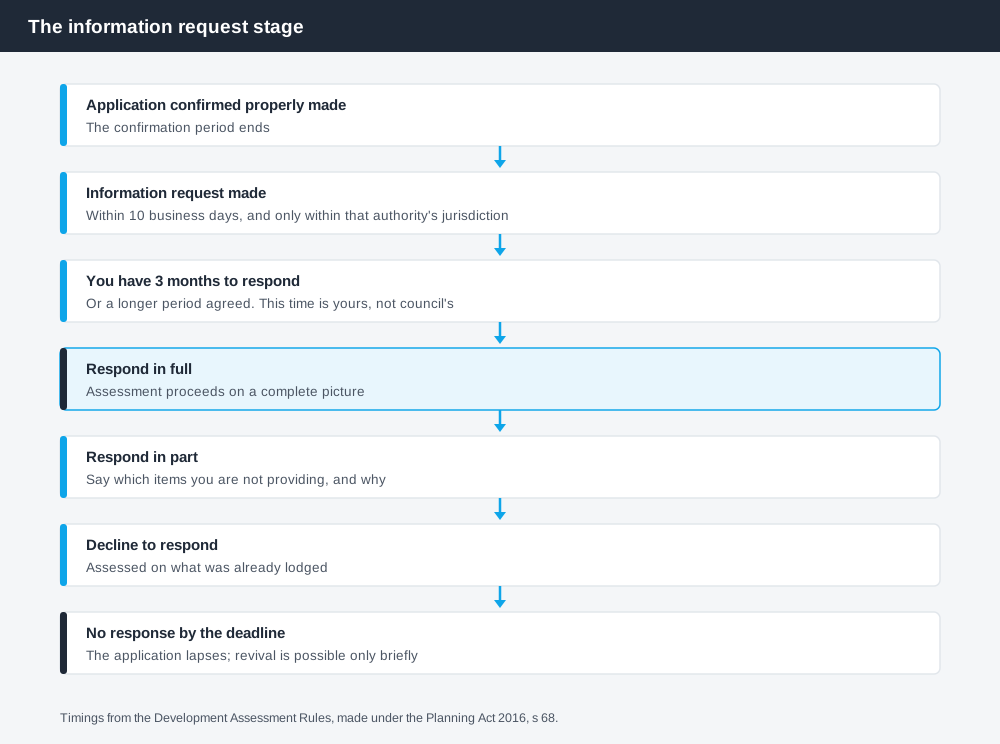
Figure 1: The information request stage, and where each response path leads.
What the clock actually does
Spend 5 minutes, not 3 weeks
instantDA generates a council-ready planning report for Queensland development applications. No town planner. No waiting.
Get your report →This is the part most applicants get wrong, and it costs them.
The assessment manager's decision period is 35 business days. Critically, that period includes the time the assessment manager took to make the information request — but only up to 10 business days of it. The time you spend responding is not part of the decision period at all.
So an information request does not eat council's time. It pauses it and hands the clock to you. An applicant who takes ten weeks to produce a stormwater plan has added ten weeks to their own approval, and council's statutory position is unchanged.
The practical implication: the request is not the delay. Your response time is.
Your three options
Under the Development Assessment Rules you may respond by giving all of the information requested, part of it, or by telling the authority you will not be providing any of it. All three are legitimate, and each has a different consequence.
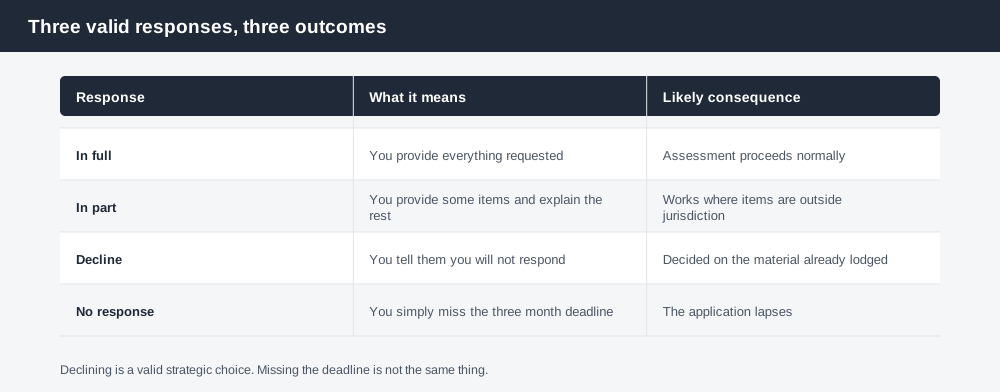
Figure 2: Three valid responses, three different outcomes.
Respond in full. The normal path. Provide what was asked, and the assessment proceeds with a complete picture.
Respond in part. Sometimes correct — where part of the request is outside jurisdiction, or where the information genuinely does not exist. Say which items you are not providing and why, rather than leaving gaps for the assessor to interpret.
Decline to respond. The assessment proceeds on what has already been lodged. That is a real strategic option where you believe the material is sufficient, but understand what you are choosing: the assessment manager will decide the application without the requested information, and where that information was needed to demonstrate compliance with an assessment benchmark, the likely answer is refusal or heavy conditions.
Where a referral agency made the request, give a copy of your response to the assessment manager too.
Lapsing: the deadline that actually bites
The response period is three months from the date the information request was made, or a longer period you and the authority agree.
Miss it, and the application lapses. That is not a delay; the application stops existing. The Rules do allow a lapsed application to be revived by taking the required actions within a short prescribed window, but once that window closes, a lapsed application may not be revived — and you are back to lodging fresh, with a fresh fee.
- ✓Diarise the three month date the day the request arrives
- ✓Ask for an extension in writing before the deadline, not after
- ✓Confirm any agreed extension in writing
- ✓If a technical report will take longer than three months, agree a longer period up front
- ✓Copy the assessment manager on any referral agency response
Extensions are commonly agreed, and asking early is uncontroversial. Asking after the deadline is a different conversation.
Why requests happen, and how to avoid them
Almost every information request traces to the same handful of causes, and all of them are fixable before lodgement rather than after.
Plans that are not dimensioned or not to scale. Plans that contradict each other. A planning report that lists the codes but does not actually assess the proposal against the acceptable outcomes. A non-compliance asserted to be acceptable without evidence. And most often, a technical report triggered by an overlay that the applicant did not know applied to their land.
The prevention is unglamorous: identify every overlay affecting the premises before you draw anything, then read what each overlay code requires you to demonstrate. What documents council needs for your DA sets out the usual package and what triggers each technical report.
The Part 6 election, and why it is riskier than it looks
DA Form 1 lets you elect not to receive an information request. Make that election and neither the assessment manager nor any referral agency can issue one — they must assess and decide on what you lodged. DA Form 1 explained covers where that sits on the form.
Applicants use it to compress the timeline, and it does work when the package is genuinely complete. When it is not, you have removed the only mechanism by which a gap could have been fixed before the decision. There is no partial credit at the decision stage; an application that cannot demonstrate compliance gets refused or conditioned around the problem.
Waive it only when you would be comfortable having the application decided tomorrow on exactly what you sent.
Responding well
Answer the question that was asked, item by item, in the order it was asked. Use the same numbering as the request. Where you have amended plans, say clearly which drawings are superseded — councils assessing two versions of the same elevation generate a second request.
Where a request touches a non-compliance, do not simply supply the measurement. Supply the measurement and the argument: the performance outcome is still achieved, and here is why. How long council approval takes puts the whole sequence in context.
What to do next
Most information requests are planning questions, not engineering ones. An instantDA planning report works through your zone, your overlays and the applicable codes benchmark by benchmark before you lodge — for $169, against the $800–$1,500 a town planner typically charges for the same document.
Start with a planning report, or go straight to creating your report.
Frequently asked questions
Is an information request bad news?
How long do I have to respond to an information request?
When must council make an information request?
What happens if I do not respond?
Can council ask for anything it likes?
Should I waive my right to an information request?
Ready to generate your report?
Skip the writing. Get a council-ready planning report in 5 minutes.
Get your report