Key takeaways
- ✓The statutory decision period is 35 business days, but it runs from the end of the last applicable stage — not from lodgement.
- ✓A clean code assessable application with no referral and no information request is the fast path, often decided within about two months.
- ✓Impact assessment adds public notification and a submissions period, and typically runs several months longer.
- ✓Your own response time to an information request is the single largest variable, and it is not counted against council.
- ✓Deemed approval exists for code assessment only, and several exclusions apply. It is a remedy, not a plan.
How Long Does Council Approval Take in QLD?
The honest answer has two halves. The statutory clock is precise, published, and the same in every Queensland council. The elapsed time is not, because most of what determines it happens on your side of the process rather than council's.
Applicants who only know the first half are the ones who are surprised. An application with a statutory decision period of 35 business days can easily take eight months, and nothing has gone wrong.
Get a council-ready planning report in 5 minutes — no planner, no waiting.
Get your report →The short answer
The statutory decision period is 35 business days, running from the end of the last applicable stage, not from lodgement. Add 10 business days for confirmation, any referral, an information request, and for impact assessment a notification period of at least 15 business days. A clean code assessable DA often takes about two months.
The statutory periods
These come from the Development Assessment Rules, made under section 68 of the Planning Act 2016, and they apply statewide.
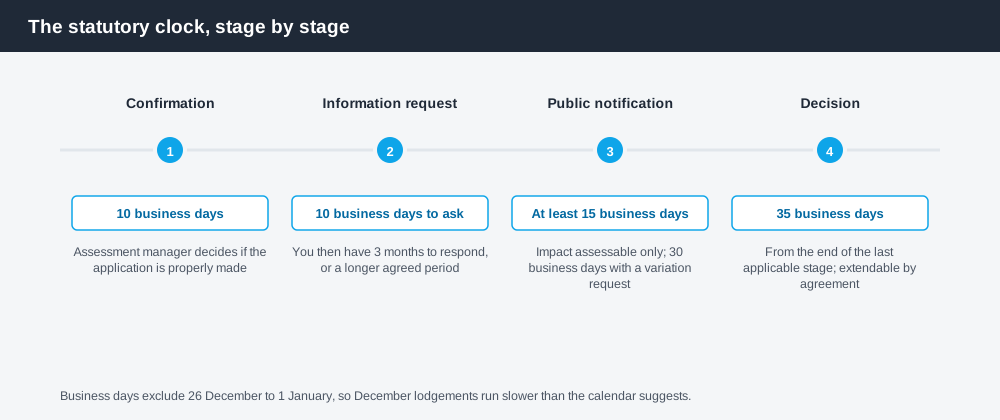
Figure 1: The statutory clock. Not every stage applies to every application.
Confirmation period — 10 business days. The assessment manager determines whether the application is properly made and gives a confirmation notice, or an action notice if it is not.
Information request — 10 business days to ask. If one is made, you then have three months to respond, or a longer agreed period.
Public notification — at least 15 business days. Impact assessable applications only. Notification must start within 20 business days of the preceding stage ending, and the minimum period rises to 30 business days where the application includes a variation request.
Decision period — 35 business days. The assessment manager must assess and decide the application within 35 business days from the end of the last applicable stage, or a longer period agreed.
One counting detail matters more than it sounds: the Rules count in business days, and exclude the days between 26 December and 1 January. A December lodgement moves noticeably slower than the calendar implies.
Where the time actually goes
Spend 5 minutes, not 3 weeks
instantDA generates a council-ready planning report for Queensland development applications. No town planner. No waiting.
Get your report →The decision period does not start at lodgement. It starts when the last applicable stage ends, and that is where the elapsed time accumulates.
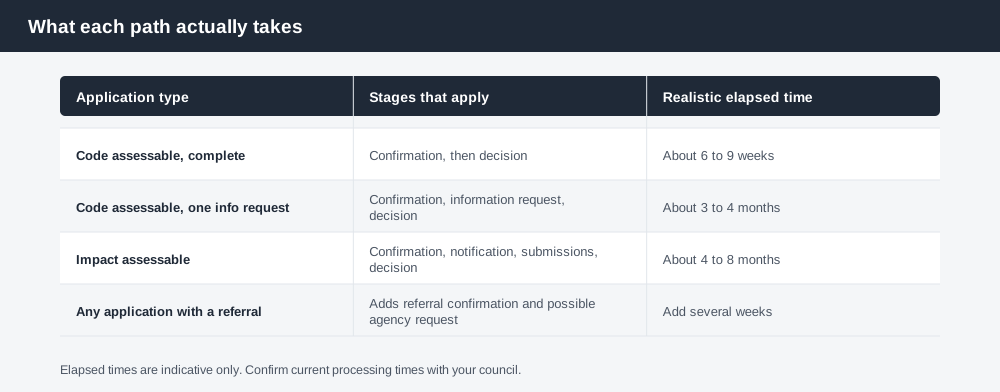
Figure 2: Three paths through the same process.
There is one asymmetry worth understanding clearly. The decision period absorbs up to 10 business days of the time the assessment manager took to make an information request — but the time you take responding is not part of it at all. If you spend two months producing an acoustic report, that is two months added to your approval and nothing added to council's obligation.
That is why responding to an information request well and quickly is the single largest lever an applicant controls.
Realistic end-to-end timelines
Statutory minimums assume a perfect run. Here is what actually happens.
Code assessable, complete application, no referral, no information request. Confirmation, then straight to decision. Roughly six to nine weeks. This is the fast path, and it is entirely achievable — but only for applications lodged complete.
Code assessable with one information request. Add the 10 business days to issue, your response time, and the re-assessment. Where the response is quick, three to four months. Where a technical report is needed, longer.
Impact assessable. Add notification, the submissions period, and the assessment manager's consideration of submissions. Realistically four to eight months, and longer where submissions are numerous or a second notification is triggered by a change to the application. Public notification in QLD sets out that stage.
Anything with a referral agency. The referral runs its own confirmation and can make its own information request, so add several weeks even when everything goes smoothly.
When council runs over: deemed approval
There is a remedy, and it is narrower than people expect.
Section 64 of the Planning Act 2016 allows an applicant to give the assessment manager a deemed approval notice where the assessment manager has not decided the application within the period, or extended period, allowed under the Development Assessment Rules. On the day the assessment manager receives that notice, they are taken to have given an approval.
The limits matter. Section 64 applies only to applications that require only code assessment. It does not apply where the application includes a variation request, where a referral agency has directed refusal or a partial approval, or where the building assessment provisions are an assessment benchmark for the development.
So deemed approval is not available on an impact assessable application at all. And a deemed approval comes with standard conditions set by ministerial instrument unless the assessment manager gives a decision notice within 10 business days of receiving the notice — conditions you did not negotiate.
- ✓Check the application requires only code assessment
- ✓Check there is no variation request
- ✓Check no referral agency directed refusal or partial approval
- ✓Check the building assessment provisions are not a benchmark
- ✓Understand you may inherit standard conditions
Treat it as a remedy for a stalled application, not as a shortcut. Most applicants are better served by agreeing an extension and getting the conditions they want.
What you can actually control
Very little of the statutory clock, and almost all of the elapsed time.
Lodge complete. An application that avoids an information request skips the largest single source of delay. Confirm every overlay before you draw, and address every applicable code in the planning report rather than listing them.
Answer requests fast and completely. Partial answers generate second requests.
Agree extensions early. A council that has run out of decision period and cannot get an extension has to decide on what it has, and that decision may not be the one you wanted.
Get your category right at the start. If the proposal can be designed to stay code assessable rather than impact assessable, that choice alone can save months, and accepted versus code versus impact assessable explains where the line falls.
Finally, be realistic about when you lodge. Councils carry uneven workloads through the year, and the statutory periods say nothing about how long a busy assessment team takes to pick an application up in practice. Nor do they cover the time before lodgement — assembling plans, commissioning a survey, waiting on a consultant. For most homeowners that preparation phase is longer than the assessment itself, and it is entirely within your control. If a project has a fixed end date, count backwards from it and start earlier than feels necessary. Current processing times are worth confirming directly with your council, because they vary between councils and across the year.
What to do next
The fastest DA is a complete one. An instantDA planning report gives you the benchmark-by-benchmark planning assessment before you lodge — your zone, your overlays, your council's codes — for $169, against the $800–$1,500 a town planner typically charges.
Start with a planning report, or go straight to creating your report.
Frequently asked questions
How long does a development application take in Queensland?
When does the decision period start?
Does an information request delay council or me?
How long is public notification?
What is a deemed approval?
Why do the day counts feel longer than the calendar?
Ready to generate your report?
Skip the writing. Get a council-ready planning report in 5 minutes.
Get your report