Key takeaways
- ✓Queensland has no regulated fee scale for town planners. Every quote is a commercial rate.
- ✓Fees track complexity and risk, not the size of the building. A small proposal in the wrong zone costs more.
- ✓Regional fees are often lower per hour but can be higher overall, because fewer firms know the local scheme.
- ✓Preliminary advice is the cheapest service and the one most worth buying first.
- ✓Fixed fee against a defined scope, with a stated variation trigger, is the engagement to ask for.
Town Planner Fees in Queensland: What You'll Pay
You'll usually hear this called a development application, or DA — that's the formal name for council approval under the Planning Act 2016. Working out what a town planner should cost you across Queensland is harder than it looks, because unlike council fees there is no schedule to consult. Planning is an unregulated professional market, and the numbers reflect what each firm judges the work is worth.
Get a council-ready planning report in 5 minutes — no planner, no waiting.
Get your report →The short answer
Queensland has no regulated fee scale for town planners. Preliminary advice runs from a few hundred dollars for a desktop review into the low thousands for a detailed one. Code assessable applications typically cost several thousand in consultant fees, impact assessable applications considerably more, with council fees separate.
What you are actually buying
Planners sell four distinct things, and quotes only make sense once you know which one you asked for.
Preliminary advice or due diligence. A written opinion on what your land allows: the zone, every overlay, the likely category of assessment, and the obstacles that will decide whether your proposal works. A basic desktop review sits at a few hundred dollars. A detailed constraints analysis with a written pathway is typically low thousands. A full planning assessment against the relevant codes can reach five figures on a difficult site.
Preparing and lodging an application. For a code assessable proposal — a secondary dwelling, an extension, a dual occupancy where the scheme supports it — consultant fees usually sit in the low-to-mid thousands. For impact assessable proposals, they commonly reach five figures, because the assessment opens the whole scheme, the application must be publicly notified, and submitters can appeal.
Managing an application after lodgement. Responding to an information request, negotiating conditions, or making a change application. Usually hourly.
Hourly consulting. Published Queensland rate cards for 2024–26 put town planners in the low-to-mid hundreds per hour, senior planners higher, and directors higher again. Always ask which level of planner will do the drafting, because a director's rate on the rate card does not mean the director writes your report.
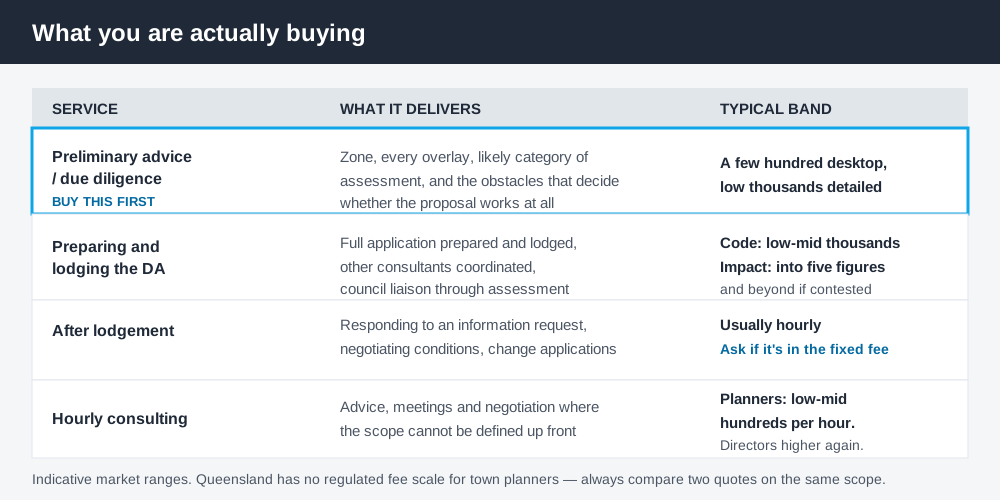
Figure 1: Four services. Confirm which one you are being quoted for.
South-east Queensland versus the regions
Spend 5 minutes, not 3 weeks
instantDA generates a council-ready planning report for Queensland development applications. No town planner. No waiting.
Get your report →The intuition is that regional work is cheaper. It is more complicated than that.
Hourly rates are generally lower outside the south-east, reflecting local market conditions and overheads. But two things push regional totals back up.
Scheme familiarity. Queensland planning schemes follow the Queensland Planning Provisions structure, so the documents look recognisable from council to council — but each council layers its own zone codes, local plans, overlays and thresholds on top. They are not uniform. A planner who works in your council's scheme every week will do the same job in a fraction of the hours a competent outsider needs, and that difference usually outweighs the hourly rate difference.
Travel and site attendance. Where a firm has to travel for a site inspection or a pre-lodgement meeting, that is billed.
The practical rule: engage someone who works in your council's scheme regularly, and treat hourly rate as a secondary consideration. A south-east firm charging more per hour and finishing in half the time is the cheaper option.
What drives your number
Category of assessment. This is the dominant variable by a distance. Code assessment is bounded — the assessment manager considers only the assessment benchmarks, there is no public notification and no submitter appeal rights. Impact assessment opens the whole planning scheme, must be notified, and gives submitters a right of appeal. Accepted vs code vs impact assessable in QLD sets out how your category is determined.
Overlays. Every overlay affecting the premises adds assessment benchmarks and often a specialist report — flood hazard, bushfire hazard, heritage, character, biodiversity, coastal hazard, acid sulfate soils.
Compliance. A proposal that meets every acceptable outcome is a documentation exercise. One relying on performance outcomes needs a written argument, which is the skilled part and the slow part.
Other consultants. Engineers, surveyors, traffic, acoustic, ecology, arborists, bushfire assessors. Each is a separate fee, and co-ordinating them is billed time.
Opposition. Submissions extend timeframes, generate further information requests, and can lead to appeals in the Planning and Environment Court.
- ✓Establish your category of assessment before you brief anyone
- ✓Ask for a fixed fee against a written scope
- ✓Ask what triggers a variation
- ✓Ask who does the drafting
- ✓Ask how many of these they have done in your council's scheme
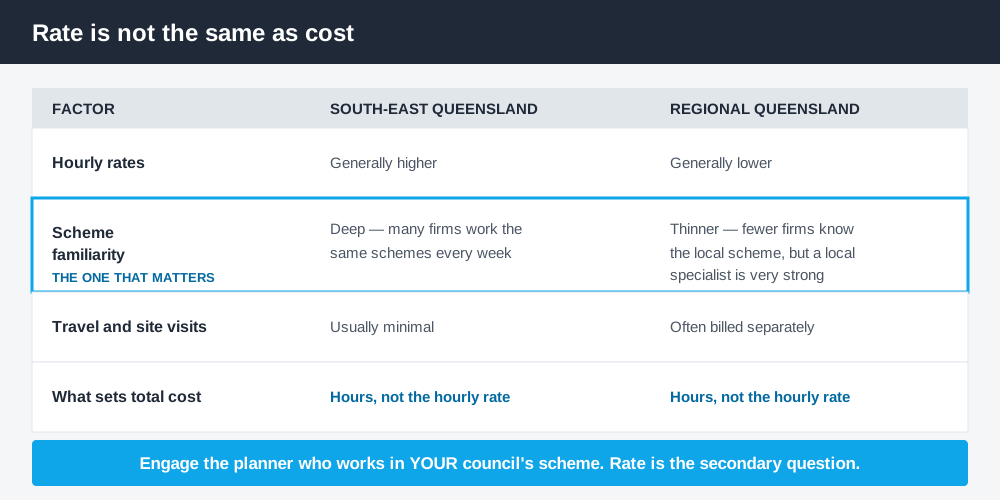
Figure 2: The cheaper hourly rate is not reliably the cheaper job.
Council fees are separate
Worth stating plainly because it catches people every time: your planner's fee buys their work. Council application fees are a separate payment to the council, set by each local government under the Local Government Act 2009 on a cost-recovery basis, and published in that council's annual fees and charges schedule. They vary substantially between councils.
Infrastructure charges are separate again where they apply, and on a subdivision or a multi-dwelling project they can be the largest number on the page. What council approval costs in QLD breaks the total bill into its components so you can budget for all of it rather than the visible part.
How to buy it well
Buy the cheap thing first. Preliminary advice costs a fraction of an application and can save you the application entirely, either by showing that a redesign avoids assessment or by showing that the proposal was never going to be supported in that zone. It is routinely skipped by people who then spend many times as much learning the same thing slowly.
Get two quotes, on the same scope. Quotes are only comparable if they cover the same work. Write the scope yourself if you have to.
Ask about the information request. A further information request from council is the single most common trigger for a variation to a fixed fee. Ask up front whether responding to one is included, and if not, how it will be charged.
Know your own site first. The best-briefed clients get better prices, because there is less discovery work to bill. Check your council's planning scheme maps for the zone, precinct and overlays, and use Queensland Globe for lot and plan details and state-mapped layers.
If you'd rather read your zone, your overlays and your likely category of assessment in one document than commission a preliminary opinion, an instantDA planning report does that for your address for $169, against the $800–$1,500 a town planner typically charges for a preliminary opinion. It is the step before you decide whether you need a planner, not a replacement for one on a complex or contested proposal. You can start a report in a few minutes.
For Brisbane-specific pricing and the council fee side, town planner cost in Brisbane goes into more detail. And confirm anything you rely on with your council, because schemes are not uniform across Queensland.
Frequently asked questions
How much does a town planner cost in Queensland?
Are town planner fees regulated in Queensland?
Is a regional town planner cheaper than one in Brisbane?
What do town planning consultants charge per hour in Queensland?
Do town planner fees include council fees?
What is the cheapest way to get planning advice in Queensland?
Ready to generate your report?
Skip the writing. Get a council-ready planning report in 5 minutes.
Get your report