Key takeaways
- ✓The council application fee is usually the smallest line on the bill, not the largest.
- ✓Five components make up a DA cost: council fee, consultants, state referral fees, notification, and infrastructure charges.
- ✓Infrastructure charges can dwarf everything else on a subdivision or multi-dwelling project.
- ✓The Planning Regulation 2017 sets a maximum adopted infrastructure charge, but councils set their own DA fees.
- ✓Your category of assessment moves the total more than the size of your building does.
What Does Council Approval Cost in QLD? DA Costs Explained
You'll usually hear this called a development application, or DA — that's the formal name for council approval under the Planning Act 2016. Ask what one costs and you will get a number that turns out to be the council's application fee, which is often the smallest item on the eventual bill. The gap between that number and the total is where budgets come apart.
Get a council-ready planning report in 5 minutes — no planner, no waiting.
Get your report →The short answer
Five things make up the cost: your council's application fee, consultant fees, state referral fees where a referral is triggered, public notification for impact assessable applications, and infrastructure charges. On a subdivision or multi-dwelling project the infrastructure charges usually exceed everything else combined.
Component 1: the council application fee
Each Queensland local government sets its own development application fees. They are cost-recovery fees fixed by resolution under the Local Government Act 2009, and section 97(4) of that Act requires that a cost-recovery fee must not be more than the cost to the local government of taking the action the fee is charged for.
Two consequences follow. First, there is no state-wide schedule — the Planning Regulation 2017 does not cap ordinary council DA fees, so the same application can cost meaningfully different amounts in neighbouring councils. Second, fees are supposed to reflect assessment effort, which is why an application for a dwelling house costs a fraction of one for a multiple dwelling development.
Every council publishes its fees in an annual fees and charges schedule, usually updated at the start of the financial year. That schedule is the only authoritative source for your figure. Council DA fees compared in QLD explains how to read one and why the variation between councils is so wide.
Component 2: consultants
Spend 5 minutes, not 3 weeks
instantDA generates a council-ready planning report for Queensland development applications. No town planner. No waiting.
Get your report →Usually the largest professional cost, and the one people forget when they budget from the council's fee alone.
Depending on your project you may need a town planner to prepare the application, a surveyor for a feature survey or subdivision plan, an engineer for stormwater, roadworks or water reticulation, an architect or building designer for drawings, and specialists — traffic, acoustic, ecology, arborist, bushfire — where an overlay or referral triggers them.
Every one of these is a separate fee set by a commercial market, and co-ordinating them is itself billed time. Town planner fees in Queensland covers the planning component in detail.
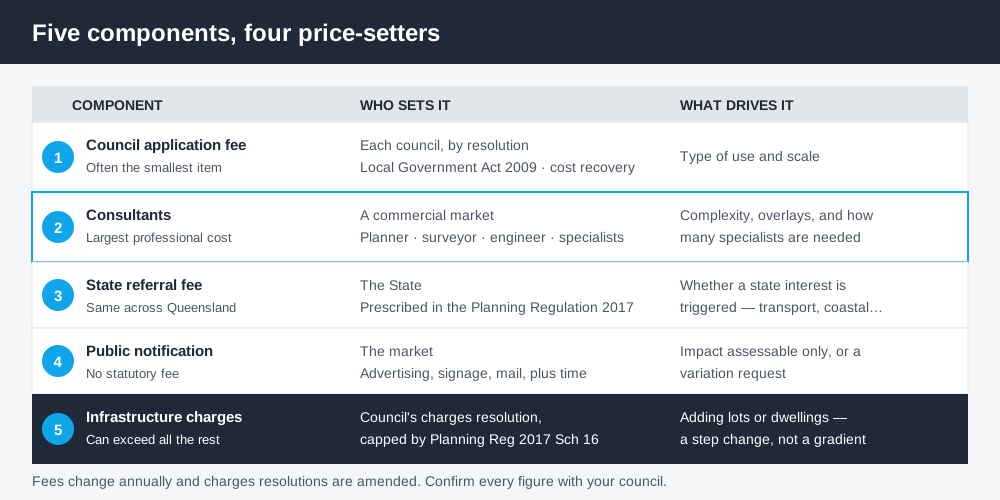
Figure 1: Five components, four different people setting the price.
Component 3: state referral fees
Where your application triggers a state interest, it must be referred to the State Assessment and Referral Agency, and a state-set fee applies. Common triggers include development affecting state transport infrastructure, coastal management areas, native vegetation, or contaminated land.
Unlike council fees, these are prescribed in the Planning Regulation 2017 and its fee amendments, so they are the same wherever you are in Queensland. They are additional to your council's fee, not instead of it.
Component 4: public notification
Only applies to impact assessable applications, and to applications including a variation request — code assessable applications are not notified. Where it does apply, notification means newspaper notices, on-site signage and letters to affected owners and occupiers, plus the professional time to manage it.
There is no statutory fee for notification. The costs are whatever the advertising, printing and signage actually cost, and they are modest compared with the real consequence of notification: submitters, potential appeal rights, and an extended timeline.
Component 5: infrastructure charges
The one that surprises people, and on the right project the largest number by a wide margin.
Infrastructure charges are levied by local governments and distributor-retailers on development that places additional demand on trunk infrastructure — roads, water, sewerage, stormwater, parks and community facilities. A council can levy them where it has a Local Government Infrastructure Plan in its planning scheme and has adopted an infrastructure charges resolution.
Here the State does intervene. Schedule 16 of the Planning Regulation 2017 prescribes the maximum amount — the "prescribed amount" — that a local government or distributor-retailer can adopt in a charges resolution. A council's adopted charge must be no more than that maximum, though a council and a developer can agree a higher charge through an infrastructure agreement, typically for development outside a planned area or at higher densities.
Practically: a single dwelling extension usually attracts nothing. A secondary dwelling may or may not, depending on the council's resolution. A subdivision or a multi-dwelling development almost certainly will, per lot or per dwelling, and the total can exceed every other component combined. Check your council's current charges resolution — it is a published document — before you model any project that adds lots or dwellings.
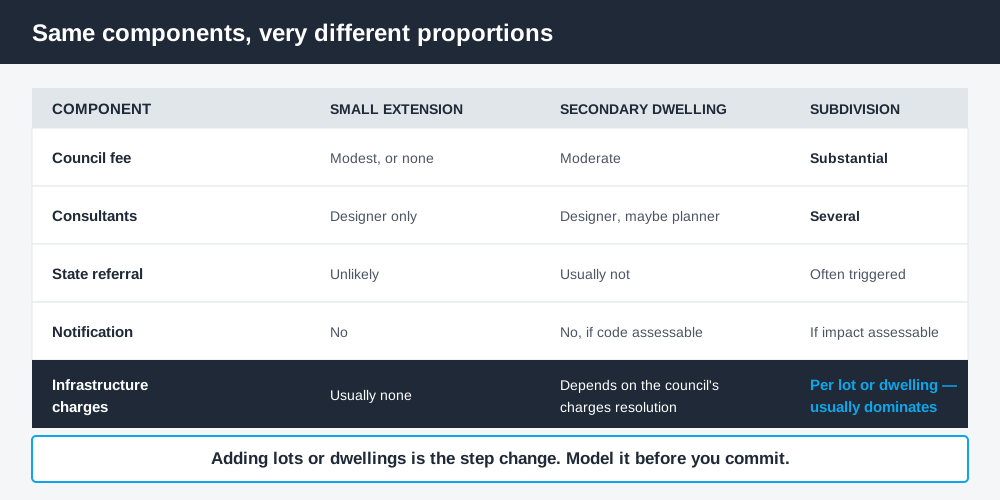
Figure 2: The same five components, in very different proportions.
What actually drives the total
Your category of assessment. Code assessment is bounded — assessed only against the assessment benchmarks, no public notification, no submitter appeal rights. Impact assessment opens the whole scheme, must be notified, and gives submitters a right of appeal. That difference moves consultant fees, timeline and risk simultaneously. Accepted vs code vs impact assessable in QLD sets out how your category is determined.
Whether you add lots or dwellings. This is the infrastructure charges trigger, and it is a step change rather than a gradual increase.
How many overlays apply. Each adds benchmarks and often a specialist report.
Whether the proposal complies. Meeting every acceptable outcome makes the application a documentation exercise. Relying on performance outcomes makes it an argument.
Whether anyone objects. Submissions extend timeframes, generate further information requests, and can lead to appeal.
- ✓Council application fee, from the current fees and charges schedule
- ✓Consultant fees, quoted on a defined scope
- ✓State referral fee, if a referral is triggered
- ✓Notification costs, if impact assessable
- ✓Infrastructure charges, from the council's charges resolution
Getting a reliable estimate
Work in that order, and start with the free information. Establish the zone, every overlay and your likely category of assessment before you ask anyone for a quote — it makes every quote more accurate and it may tell you that no approval is needed at all.
Use your council's planning scheme maps, Queensland Globe for lot, plan and state-mapped layers, and the state's guidance on infrastructure charges to understand how the charging framework applies. Then pull your council's current fees and charges schedule and its adopted infrastructure charges resolution — both are published.
If you'd rather read your zone, your overlays and your likely category of assessment in one document than work through a planning scheme yourself, an instantDA planning report does that for your address for $169, against the $800–$1,500 a town planner typically charges for a preliminary opinion. You can start a report in a few minutes.
A pre-lodgement meeting with your council is also worth its fee, because it is the cheapest point at which to discover that your proposal needs to change. And confirm every figure with your council directly — fees change annually, charges resolutions are amended, and schemes are not uniform across Queensland.
Frequently asked questions
How much does a development application cost in Queensland?
Are council DA fees the same across Queensland?
What are infrastructure charges in Queensland?
Is there a cap on infrastructure charges?
Do I pay for public notification?
What makes one DA cost more than another?
Ready to generate your report?
Skip the writing. Get a council-ready planning report in 5 minutes.
Get your report