Key takeaways
- ✓Queensland has no state-wide DA fee schedule. Each council sets its own by resolution.
- ✓Fees are cost-recovery fees under the Local Government Act 2009 and must not exceed the cost to the council of the work.
- ✓That is why fees track assessment effort — a dwelling house costs a fraction of a multiple dwelling development.
- ✓Fee schedules are published annually, usually from 1 July, and last year's figure is not this year's.
- ✓Compare fees on the same application type, and remember infrastructure charges are a separate document entirely.
Council DA Fees Compared Across Queensland
You'll usually hear this called a development application, or DA — that's the formal name for council approval under the Planning Act 2016. Look for "the Queensland DA fee" and you will not find one, because there is no such thing. Every council sets its own, and the same application can cost quite different amounts on either side of a local government boundary.
Get a council-ready planning report in 5 minutes — no planner, no waiting.
Get your report →The short answer
There is no state-wide DA fee schedule in Queensland. Each local government fixes its own fees by resolution under the Local Government Act 2009, as cost-recovery fees that must not exceed the council's cost of doing the work. Every council publishes an annual fees and charges schedule, and that is the only authoritative source.
How the fees are legally set
Council DA fees are cost-recovery fees under section 97 of the Local Government Act 2009. A local government may fix a cost-recovery fee under a local law or by resolution, and the category expressly covers a fee for an application for the issue of a permit or other approval.
The constraint that matters is section 97(4): a cost-recovery fee must not be more than the cost to the local government of taking the action for which the fee is charged. The Queensland Ombudsman's guidance on cost-recovery fees puts the practical obligation plainly — councils should identify the work elements involved, cost them, fix the fee at no more than that cost, and record it in a register of cost-recovery fees, which in practice is the annual fees and charges document.
Two things follow, and both explain what you see when you compare schedules.
Fees track assessment effort, not property value. This is why an application for a dwelling house sits at one end of a schedule and a multiple dwelling or commercial application at the other, and why fees are often calculated per dwelling, per lot, per hectare or per 100 m² of gross floor area.
Councils with different cost structures land on different numbers. A large metropolitan council with specialist assessment teams and a small regional council with a generalist officer have genuinely different costs, and the Act requires the fee to reflect that.
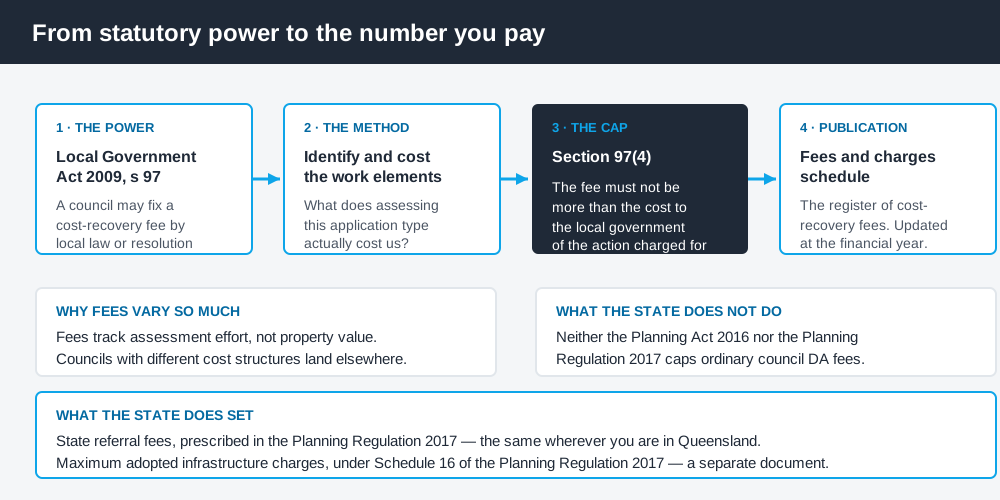
Figure 1: The legal path from statutory power to the number you pay.
What the State does and does not control
Spend 5 minutes, not 3 weeks
instantDA generates a council-ready planning report for Queensland development applications. No town planner. No waiting.
Get your report →This trips people up, so it is worth separating clearly.
The State does not cap ordinary council DA fees. Neither the Planning Act 2016 nor the Planning Regulation 2017 prescribes a maximum for a council's own development assessment fees. The only constraint is the cost-recovery requirement in the Local Government Act 2009.
The State does set referral fees. Where your application triggers a state interest and must be referred to the State Assessment and Referral Agency, the fee is prescribed in the Planning Regulation 2017 and is the same wherever you are.
The State does cap infrastructure charges. Schedule 16 of the Planning Regulation 2017 prescribes the maximum amount a local government or distributor-retailer can adopt in a charges resolution. This is a separate document from the fees and charges schedule and a separate payment.
How to find and read your council's schedule
Every Queensland council publishes a fees and charges schedule, usually as a single annual document, updated at the start of the financial year. Search your council's website for "fees and charges" and look for the planning, development assessment or development services section.
Reading it takes a little care.
Find the right application type first. Material change of use, reconfiguring a lot, building work, or a combined application. These are separate line items with very different fees.
Then find the right use and scale. MCU fees are usually broken down by defined use — dwelling house, dual occupancy, multiple dwelling, commercial — and often by gross floor area or number of dwellings above a threshold. Reconfiguring a lot fees are usually banded by number of lots.
Check for the extras. Pre-lodgement meeting fees, referral agency response fees where the council is a referral agency, change application fees, extension of currency period fees, plan sealing or survey plan endorsement fees, and compliance assessment fees. Some councils bundle inspections into the application fee, others charge separately.
Check whether your council uses a points system. Some councils, including Brisbane, express fees in points with a published dollar conversion rather than direct dollar amounts, which makes a straight comparison harder.
- ✓Identify the application type
- ✓Identify the defined use and the scale band
- ✓Check for combined application discounts
- ✓Add pre-lodgement, change and extension fees you may need
- ✓Check the charges resolution separately for infrastructure charges
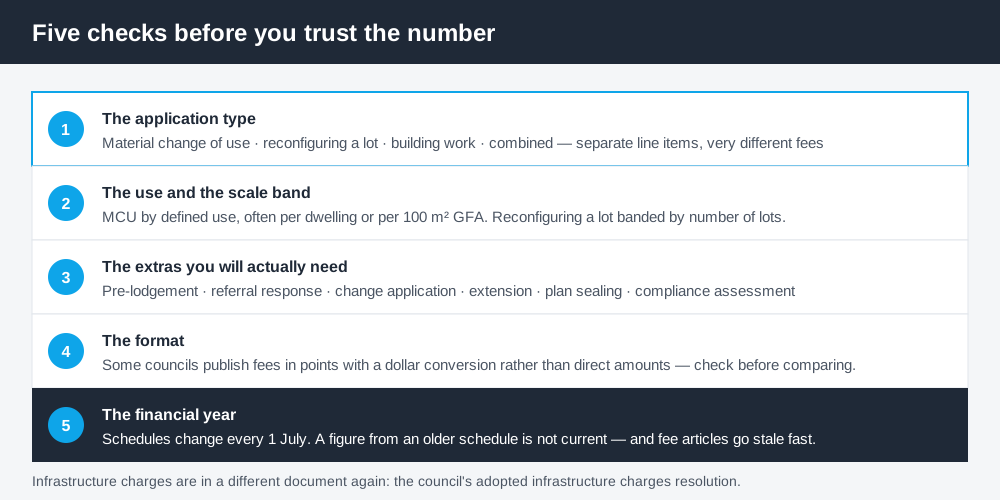
Figure 2: Five checks before you trust a number you found in a schedule.
Comparing councils fairly
Three cautions, because fee comparisons circulate online and most of them are not comparing like with like.
Match the application type exactly. A council's "dwelling house MCU" and another's "combined MCU and referral agency response" are different products. Combined applications commonly cost more because they cover more.
Check the financial year. Schedules change every 1 July. A figure quoted from a 2023 schedule is not current, and fee comparison articles go stale quickly. This one deliberately does not quote dollar figures for that reason — pull your own council's current schedule instead.
Do not compare fees without comparing charges. A council with lower application fees and higher adopted infrastructure charges is not cheaper on a project that adds lots or dwellings. Look at both documents together. What council approval costs in QLD sets out the full picture, including the components councils do not set.
And remember the fee is a small part of what determines whether your project works. Your category of assessment, the overlays on your land and whether your proposal complies with the acceptable outcomes will move your total cost and timeline far more than the application fee will — accepted vs code vs impact assessable in QLD explains how that category is worked out, and it is worth reading before you budget anything.
Before you look up a fee
Work out what you are actually applying for. The fee line you need depends on the defined use, the scale and the assessment type, and getting those wrong means budgeting from the wrong row.
Start with your council's planning scheme maps for the zone, precinct and overlays, and use Queensland Globe for lot, plan and state-mapped layers. The state's guidance on local planning schemes explains how the documents fit together.
If you'd rather read your zone, your overlays and your likely category of assessment in one document than work through a scheme yourself, an instantDA planning report does that for your address for $169, against the $800–$1,500 a town planner typically charges for a preliminary opinion. You can start a report in a few minutes.
Then ring your council's development enquiries line with the application type in hand and confirm the fee. It costs nothing, it takes ten minutes, and it is the only way to be certain — schemes and schedules are not uniform across Queensland.
Frequently asked questions
Are development application fees the same across Queensland councils?
Who sets council DA fees in Queensland?
Does the State cap council DA fees?
Where do I find my council's DA fees?
Why is one council's fee so much higher than another's?
Are infrastructure charges included in the DA fee?
Ready to generate your report?
Skip the writing. Get a council-ready planning report in 5 minutes.
Get your report