Key takeaways
- ✓Brisbane publishes a development assessment and compliance fees schedule each financial year, and it is the only reliable source of current figures.
- ✓Brisbane has long used a points-based calculation, where an application type is assigned points and points convert to dollars.
- ✓For many application types Brisbane confirms the fee after lodgement rather than requiring payment up front.
- ✓The application fee is rarely the largest Brisbane cost. Infrastructure charges and preparation costs usually are.
- ✓The traditional building character overlay is the most common reason a Brisbane homeowner ends up needing an application at all.
Brisbane City Council DA Fees: How They Are Calculated
If you are working out what an application to Brisbane City Council will cost, the honest answer is that you cannot get it from a general article — you get it from the council's own schedule. What an article can usefully give you is the structure: how Brisbane arrives at a number, when you pay it, and which other Brisbane costs sit around it.
Get a council-ready planning report in 5 minutes — no planner, no waiting.
Get your report →The short answer
Brisbane City Council publishes a development assessment and compliance fees schedule each financial year and calculates development application fees from it, using a points-based approach where an application type is assigned points that convert to a dollar amount. For many application types the fee is confirmed after lodgement rather than paid up front.
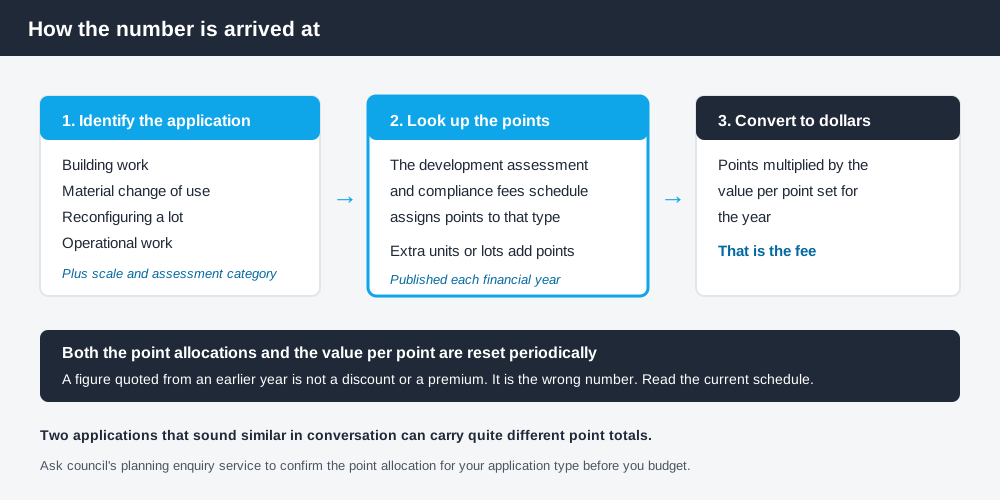
Figure 1: How the number is arrived at.
The points-based calculation
Brisbane's fee structure is not a flat price list. Each application type carries a number of points, and each point has a dollar value set for the financial year. The fee is the points multiplied by that value.
- ✓The type of development — building work, material change of use, reconfiguring a lot, operational work
- ✓The scale — number of dwellings or lots, or gross floor area
- ✓Whether the application is code or impact assessable
- ✓Whether an overlay adds an assessment
The practical effect is that fees scale with complexity in a way a flat schedule cannot. A single dwelling house application and a multiple-dwelling application are not two entries on a list; they are different point totals, with additional points accruing per extra unit.
The consequence for budgeting is that you cannot estimate a Brisbane fee accurately from someone else's project. Two applications that sound similar in a conversation can carry quite different point totals.
Where the schedule lives, and why the year matters
Spend 5 minutes, not 3 weeks
instantDA generates a council-ready planning report for Queensland development applications. No town planner. No waiting.
Get your report →Brisbane publishes its development assessment and compliance fees for each financial year as a document on the council's website, and it updates annually. Council also maintains a plain-English page on development application fees.
Because the point value and the point allocations are both reset periodically, a figure quoted in a blog post from two years ago is not a discount or a premium — it is simply the wrong number. Always read the current year's document.
When you actually pay
Councils across Queensland differ on this, and Brisbane sits at one end.
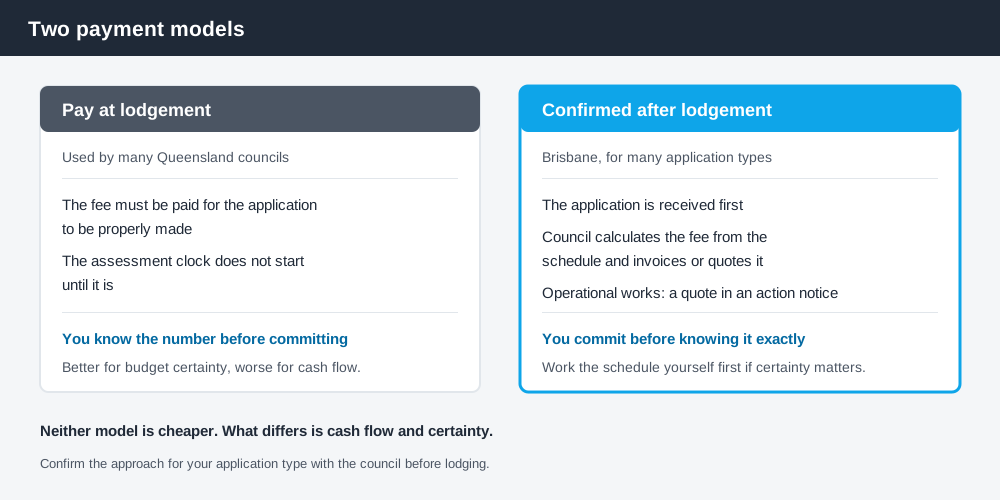
Figure 2: Two payment models, and what each means for you.
Many Queensland councils require the fee to be paid at lodgement for the application to be properly made — no payment, no properly made application, and the clock does not start.
Brisbane's approach for many application types is to receive the application, calculate the fee from the schedule, and invoice or quote it afterwards. For operational works, council issues a fee quote as part of an action notice after lodgement.
Neither model is cheaper. What differs is cash flow and certainty: paying at lodgement means you know the number before you commit, while confirming afterwards means you commit before you know it exactly. If certainty matters to your budget, work the schedule yourself before lodging, or ask council's planning enquiry service to confirm the point allocation for your application type.
For how other Queensland councils structure this, council DA fees in QLD sets out the general pattern.
The Brisbane costs that are not the application fee
For most Brisbane projects, the application fee is not the biggest number on the page.
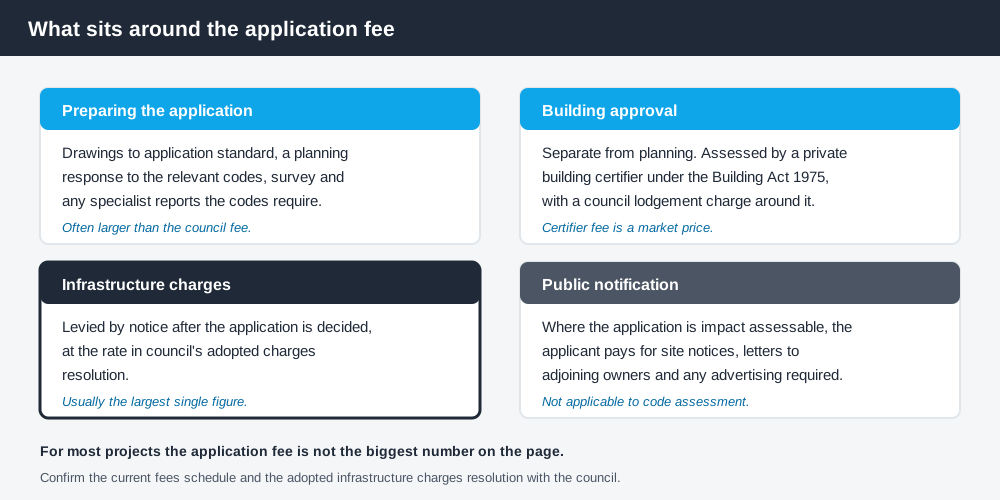
Figure 3: What sits around the application fee.
Preparing the application. Drawings to application standard, a planning response addressing the relevant codes, survey, and any specialist reports the codes require. On a character-area extension this is frequently larger than the council fee.
Building approval. Separate from planning, assessed by a private building certifier under the Building Act 1975, with its own market-set fee and a council lodgement charge around it.
Infrastructure charges. Levied after the application is decided, by an infrastructure charges notice, at the rate in council's adopted charges resolution. For anything creating additional dwellings or lots, this is usually the largest single figure. Infrastructure charges in QLD explains the calculation.
Public notification. Where the application is impact assessable, the applicant pays for notification — site notices, letters to adjoining owners, and any advertising required.
The Brisbane-specific trigger: character areas
The most common reason a Brisbane homeowner ends up paying a development application fee at all is not the size of their project. It is the traditional building character overlay.
That overlay applies across whole suburbs where pre-1947 dwellings define the streetscape. On a site in it, work that would otherwise be accepted development can become assessable. Brisbane's own guidance on extensions, raising or renovations states that you will generally need planning approval for external extensions, and that some extensions and renovations to a house built during or before 1946 require it.
It is not a blanket rule, though, and the exceptions matter. The same guidance lists work that remains accepted development on those sites — including enclosing under an existing building, an external stair or ramp, some carports, rear outbuildings, and raising a house where the new height does not exceed 9.5m.
Heritage and pre-1911 provisions apply a higher level of protection again, with more documentation and generally a more complex assessment. The character overlay in QLD covers how character provisions work more broadly, including in councils that use different names for the same idea.
- ✓Check whether your property is in the traditional building character overlay
- ✓Check whether the specific work you want is on council's accepted development list
- ✓If it is not, budget for both a design that responds to the overlay code and an application fee
What to do next
Do two things before you assume a number. First, confirm whether your project needs a planning application at all — for many Brisbane homeowners, the overlay answer decides that. Second, if it does, read the current year's fees schedule rather than any figure you have been quoted informally.
If you'd rather see your zone, your overlays and your likely category of assessment set out in one document than work through a planning scheme yourself, an instantDA planning report does that for your address for $169 — against the $800–$1,500 a town planner typically charges for a preliminary opinion. You can start a report in a few minutes.
Brisbane's approach is not the Queensland norm, so if you are comparing across councils, Gold Coast City Council DA fees is a useful contrast — the two councils structure and time their fees differently for the same kind of project.
Then confirm the fee with council directly before lodging. It costs a phone call and removes the largest uncertainty in the budget.
Frequently asked questions
How does Brisbane City Council calculate development application fees?
When do you pay a Brisbane development application fee?
Where do I find Brisbane's current DA fees?
Is the application fee the biggest cost?
Why do so many Brisbane homeowners need an application?
Does everything in a Brisbane character area need approval?
Ready to generate your report?
Skip the writing. Get a council-ready planning report in 5 minutes.
Get your report