Key takeaways
- ✓Infrastructure charges are a separate bill from your application fee, and they usually dwarf it.
- ✓They arrive as an infrastructure charges notice, given under section 119 of the Planning Act 2016, normally alongside the decision notice.
- ✓Councils set their own charges in a charges resolution under section 112, capped by a maximum amount the state prescribes and indexes each year.
- ✓You almost always get a credit for the demand your land already generates — an existing house is not charged twice.
- ✓You have a formal right to make representations about the notice under section 123, and a separate right of appeal.
Infrastructure Charges in QLD — What You'll Pay
If you have applied for council approval to subdivide, build a second dwelling or change what a building is used for, there is a good chance the biggest number in the whole process is not the application fee. It is the infrastructure charge — a contribution towards the trunk water, sewerage, stormwater, road and parkland networks your development will draw on. You will sometimes hear it called a headworks charge, which is the older term for the same thing.
Get a council-ready planning report in 5 minutes — no planner, no waiting.
Get your report →The short answer
Infrastructure charges are a separate contribution towards trunk networks, levied by council on approvals that increase demand — new lots, new dwellings, or a more intensive use. Council sets the rate in a charges resolution, capped by a state maximum. You receive a charges notice with your decision, and can make representations about it.
That is the shape of it. The detail that decides your number is the credit, and most people find out about the credit far too late.
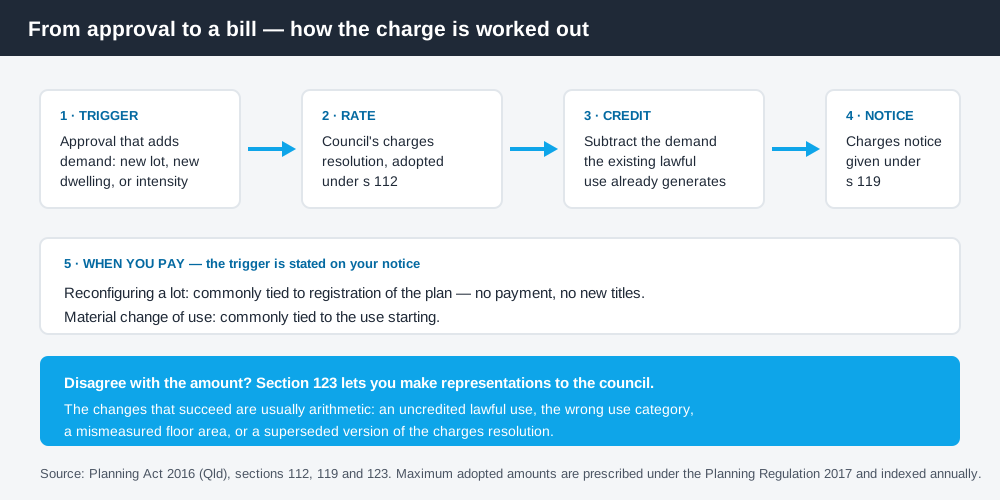
Figure 1: How a charge moves from approval to a bill you have to pay.
What triggers a charge
The charge follows additional demand, not construction cost. Three things typically create it.
- ✓Reconfiguring a lot — each new lot beyond the first draws its own demand
- ✓A material change of use — a new or additional dwelling, or a shift to a more intensive use
- ✓An intensification of an existing use — extra floor area in a commercial building, for example
A renovation that does not add a dwelling, a shed, a deck or a carport generally does not attract a charge, because none of them put more pressure on a water main or a park. Splitting one lot into two usually does, because the second lot is a second household.
This is why the charge feels arbitrary to homeowners and obvious to developers. It is not indexed to what you spend. It is indexed to what the network now has to carry.
Who sets the amount
Spend 5 minutes, not 3 weeks
instantDA generates a council-ready planning report for Queensland development applications. No town planner. No waiting.
Get your report →Councils adopt their own charges through a charges resolution, made under section 112 ("Adopted charges") of the Planning Act 2016. That resolution is a public document, published on the council's website, and it is where your actual rate lives.
Council does not have a free hand. The state prescribes a maximum amount a local government may adopt for each type of development under the Planning Regulation 2017, and those maximum amounts are indexed annually. A council can charge less than the cap — several do, in specific zones or for specific uses, as an incentive — but it cannot charge more.
Because the caps are indexed and each council reviews its resolution on its own cycle, any dollar figure quoted in an article has a short shelf life. Read the current charges resolution for your own council rather than relying on a number you found online — including this one.
The credit — the part that changes your bill
You are charged for the additional demand your development creates, not the total demand of the finished thing. So the calculation runs: demand after, minus the demand your land is already credited with, equals the charge.
An existing lawfully approved house on the land generates a credit. If you subdivide that lot into two and keep the house, you are broadly being charged for the one new household, not two. If you demolish a dwelling and build two, the demolished dwelling still counts — the credit attaches to the lawful entitlement, not to whether the building is standing today.
Two traps sit here. The first is that a credit generally depends on the previous use being lawful — an unapproved second dwelling may generate no credit at all, which is one of the quieter costs of unapproved work. If that is your situation, retrospective building approval in QLD explains the process for regularising it. The second is that credits are calculated per network. You can hold a strong water credit and a weak parkland credit on the same site.
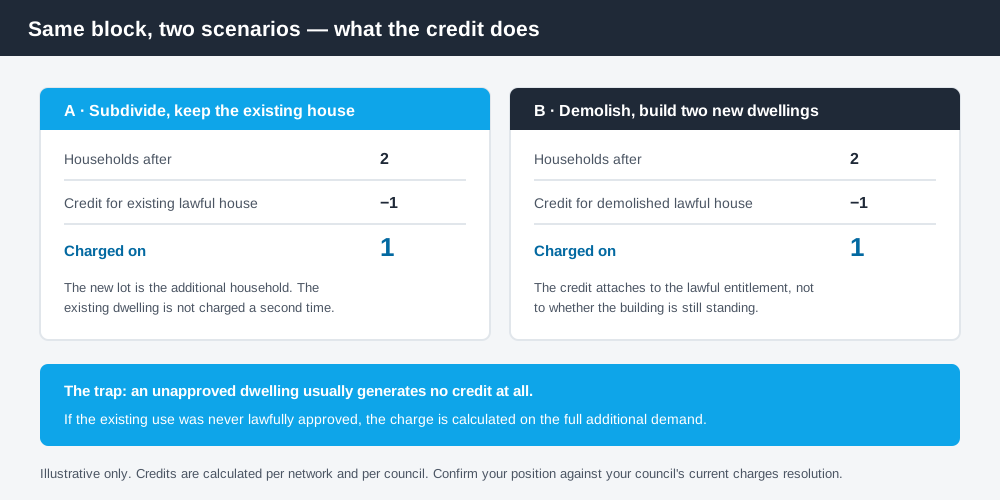
Figure 2: The same block, two scenarios, very different charges.
When the notice arrives and when you pay
The charge is communicated in an infrastructure charges notice, given under section 119 ("Infrastructure charges notice") of the Planning Act 2016. It normally comes with, or immediately after, your decision notice, and it states the amount, how it was worked out and when it falls due.
The timing of payment depends on what you are doing. Broadly, for reconfiguring a lot the charge is tied to the plan being registered — you will not get your new titles without it. For a material change of use it is generally tied to the use starting. Your notice will state the trigger, and that is the version that binds you, not a general rule.
Plan for this in your feasibility, not at settlement. On a subdivision, an infrastructure charge is routinely one of the largest single line items after the civil works. If you are costing a project, subdivision cost in QLD sets out where it sits against surveying, civil construction and professional fees.
If you think the amount is wrong
You have a formal route. Section 123 ("Representations about infrastructure charges notice") of the Planning Act 2016 lets an affected person make representations to the local government about the notice, which can result in a negotiated notice replacing the original. There is also a separate right of appeal about an infrastructure charges notice, which is heard in the Planning and Environment Court or, in some matters, the Development Tribunal.
Representations are usually the first move, and they are most successful when they are arithmetic rather than argument. The things that actually get amounts changed are: an existing lawful use that was not credited, the wrong charge category applied to the use, floor area or bedroom counts measured incorrectly, and a superseded version of the charges resolution being used.
- ✓Check the credit for the existing lawful use
- ✓Check the use category applied
- ✓Check the measured area or dwelling yield
- ✓Check the resolution version and date
Note the deadlines are short and are set out on the notice itself. Read the notice the day it arrives rather than the week before you intend to pay.
Before you apply
If you want a realistic picture before you commit, three things are worth doing in order. Confirm what category of assessment your proposal falls into, because that drives everything downstream — accepted versus assessable development in QLD covers that split. Read your council's current charges resolution and find the rate for your specific use. Then identify what credit your land already carries, which usually means confirming the lawful status of what is on it now.
For land and lot work specifically, reconfiguring a lot in QLD explains how the approval itself works and where the charge attaches in that sequence. You can check your land's zone, overlays and the property details behind all of this on your council's planning scheme mapping and on the Queensland Globe, the state's free mapping tool.
If you would rather see your zone, your overlays and your likely category of assessment set out in one document before you spend money on design, an instantDA planning report does that for your address for $169 — against the $800–$1,500 a town planner typically charges for a preliminary opinion. You can start a report in a few minutes.
Infrastructure charges themselves are council-specific and change annually, so confirm the current figure with your council before you rely on it.
Frequently asked questions
What are infrastructure charges in Queensland?
How much are infrastructure charges in QLD?
Do I pay infrastructure charges on a granny flat?
When do I have to pay the infrastructure charge?
Can I dispute an infrastructure charges notice?
Do I get credit for an existing house on the land?
Ready to generate your report?
Skip the writing. Get a council-ready planning report in 5 minutes.
Get your report