Key takeaways
- ✓Reconfiguring a lot, or ROL, is the Planning Act 2016 term for changing lot boundaries — it is what councils call subdivision.
- ✓ROL is a family of things: creating lots, amalgamating lots, realigning a boundary, and creating or changing an access easement.
- ✓A boundary realignment between two existing lots is still an ROL, even though no new lot is created.
- ✓ROL is a separate kind of development from a material change of use and from building work, so it needs its own development permit.
- ✓Where the approval states no period, an ROL approval lapses if the plan is not given to council within four years — against six years for a material change of use.
- ✓An ROL approval is stage one: operational works, construction, survey, plan sealing and registration all come after it.
What Does "Reconfiguring a Lot" Mean in Queensland?
Almost nobody starts here. You started with "I want to subdivide my block", or "split the back yard off and sell it", or "move the boundary so the fence matches the driveway". Then a council officer, a surveyor or a search result handed you a phrase nobody says out loud: reconfiguring a lot. You'll usually hear the process itself called a development application, or DA — and in Queensland, reconfiguring a lot, or ROL, is the name for the kind of DA that changes lot boundaries. It is the phrase on council forms, decision notices and the public development register.
Get a council-ready planning report in 5 minutes — no planner, no waiting.
Get your report →The short answer
Reconfiguring a lot is the Planning Act 2016 term for changing lot boundaries. It covers subdividing one lot into several, amalgamating lots into one, realigning a boundary, and creating or changing an easement giving access to a lot. It is its own kind of development, needing its own development permit.
That last point does most of the work. ROL is not a sub-type of something else. It sits alongside material change of use and building work as a distinct category, with its own application, its own approval and its own deadlines.
Reconfiguring a lot is a family, not one thing
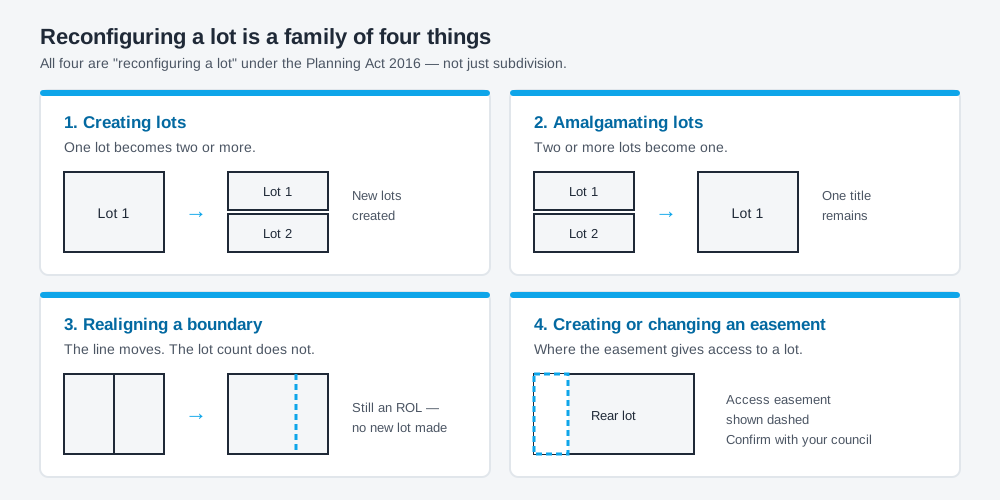
Figure 1: The four things that all count as reconfiguring a lot.
The definition in the dictionary to the Planning Act 2016 is broader than most people expect, and that is where the confusion starts. Four quite different projects all land in the same box.
Creating lots is the one everybody pictures: one lot becomes two, three or two hundred. Amalgamating lots is the reverse — existing lots are consolidated into a single lot, which people do to build across an old boundary or tidy up a title. Realigning a boundary moves the line between two existing lots without changing how many lots there are. Creating or changing an easement that gives access to a lot is the fourth, and the most often overlooked, because an easement feels like a conveyancing matter rather than a planning one.
- ✓Creating lots from one lot
- ✓Amalgamating lots into one
- ✓Realigning a boundary between existing lots
- ✓Creating or changing an easement giving access to a lot
The realignment case surprises people most. You and your neighbour agree to shift the common boundary so the shed stops straddling it. No new lot exists afterwards — two lots before, two lots after. It is still reconfiguring a lot, still checked against the planning scheme, and still ends with a new survey plan being registered. If that is your situation, the mechanics are set out in our guide to boundary realignment in Queensland.
Why ROL is its own kind of development
Spend 5 minutes, not 3 weeks
instantDA generates a council-ready planning report for Queensland development applications. No town planner. No waiting.
Get your report →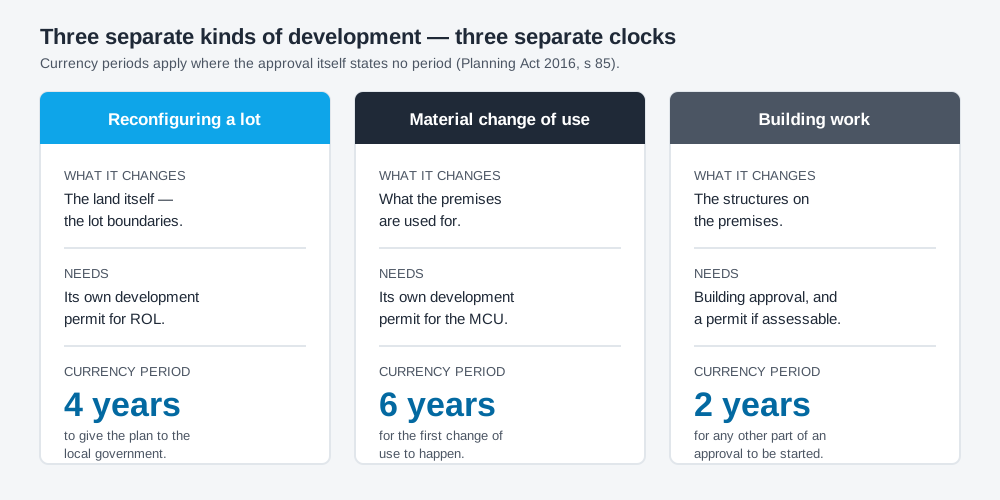
Figure 2: Three separate kinds of development, three separate permits, three different currency periods.
Under the Planning Act 2016, development is not one undifferentiated thing. Reconfiguring a lot changes the land itself. A material change of use changes what the premises are used for. Building work changes the structures on them. A project can involve several of these at once, and generally a development permit is needed for each assessable aspect — approving one does not approve the others.
That separation has a consequence people discover late: the clock runs differently. Under section 85 of the Planning Act 2016, where the approval itself states no period, a reconfiguring a lot approval lapses if the plan is not given to the local government within four years. A material change of use approval gets six years for the first change of use to happen, and any other part of an approval gets two years to be substantially started. An extension can be requested, but only before the approval lapses.
Four years sounds generous until you count backwards from it. Detailed design, an operational works approval, civil construction, the cadastral survey and plan sealing all have to fit inside that window. People approve a subdivision, wait for the market, and find the approval has quietly expired. For the lapsing rules in full, including how extension requests work, read our guide to the currency period in Queensland.
What an ROL application is assessed against
Your application is measured against the assessment benchmarks that apply to your land, which in practice means three layers. The zone code sets the expectations for lot size, shape and density. The reconfiguring a lot code — some schemes call it the subdivision code — sets the design standards for new lots, roads, access and services. Then any overlay codes that touch your land apply on top: flood, bushfire, character, vegetation, transport noise and others, depending on the council.
Queensland schemes follow the Queensland Planning Provisions structure, so the document will look familiar from council to council. The content does not. Each council writes its own zone codes, its own reconfiguring a lot code and its own overlays. There is no state-wide minimum lot size, frontage or access handle width — those are scheme matters, so read your own council's scheme and confirm the position with council.
Accepted, code assessable or impact assessable?
The level of assessment depends on your zone and on whether the proposed lots comply with the scheme. A straightforward subdivision producing lots that comfortably meet the zone code is often code assessable — a DA is required, it is assessed against the relevant codes, it is not publicly notified and neighbours have no third-party appeal right. Propose lots that fall short of the scheme's standards, or reconfigure in a zone where subdivision is not anticipated, and the application can become impact assessable, which means assessment against the whole planning scheme, public notification, and submitters gaining appeal rights.
Some minor reconfigurations are treated more lightly by particular schemes, so check your council's table of assessment rather than assuming.
An ROL approval is stage one, not the finish line
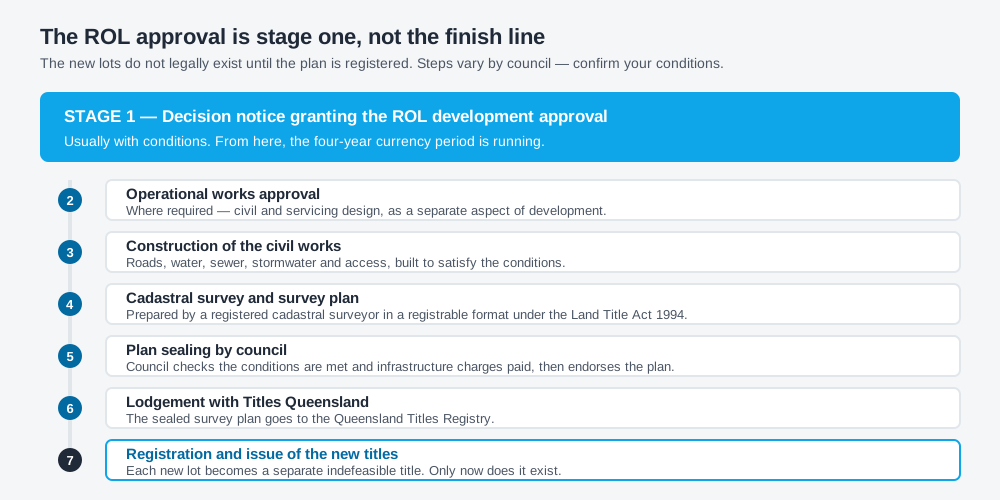
Figure 3: What still has to happen after the ROL approval is granted.
The decision notice granting your ROL approval feels like the end. It is closer to the beginning. Where civil works are required, you will need a separate operational works approval covering earthworks, roadworks, stormwater, water and sewer reticulation and access — a different aspect of development with its own permit, explained in our guide to operational works in Queensland. Then the works are built to satisfy the conditions.
After that, a registered cadastral surveyor prepares the survey plan in a registrable format under the Land Title Act 1994. The plan goes to council for plan sealing, where council checks that the conditions have been met and infrastructure charges paid. Only then does the sealed plan go to Titles Queensland for lodgement, registration and the issue of separate titles. Until that final step, the new lots do not legally exist.
Getting the answer for your own block
Everything above turns on two things you can look up: what zone your land is in and what overlays cross it. An instantDA planning report pulls the zone, the overlays and the likely level of assessment together for your specific address for $169, against the $800–$1,500 a town planner typically charges for a preliminary opinion. You can start a report in a few minutes.
Frequently asked questions
What is reconfiguring a lot in Queensland?
Is reconfiguring a lot the same as subdivision?
Do I need approval to move a boundary between two lots?
How long does a reconfiguring a lot approval last?
Can one application cover reconfiguring a lot and a material change of use?
What is the minimum lot size for subdivision in Queensland?
Ready to generate your report?
Skip the writing. Get a council-ready planning report in 5 minutes.
Get your report