Key takeaways
- ✓A material change of use is the start of a new use, the re-establishment of an abandoned use, or a material increase in the intensity or scale of a use.
- ✓No building work is needed for an MCU. Changing what happens inside an existing building can require approval on its own.
- ✓Your use must be matched to a defined use term in your council's planning scheme, not described in your own words.
- ✓The defined use plus the zone plus any overlay produces your category of assessment in the tables of assessment.
- ✓An MCU approval lapses if the first change of use does not happen within the currency period — six years by default.
Changing How You Use a Property: Material Change of Use in QLD
Most people think of council approval as being about building things. A large part of Queensland's planning system is not about building at all — it is about what happens on the land, and that half is where the surprises live.
You can need a development approval without touching a hammer. Turning a shop into a café, a house into a childcare centre, a shed into a workshop that trades, or a spare room into a business with clients arriving can each be a material change of use, and each can require an approval that has nothing to do with the building.
Get a council-ready planning report in 5 minutes — no planner, no waiting.
Get your report →The short answer
A material change of use is the start of a new use, the re-establishment of an abandoned use, or a material increase in the intensity or scale of a use. No building work is needed. Whether approval is required depends on the defined use, the zone and any overlay in the tables of assessment.
The three limbs
Schedule 2 of the Planning Act 2016 defines a material change of use of premises as any of three things, other than a change a regulation prescribes to be a minor change of use.
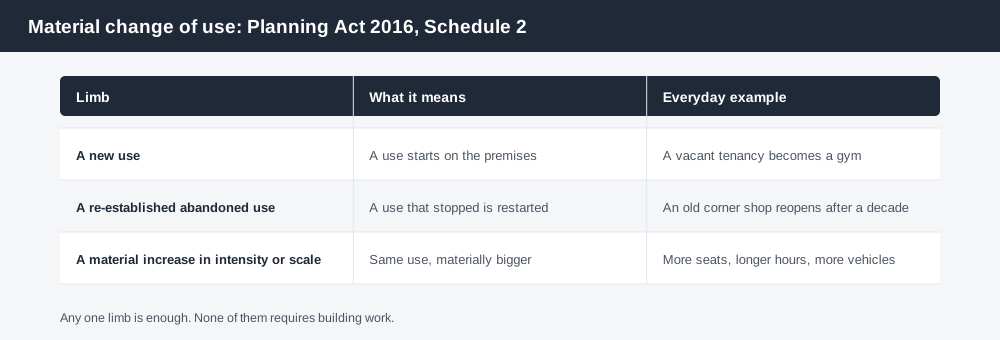
Figure 1: Three limbs, any one of which is enough.
The start of a new use of the premises. The clearest case. A vacant tenancy becomes a gym. A paddock becomes a caravan park.
The re-establishment on the premises of a use that has been abandoned. The one that catches buyers. A building that was once a corner shop, unused for a decade, is not automatically a corner shop again. If the use was abandoned, restarting it is a material change of use, and the fact that it operated historically is not an approval.
A material increase in the intensity or scale of the use of the premises. The subtlest, and the hardest to self-assess. The use has not changed in kind, but it has grown — more seats, longer hours, more vehicles, more staff, more deliveries. At some point that increase becomes material, and there is no bright-line number. Where a business is growing significantly, it is worth confirming with your council rather than assuming that "same use, just busier" carries no approval consequence.
The defined use term does the work
Spend 5 minutes, not 3 weeks
instantDA generates a council-ready planning report for Queensland development applications. No town planner. No waiting.
Get your report →This is the step people skip, and it determines everything after it.
Queensland planning schemes follow the Queensland Planning Provisions structure, and each contains a schedule of defined uses — standard terms such as dwelling house, dual occupancy, shop, food and drink outlet, health care services, child care centre, low impact industry, home based business. Your proposal has to be matched to one of those terms.
That match is not a description exercise. "A little coffee place with some retail" is not a defined use; food and drink outlet and shop are, and which one applies changes the codes, the parking rates and often the category of assessment. Where a proposal genuinely spans two defined uses, it may need approval for both.
- ✓Find the use definitions schedule in your council's planning scheme
- ✓Match your proposal to a defined use term, not a description
- ✓Check whether a second defined use also applies
- ✓Note the parking and servicing rates attached to that use
- ✓Confirm the match with your council if it is arguable
Schemes are not uniform between councils. Each layers its own codes and thresholds on top of the QPP structure, so a use term in one scheme may sit differently in another.
Finding your category
Once you have the defined use, the rest is mechanical, and it is the same method for every scheme.
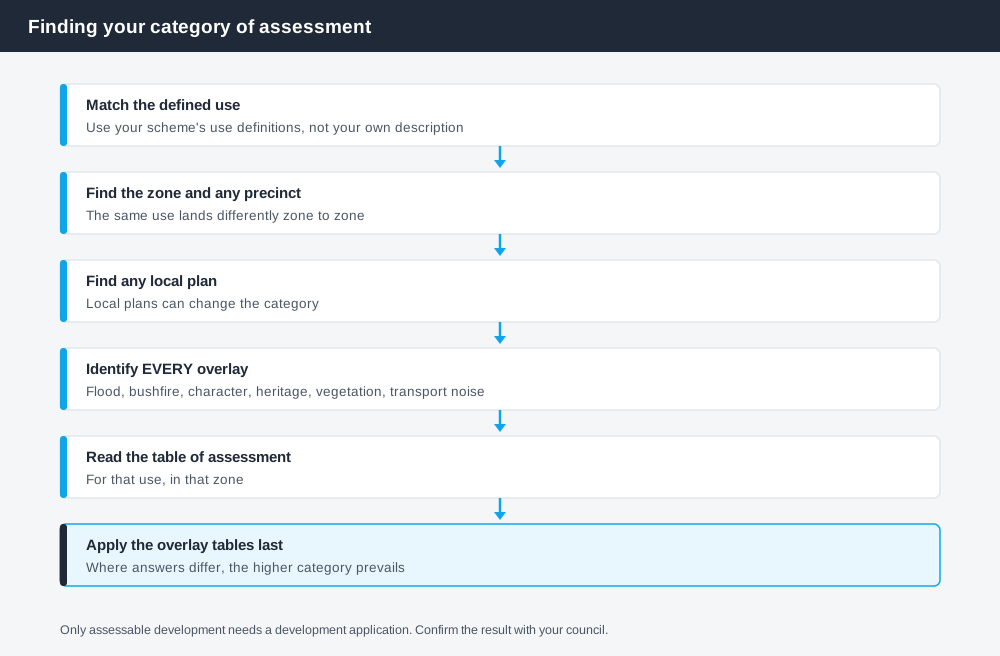
Figure 2: Use, then zone, then overlays — and overlays are applied last.
Identify the zone and any precinct. Identify any local plan. Identify every overlay affecting the premises. Then read the table of assessment for that use in that zone, and apply any overlay table on top. Where two parts of the scheme give different answers, the higher category prevails.
The outcome will be accepted development, accepted development subject to requirements, code assessable, impact assessable, or prohibited. Only assessable development needs a DA. Accepted versus code versus impact assessable explains what each of those means in practice.
The category is a property of the use on that land — not of the use in general. The same café is code assessable in a centre zone and impact assessable in a low density residential zone two streets away.
The applications that catch people
Home businesses. Working from home is usually fine. Clients arriving, staff arriving, deliveries, signage or storage can push it into a defined use with its own requirements. Running a home business in QLD covers where the line falls.
Short-stay accommodation. Letting a dwelling to short-stay guests is treated differently across schemes and can be a separate defined use.
Secondary dwellings. A granny flat used as an independent tenancy is not always the same use as one used by the household.
Growth inside an existing approval. The intensity limb applies to businesses expanding within a use they already have approval for. If your approval has conditions on hours, seats or vehicle movements, exceeding them is a separate problem again — those are conditions, and breaching them is an enforcement issue rather than an approval question.
Applying for an MCU
An MCU application is made on DA Form 1, with plans, a planning report addressing the applicable codes, the fee, and the owner's written consent where you are not the owner — consent is specifically required for a material change of use where the applicant is not the owner. How to lodge a DA in QLD walks the sequence.
The planning report for an MCU carries more weight than for building work, because much of what council is assessing is operational rather than physical: hours, staffing, vehicle movements, waste, noise, amenity impacts on neighbours. Those details belong in the application, quantified.
After approval
Two things to diarise.
The currency period. A material change of use part of an approval lapses if the first change of use does not happen within the stated period, or six years where none is stated. Building the fit-out is not the trigger — the use starting is. When your approval expires sets out the detail.
And the conditions. Operational conditions on an MCU tend to be ongoing rather than one-off — hours of operation, number of patrons, delivery times, waste collection, landscaping maintenance. They bind for as long as the use continues.
What to do next
The hard part of an MCU is matching the defined use and reading the tables of assessment correctly. An instantDA planning report does that work — your defined use, your zone, your overlays and a benchmark-by-benchmark assessment — for $169, against $800–$1,500 for a town planner preparing the same document.
Start with a planning report, or go straight to creating your report.
Frequently asked questions
What is a material change of use in Queensland?
Do I need building work for an MCU?
Does an MCU always need council approval?
Can restarting an old use trigger an MCU?
How much can a business grow before it becomes an MCU?
How long does an MCU approval last?
Ready to generate your report?
Skip the writing. Get a council-ready planning report in 5 minutes.
Get your report