Key takeaways
- ✓Queensland law does not prohibit approving building work that is already built — but nothing obliges a certifier to approve it either.
- ✓There are two separate systems and you may need both: building approval under the Building Act 1975 and development approval under the Planning Act 2016.
- ✓A certifier can only approve what they can be satisfied about, which often means opening up covered work so it can be inspected.
- ✓Footings, slabs and concealed structure are the usual dealbreakers — nobody can certify what nobody can look at.
- ✓Council can escalate through a show cause notice to an enforcement notice, and an enforcement notice can require removal.
Retrospective Building Approval in QLD — How It Works
You'll usually hear this called a development application, or DA — that's the formal name for council approval under the Planning Act 2016. When the work is already standing, people also call it a retrospective approval, or an "as-constructed" approval. Queensland law does not have a tidy named process with that title. What it has is the ordinary approval process, applied to something that has already been built.
Get a council-ready planning report in 5 minutes — no planner, no waiting.
Get your report →The short answer
Nothing in Queensland law prohibits approving building work that already exists. But approval is discretionary and evidence-based — a certifier must be satisfied the work complies, which usually means exposing covered work and getting engineering certification. Where compliance can't be demonstrated, the work has to be altered or removed.
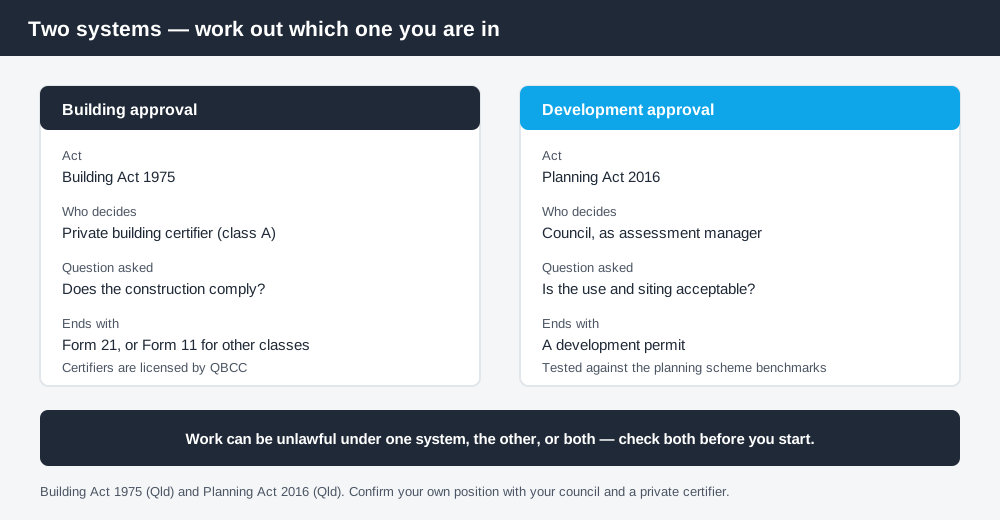
Figure 1: Which system your unapproved work sits in — and you may be in both.
Two systems, not one
This is where most of the confusion lives, so it is worth being blunt about it.
Building approval is a building development approval under the Building Act 1975. It is about whether the construction complies with the National Construction Code and the Queensland Development Code — footings, framing, tie-down, waterproofing, fire separation, glazing. It is normally issued by a private building certifier (class A), licensed by QBCC.
Development approval is a development permit under the Planning Act 2016, decided by council as assessment manager. It is about land use and siting — whether a material change of use (MCU) was needed, whether the built form met the assessment benchmarks in the planning scheme, whether an overlay applied, whether setbacks were complied with.
A shed built too close to the boundary may comply perfectly with the Code and still be unlawful, because siting is a planning question. A granny flat that meets every setback may still be unapproved building work. Work out which system you are in before you contact anyone.
Can a certifier approve work that is already built?
Spend 5 minutes, not 3 weeks
instantDA generates a council-ready planning report for Queensland development applications. No town planner. No waiting.
Get your report →Yes, in principle. Departmental guidance to certifiers has long confirmed that the planning legislation does not prohibit a building development approval being issued for existing building work, and that unapproved work which is not going to be demolished should be assessed in close liaison with the local government.
The practical constraint is proof. A certifier must be satisfied the work complies with the building assessment provisions before approving it. On a normal job that satisfaction comes from staged mandatory inspections — footings before the pour, slab before the pour, frame before lining. On finished work those inspection points are gone, and can only be reconstructed from evidence. That is why certifiers routinely ask for some combination of the following.
- ✓Removal of internal linings, external cladding, ceilings or roof sheeting so structure can be inspected
- ✓An RPEQ engineer's as-constructed assessment, with a Form 15 design certificate
- ✓A Form 16 inspection certificate for the aspects the engineer can verify
- ✓Excavation or non-destructive testing to confirm footing size and reinforcement
- ✓Amended plans that match what was actually built, not what was intended
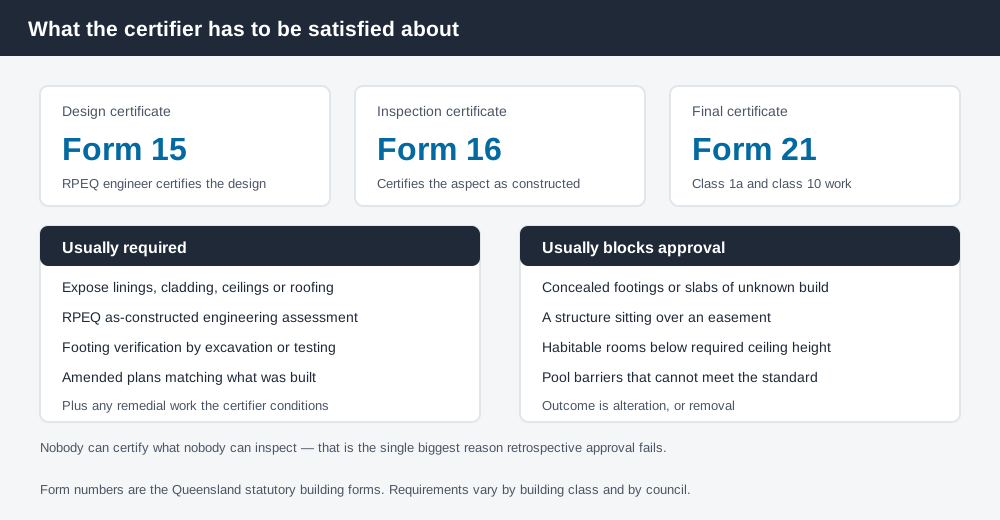
Figure 2: The evidence a certifier is trying to assemble, and where it usually breaks down.
Where the certifier can be satisfied, the sequence ends with a final certificate — a Form 21 final inspection certificate for a class 1a dwelling or a class 10 structure such as a shed, carport or pool, or a Form 11 certificate of occupancy for other classes. Until that certificate exists, the work is not finalised, whatever the approval says.
What cannot be approved retrospectively
Some things genuinely cannot be regularised, and honest advice says so early.
Concealed structural work is the classic case. If a slab was poured with unknown reinforcement, or footings sit at an unknown depth on unknown ground, an engineer may simply decline to certify — no certifier can approve on the strength of an owner's recollection. Council guidance on unapproved work is direct about it: you may never be able to finalise a building because critical hidden components cannot be effectively inspected.
The other category is work that cannot be made compliant without being rebuilt. A structure over a sewer easement, a habitable room with insufficient ceiling height, a wall inside a required fire separation distance, a pool barrier that cannot be brought to the pool safety standard. In those cases the outcome is alteration, partial demolition, or removal. That is not a threat; it is the arithmetic.
Show cause notices and enforcement notices
Council does not usually jump to prosecution. It escalates.
Under the Building Act 1975, a local government may give a show cause notice under section 247 where it reasonably believes an offence has been or is being committed. You get a stated period — generally at least 20 business days — to explain why an enforcement notice should not be issued. If the response does not satisfy council, an enforcement notice may follow under section 248, and it can require you to stop work, carry out remedial work, or demolish and remove the building work.
The Planning Act 2016 mirrors this for development offences, with a show cause notice under section 167 and an enforcement notice under section 168. Carrying out assessable development without the necessary development permit is an offence under section 163.
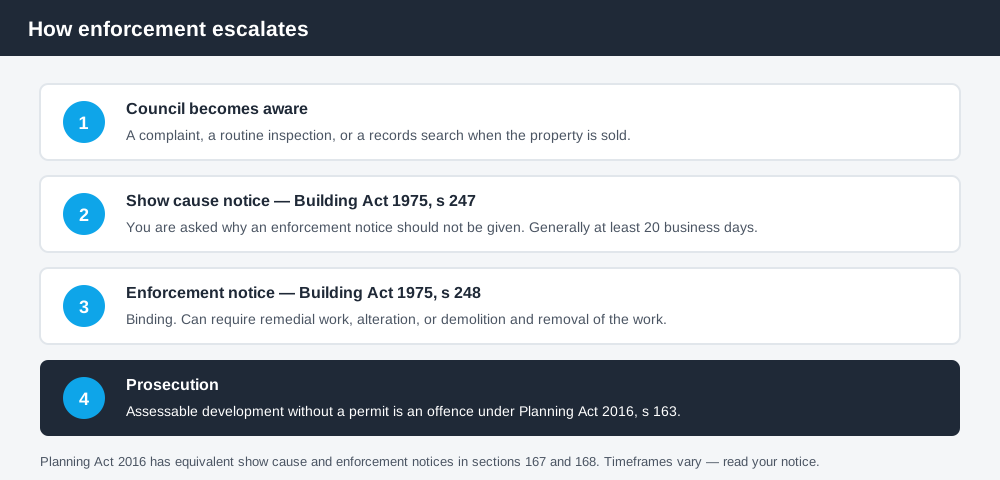
Figure 3: Enforcement escalates in steps, and each step has a deadline.
The dollar value of a penalty unit is set by regulation and indexed each 1 July, so convert it using the current value. Maximum penalties are reserved for the worst cases — commercial-scale, wilful, or heritage-affecting offending. A homeowner who self-reports a decade-old patio is in a very different position, and voluntarily seeking approval is generally treated as a mitigating step. Show cause and enforcement notices in QLD walks through what to do when one lands, and the deadline is short enough that reading it afterwards is uncomfortable.
What happens at sale
Unapproved work is most often discovered when the property is sold. A buyer's solicitor can obtain a council building records search, and a building and pest inspector will flag structures with no matching approval. What follows is usually a price reduction, a special condition requiring approval before settlement, or a terminated contract.
QBCC matters here too. It licenses both the building certifier and the contractor, and the Queensland Home Warranty Scheme only covers insurable residential work performed by a licensed contractor who paid the premium before work started. It is not a policy you can buy afterwards to cover work already built, and a buyer's solicitor can search whether cover attaches to the property. Unapproved work and conveyancing in QLD covers the disclosure side.
What it costs, honestly
Nobody can quote this in advance, and anyone who does is guessing. The cost is the sum of an application fee, certifier fees, engineering fees, opening-up and making-good, any remedial work, and possibly a planning application if the siting or use was never approved. On a habitable extension with concealed structure it can approach the cost of building it properly the first time. Get a certifier to scope it before you commit.
The Queensland Government's guidance on working with building certifiers explains what certifiers can and cannot do, and the Building Act 1975 is the source for the enforcement provisions above.
Queensland's planning schemes follow the Queensland Planning Provisions structure, but each council layers its own codes and overlays on top, so the planning half of this question has to be answered against your own scheme. If you'd rather see your zone, your overlays and the likely category of assessment for the work in one document, an instantDA planning report does that for your address for $169 — against the $800–$1,500 a town planner typically charges for a preliminary opinion. You can start a report in a few minutes. If you are still working out whether your work was ever caught, building without approval in QLD is the better starting point.
Then confirm with your council and a private certifier before you open a single wall.
Frequently asked questions
Can you get retrospective building approval in Queensland?
What will a certifier make me do to approve existing work?
What if the work cannot be approved?
Is a show cause notice the same as an enforcement notice?
Do I need council approval as well as building approval?
Does QBCC home warranty insurance cover unapproved work?
Ready to generate your report?
Skip the writing. Get a council-ready planning report in 5 minutes.
Get your report