Key takeaways
- ✓Unlawful development does not expire. It stays attached to the land until it is approved, certified or removed.
- ✓First establish which approval was actually missing, because building approval and development approval are separate systems.
- ✓Some structures people assume are unlawful were accepted development all along. Check before you confess.
- ✓You have three real options: retrospective approval, certification of what exists, or removal.
- ✓The problem usually surfaces at sale, at an insurance claim, or when a neighbour complains — rarely at a convenient moment.
Building Without Council Approval in QLD: What Happens Next
You'll usually hear this called a development application, or DA — that's the formal name for council approval under the Planning Act 2016. If work that needed one was carried out without it, the structure is unlawful development, and Queensland law treats that as a condition of the land rather than a historical event. It does not lapse, it does not become lawful with age, and it does not stop being your problem because someone else built it. Learn more about the unapproved building work insurance.
Get a council-ready planning report in 5 minutes — no planner, no waiting.
Get your report →The short answer
Unlawful development stays with the land indefinitely. Council can issue a show cause notice and then an enforcement notice requiring you to stop, rectify, demolish or restore. Your options are retrospective approval, certification of the existing work, or removal. Establish which approval was missing before you do anything.
Step one: work out what was actually missing
People say "no approval" when they usually mean one of three quite different things, and the fix differs for each.
No development approval. The work was assessable development under the planning scheme and no DA was lodged. This is a Planning Act 2016 problem, and the council is the assessment manager.
No building approval. The work was assessable building work and no building development approval was obtained. This is a Building Act 1975 problem, resolved through a building certifier and the council's building compliance team.
No approval was ever needed. More common than you would expect. A structure that felt substantial may have been accepted development under both systems. A deck under the height threshold, a shed inside the size limits, a fence under 2 m — all can be perfectly lawful without a single piece of paper.
Establish which of the three you are in before you speak to anyone. What you can build without council approval in QLD sets out the thresholds that decide it, and building approval vs development approval in QLD explains why the two systems answer different questions.
- ✓Order a council building records search
- ✓Check the development application history on your council's portal
- ✓Find the zone and overlays on the scheme maps
- ✓Identify what the scheme said at the time the work was done
- ✓Only then decide what to do
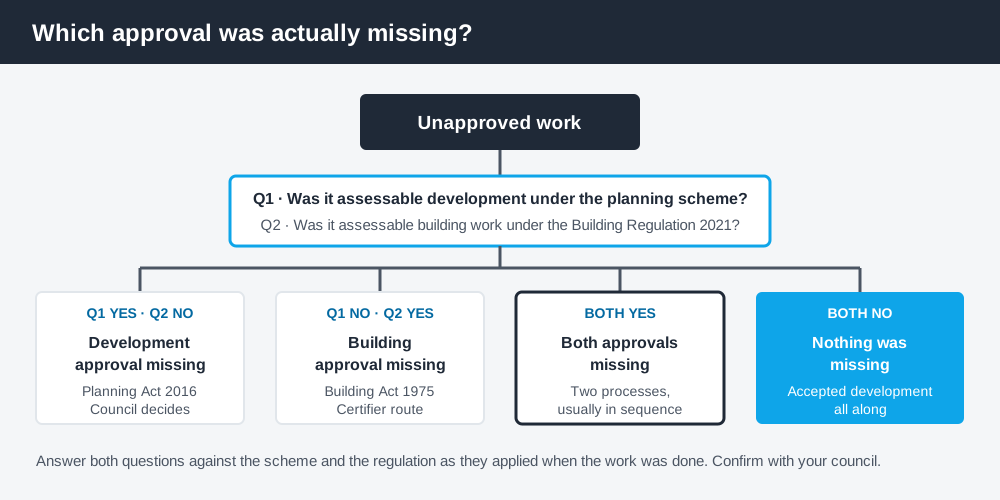
Figure 1: Three different problems wear the same clothes. Diagnose before you treat.
What your council can do
Spend 5 minutes, not 3 weeks
instantDA generates a council-ready planning report for Queensland development applications. No town planner. No waiting.
Get your report →If a council reasonably believes a development offence has been or is being committed, the Planning Act 2016 provides for a show cause notice under section 167, giving you a stated period to respond. If the matter is not resolved, the council may give an enforcement notice under section 168, which can require you to stop work, carry out work, demolish or remove, or restore the land as far as practicable. Contravening an enforcement notice is itself an offence.
The published maximum penalties are substantial — carrying out assessable development without permit carries a maximum of 4,500 penalty units under section 163 — but they are court-imposed ceilings, not standard fines. Fines for building without council approval in QLD sets out the numbers and what councils actually do with them.
The Building Act 1975 runs a parallel track for unlawful building work, with its own offence provisions and its own show cause and enforcement notice powers exercised by the local government.
Two things worth knowing. First, councils are generally reactive: most matters begin with a neighbour complaint or a search triggered by a sale rather than a patrol. Second, liability follows the land. A council can serve a notice on the current registered owner about work carried out by someone else years earlier.
Your three real options
Retrospective approval. Lodge a development application, and where relevant a building application, for work already completed. This is genuinely available in Queensland, but the assessment manager is under no obligation to approve what is in front of them, and the assessment is against current benchmarks rather than the ones in force when the work was done. Expect to produce measured drawings, engineering certification and a planning justification. Retrospective building approval in QLD covers what is achievable and what is not.
Certification of the existing work. Where the gap is on the building side, an engineer and a certifier may be able to inspect, test and certify completed work against the applicable standards. This often means opening up finished surfaces to prove footings, tie-downs and bracing, because a certifier cannot certify what they cannot see.
Removal. Demolish it. Sometimes this is genuinely the cheapest path, particularly for a modest structure that would fail current benchmarks, and it is the outcome an enforcement notice can compel if nothing else works.
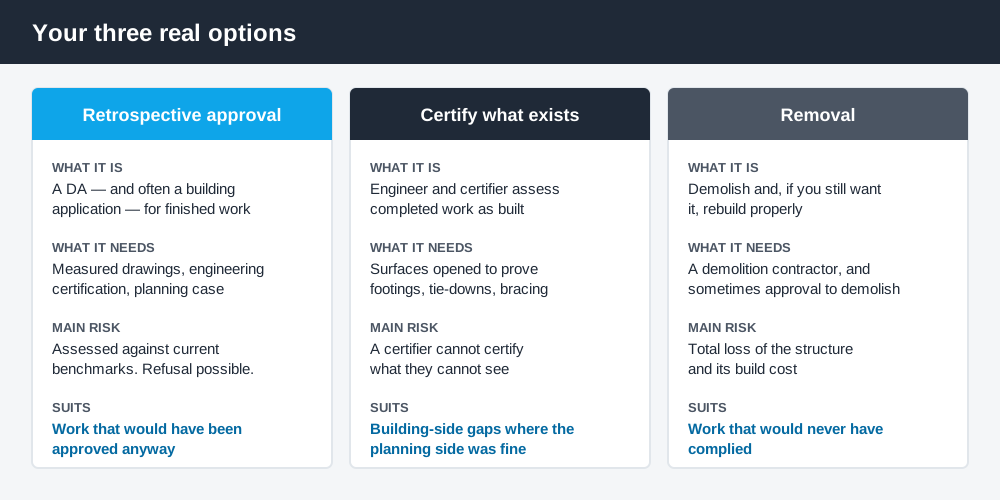
Figure 2: Which path suits depends on whether the work could have been approved in the first place.
When the problem surfaces
Almost nobody discovers unapproved work at a moment of their choosing.
At sale. The buyer's solicitor orders a council building records search, the approved plans do not show the enclosed carport, and the contract stalls. Queensland's seller disclosure scheme under the Property Law Act 2023 requires a seller to give a disclosure statement and prescribed certificates before the buyer signs, but it does not require disclosure of past building or development approvals, or a declaration of unapproved work. Buyers are expected to search. They do.
At an insurance claim. Cover for a structure that was never approved can be limited or refused, and where the unapproved structure is central to the loss the exposure is real. Building work over $3,300 generally requires a licensed contractor, and unlicensed work can sit outside the Queensland Home Warranty Scheme entirely.
At a complaint. A neighbour objects to overlooking, drainage or noise, rings the council, and an officer attends.
What it costs to fix
There is no useful single figure, because the variable is not the size of the structure but whether it could have been approved. Work that would have sailed through as code assessable is usually a documentation exercise. Work that breaches a setback, sits in a flood hazard overlay, or was never going to comply is a much harder conversation, and demolition may be the honest answer.
Add the indirect costs: the delay to a sale, the discount a buyer applies to a property with an open compliance issue, and the professional fees for drawings, engineering and planning advice. Those routinely exceed any penalty.
What to do now
Do not build anything further, and do not ring the council before you know the facts. Order the building records search, pull the development history from your council's development.i or equivalent portal, and check the zone and overlays on the scheme maps. Queensland Globe gives lot and plan details and state-mapped layers that help you understand what constraints apply.
If you'd rather read your zone, your overlays and what your scheme requires in one document than work through a scheme yourself, an instantDA planning report does that for your address for $169, against the $800–$1,500 a town planner typically charges for a preliminary opinion. You can start a report in a few minutes.
If a show cause notice has already arrived, treat the response as the most important document in the process and get planning advice before you send it. If you are buying rather than owning, buying a house with unapproved structures in QLD covers what to search for and how to protect yourself in the contract. And confirm everything with your council — schemes are not uniform across Queensland, and general guidance is no substitute for your own scheme, for your own address.
Frequently asked questions
Does unapproved building work in Queensland ever become legal with time?
Can the council make me demolish an unapproved structure?
Am I responsible for work the previous owner did without approval?
Will my insurance cover an unapproved structure?
Do I have to tell a buyer about unapproved work when I sell?
Should I contact the council first?
Ready to generate your report?
Skip the writing. Get a council-ready planning report in 5 minutes.
Get your report