Key takeaways
- ✓Liability follows the land. After settlement, the unapproved structure is your problem, not the seller's.
- ✓Queensland's seller disclosure statement does not require disclosure of past building approvals or unapproved work. You have to search.
- ✓A council building records search is the single most useful document you can order before going unconditional.
- ✓Compare the approved plans against what is physically on the block. Enclosed carports and under-house rooms are the usual finds.
- ✓If you find something, deal with it in the contract before settlement, not afterwards.
Buying a House With Unapproved Structures in QLD
You'll usually hear this called a development application, or DA — that's the formal name for council approval under the Planning Act 2016. When you buy a Queensland property with work that never had one, you are not buying a historical curiosity. You are buying an open compliance issue that becomes yours at settlement, and that a council can act on afterwards.
Get a council-ready planning report in 5 minutes — no planner, no waiting.
Get your report →The short answer
Responsibility for unlawful work passes to you at settlement. Queensland's seller disclosure statement does not require disclosure of past building approvals or unapproved work, so you must order a council building records search and compare the approved plans against what is actually on the block.
What seller disclosure actually covers
Queensland's mandatory seller disclosure scheme commenced on 1 August 2025 under the Property Law Act 2023. Before the buyer signs the contract, the seller must give a disclosure statement in the approved form — Form 2 — together with prescribed certificates.
That sounds like it should solve this problem. It does not.
The disclosure statement covers seller and property details, title and encumbrances including some unregistered ones, zoning, certain land use and environmental matters such as contaminated land registers, heritage listing and tree orders, whether there is a pool, and copies of certain notices required to be given under the Building Act 1975, the Planning Act 2016, the Queensland Building and Construction Commission Act 1991 and the Environmental Protection Act 1994.
What it expressly does not cover is set out plainly in Queensland Government guidance: it does not require disclosure of the structural soundness of the building, flooding history, or previous building or development approvals. There is no box on the form that says "this carport was never approved".
So if a live show cause or enforcement notice exists, and it is a notice that must be given under those Acts on a sale, you should see it. If the work was simply never approved and nobody ever complained, you will hear nothing at all. Queensland Government's seller disclosure scheme guidance is worth reading before you rely on the form.
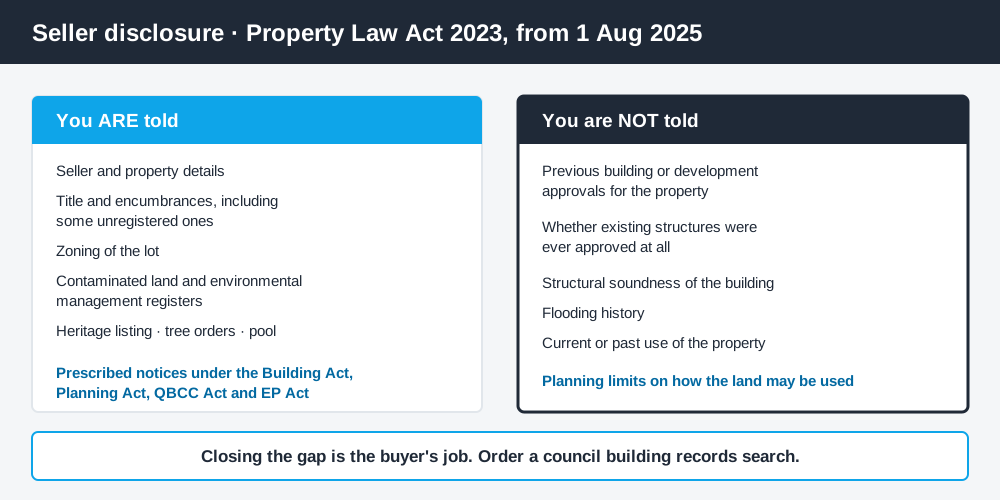
Figure 1: The gap between what you are told and what you need to know.
The searches that actually find it
Spend 5 minutes, not 3 weeks
instantDA generates a council-ready planning report for Queensland development applications. No town planner. No waiting.
Get your report →Your solicitor will order a standard search package. Make sure these are in it, and read them yourself.
Council building records search. Different councils call it a building records search, a building approvals search or a building information search. It lists the building approvals held for the property — approval numbers, descriptions of the work, approval and final inspection dates, and often any outstanding notices or requisitions. This is the document that matters most.
Building plans and documents search. Copies of the approved plans. Without these you cannot do the comparison that finds the problem.
Planning and development certificate. A standard, limited or full certificate covering planning approvals and conditions affecting the land.
Development application history. Your council's development.i or equivalent enquiry portal shows applications, decisions and conditions by address. Useful context, but these portals do not replace the council's official property searches for conveyancing, and they are not a complete record of building approvals.
QBCC licence search. If recent work has been done, check the contractor was appropriately licensed. Building work over $3,300 generally requires a licensed contractor, and unlicensed work can fall outside the Queensland Home Warranty Scheme.
- ✓Council building records search
- ✓Copies of approved plans
- ✓Planning and development certificate
- ✓Development application history on the council portal
- ✓QBCC licence check on any recent builder
- ✓Queensland Globe for lot, plan and mapped layers
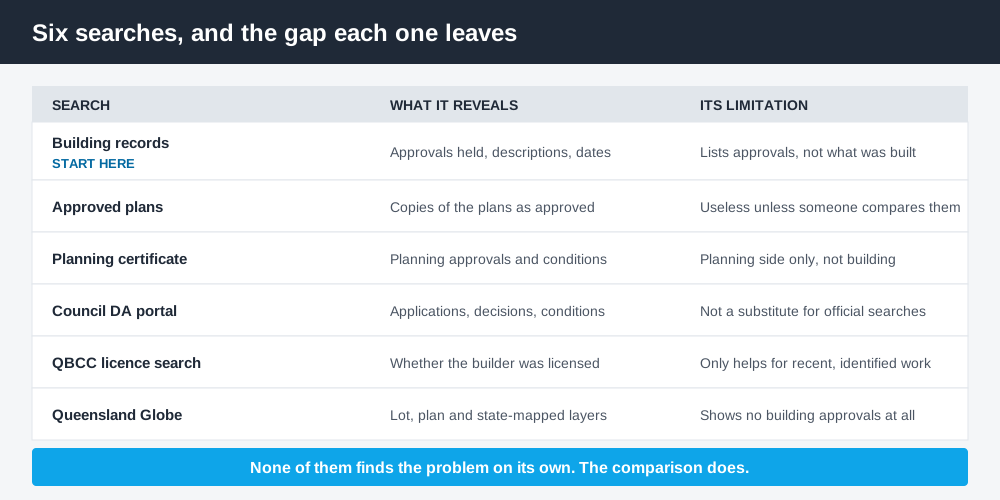
Figure 2: Order all six. Each covers a gap the others leave open.
Then do the comparison
The searches only work if someone lays the approved plans next to the property and looks. Nobody will do this for you unless you ask.
Walk the block with the plans in hand. The recurring finds in Queensland are an enclosed carport — approved as an open carport, later walled in, which changes its classification and often its setback compliance; rooms built in under a highset house, where the approved plan shows a laundry and storage and the reality is two bedrooms and a bathroom; a deck or patio that grew; a shed that exceeds the size or height thresholds; a retaining wall over 1 m or with a driveway surcharging it; and a secondary dwelling that never had a material change of use approval.
Also check the pool. Any fence or wall forming part of a regulated pool barrier must comply with the pool safety provisions of the Building Act 1975 and the barrier standard in the Queensland Development Code, and a pool safety certificate is a prescribed certificate under the disclosure scheme where applicable.
How the risk transfers
This is the part buyers underestimate. Council enforcement is directed at the land and the current registered owner. After settlement, a show cause notice or enforcement notice about work carried out by an owner three transfers ago arrives addressed to you.
Your practical exposure has four parts. Rectification — retrospective approval, certification, or demolition, none of which is cheap. Insurance — cover for an unapproved structure can be limited or refused, and unlicensed work may sit outside the Home Warranty Scheme. Finance — valuers and lenders generally assume structures are lawful, and outstanding building notices or significant unapproved additions can affect a valuation or attach conditions to a loan. Resale — the next buyer's solicitor orders the same search you should have.
Building without council approval in QLD explains the enforcement process in full, and retrospective building approval in QLD covers whether the work can realistically be made lawful.
What to do if you find something
Deal with it before settlement, in the contract, while you still have leverage.
The usual options are a special condition requiring the seller to obtain retrospective approval or certification at their cost before settlement; a price adjustment reflecting a properly quoted rectification cost; a retention held at settlement against the work being made compliant; or walking away while you are still conditional.
Before you negotiate, you need to know whether the work could be approved at all — which depends on the zone, the overlays and the benchmarks in your council's scheme. That answer changes the negotiation completely, because "this needs paperwork" and "this has to come down" are very different conversations.
If you'd rather read the zone, the overlays and what the scheme requires for a specific address in one document than work through a planning scheme yourself, an instantDA planning report does that for $169, against the $800–$1,500 a town planner typically charges for a preliminary opinion. You can start a report in a few minutes.
Use Queensland Globe for lot and plan details and state-mapped layers alongside your council's scheme maps. And get your own legal advice on the contract — this article is general information, and the wording of special conditions is exactly where a Queensland property lawyer earns their fee.
Frequently asked questions
Does the seller have to tell me about unapproved building work in Queensland?
What search finds unapproved structures?
Am I liable for unapproved work a previous owner did?
Can I still get finance on a house with unapproved structures?
What should I put in the contract if I find unapproved work?
Is an enclosed carport a problem?
Ready to generate your report?
Skip the writing. Get a council-ready planning report in 5 minutes.
Get your report