Key takeaways
- ✓Seller disclosure covers unsatisfied show cause and enforcement notices — not the absence of building approvals.
- ✓Current and historical building approvals are expressly outside the disclosure scheme, so searching remains the buyer's job.
- ✓Responsibility for unapproved work rests with the current owner, which after settlement means the buyer.
- ✓Order the council building and development searches, then walk the property comparing plans to reality.
- ✓Price the fix before going unconditional. Afterwards you're negotiating with yourself.
Unapproved Work and QLD Conveyancing
You'll usually hear this called a development application, or DA — that's the formal name for council approval under the Planning Act 2016. Unapproved building work is the most common serious problem in Queensland residential conveyancing, and the introduction of mandatory seller disclosure has made buyers more relaxed about it rather than less — because people assume disclosure covers it.
It largely doesn't. Understanding exactly where the line falls is worth real money.
Get a council-ready planning report in 5 minutes — no planner, no waiting.
Get your report →The short answer
Queensland's seller disclosure scheme requires disclosure of unsatisfied show cause and enforcement notices, but expressly does not cover current or historical building approvals or limits under planning laws. A seller need not volunteer that a deck or granny flat was never approved. Finding that out is the buyer's job.
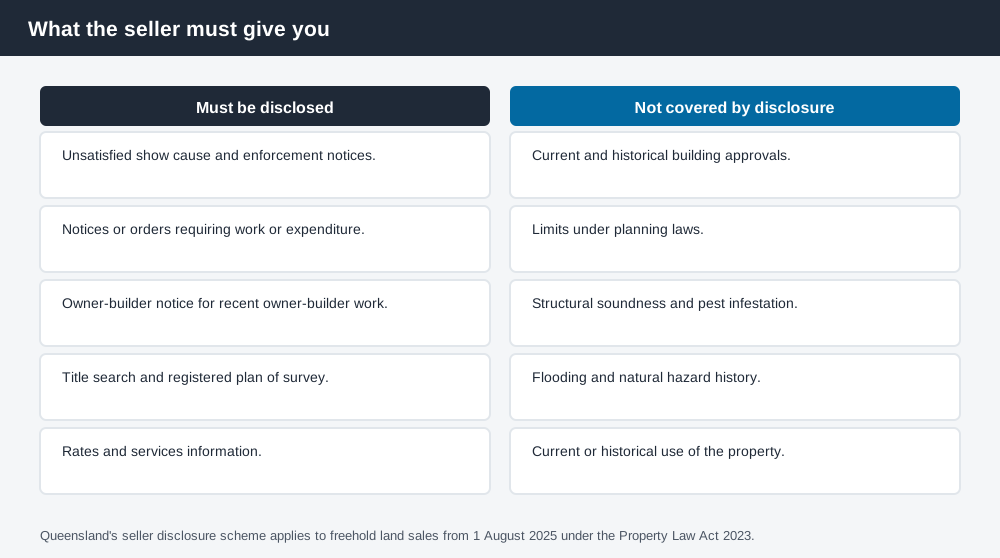
Figure 1: The right-hand column is where unapproved work usually sits.
What disclosure actually requires
From 1 August 2025, sellers of freehold land in Queensland must give the buyer a disclosure statement in the approved form plus prescribed certificates before the buyer signs, under the Property Law Act 2023.
The prescribed certificates include a title search and registered plan of survey, unsatisfied show cause and enforcement notices under the Building Act 1975 and the Planning Act 2016, any notice or order in effect requiring work to be done or money to be spent in relation to the lot, and an owner-builder notice where owner-builder work was carried out within the last six years.
Where the disclosure statement or certificates are incomplete or inaccurate about a material matter, the buyer may have a right to terminate before settlement.
What the scheme expressly does not include is telling: flooding and other natural hazard history, structural soundness, pest infestation, current or historical use of the property, current or historical building approvals, limits under planning laws, and services connected.
That distinction is the whole article. A property with an unapproved deck, an enclosed carport, an unapproved granny flat or a shed built without approval — where council has never issued a notice — generates no disclosure obligation at all.
What actually finds it
Spend 5 minutes, not 3 weeks
instantDA generates a council-ready planning report for Queensland development applications. No town planner. No waiting.
Get your report →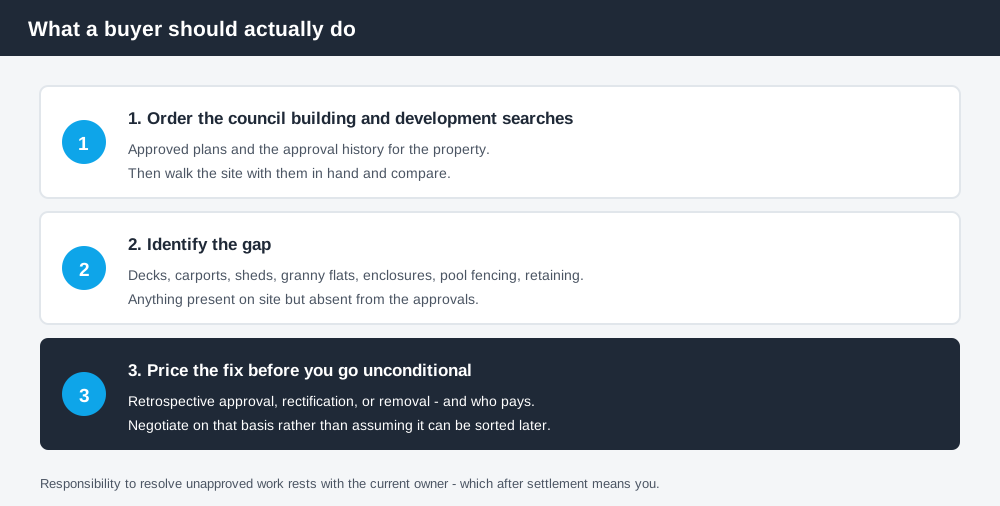
Figure 2: Search, compare, price. In that order and before going unconditional.
Council building and development searches are the tool. They produce the approved plans and approval history for the property. The method is then simple and slightly tedious: walk the property with the approved plans and compare what's drawn to what's there.
- ✓Decks, patios and pergolas
- ✓Carports, garages and enclosed carports
- ✓Sheds and outbuildings
- ✓Granny flats and secondary dwellings
- ✓Retaining walls above the exemption thresholds
- ✓Pool fencing and pool certification
- ✓Bathrooms and wet areas added in unusual places
- ✓Anything that has visibly been enclosed
Enclosed carports and later-added decks are the two that recur most. Both are cheap, both are common, and both change the building in ways that needed approval.
Where the risk lands
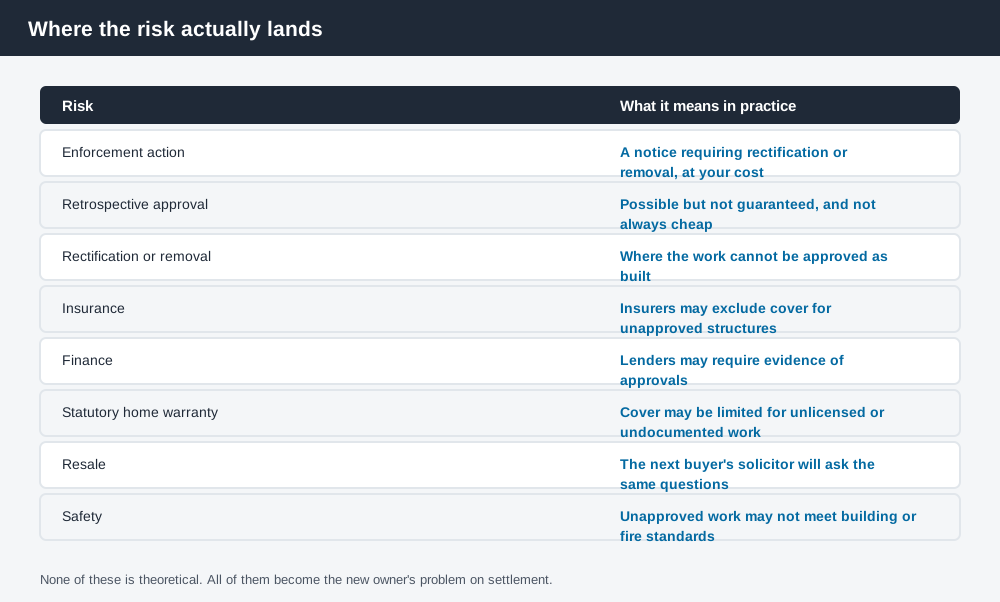
Figure 3: Eight risks. All of them transfer on settlement.
The core principle is that responsibility to resolve unapproved work rests with the current owner. Not the person who built it, not the person who sold it to them — the owner at the time council acts. After settlement, that's you.
Councils can issue show cause and enforcement notices requiring rectification, retrospective approval or removal at the owner's cost. Show cause and enforcement notices in QLD covers how that process runs.
Beyond enforcement, unapproved structures create insurance and finance friction: insurers may exclude cover, lenders may want evidence of approvals, and statutory home warranty cover can be limited where work was unlicensed or undocumented. And the problem recurs at resale, because the next buyer's solicitor will ask the same questions you should be asking now.
Two categories deserve extra attention because they combine a building problem with a use problem. An unapproved secondary dwelling is not just unapproved building work — it may also be an unlawful use, which is enforceable separately and may be harder to regularise than the structure itself. And pool fencing carries its own compliance regime with certification requirements attached to sale, which sits alongside the building approval question rather than inside it.
Fixing it, and who pays
Unapproved work is often resolvable through retrospective approval — an application for work already carried out. It is not guaranteed. Some work cannot be approved as built, either because it doesn't comply with the applicable standards or because it sits somewhere no approval would be granted. In those cases the outcome is rectification or removal. Retrospective building approval in QLD covers what's involved.
The commercial question is who pays, and the answer depends entirely on timing. Before going unconditional, unapproved work is a negotiating position: a price adjustment, a special condition requiring the seller to obtain approval, or a right to terminate. After settlement it is simply your cost.
Queensland's planning schemes follow the Queensland Planning Provisions structure, but each council layers its own codes and overlays on top. They are not uniform, and whether a structure could be approved retrospectively depends on the scheme, the zone, the overlays and the building standards applying to that work.
What to do next
Order the council building and development searches early — early enough that the results arrive while you still have contractual options. Walk the property with the approved plans. Where you find a gap, get a builder or certifier to indicate what retrospective approval or rectification would cost, and negotiate on that number.
You can check the zone and overlays affecting the property on your council's planning scheme mapping and on the Queensland Globe, which helps assess whether a structure could realistically be approved where it stands.
If you're buying a property specifically known to have unapproved structures, buying a house with unapproved structures in QLD goes further into the negotiation. If you're buying vacant land instead, buying land to build on in QLD sets out the pre-contract checklist.
If you'd rather see the zone, the overlays and the likely category of assessment for an address set out in one document than work through a planning scheme yourself, an instantDA planning report does that for $169 — against the $800–$1,500 a town planner typically charges for a preliminary opinion. You can start a report in a few minutes.
Then get legal advice on the contract. This article is general information, not legal advice, and the drafting of a special condition is exactly where a conveyancer earns their fee.
Frequently asked questions
Does a Queensland seller have to disclose unapproved building work?
How do I find out if a structure was approved in Queensland?
Who is responsible for unapproved work after settlement?
Can unapproved building work be approved retrospectively in Queensland?
Will unapproved work affect my finance or insurance?
What should I do if I find unapproved work before going unconditional?
Ready to generate your report?
Skip the writing. Get a council-ready planning report in 5 minutes.
Get your report