Key takeaways
- ✓A show cause notice is not a penalty. It is an invitation to respond before an enforcement notice is given.
- ✓An enforcement notice can require you to stop, to remedy the effect of the offence, and in some cases to demolish or remove works.
- ✓An enforcement notice must usually be preceded by a show cause notice, but the Act contains exceptions.
- ✓Appeals are generally to the Planning and Environment Court, with a Development Tribunal available for certain categories, and the period is generally 20 business days.
- ✓The response to the show cause notice is the most valuable document in the process. Do not send it without advice.
Show Cause and Enforcement Notices in QLD: What to Do
You'll usually hear this called a development application, or DA — that's the formal name for council approval under the Planning Act 2016. If a letter has arrived from your council about work carried out without one, it is almost certainly one of two documents, and they are very different things. Knowing which one you are holding determines what you should do this week.
Get a council-ready planning report in 5 minutes — no planner, no waiting.
Get your report →The short answer
A show cause notice tells you the council is considering giving an enforcement notice and invites your response within a stated period. An enforcement notice is the binding instrument: it can require you to stop, to remedy the offence, or to demolish. Appeals are generally within 20 business days.
The show cause notice
Under section 167 of the Planning Act 2016, an enforcement authority that reasonably believes a person has committed or is committing a development offence may give a show cause notice. It notifies you that the authority is considering giving an enforcement notice, and it must state the reasons for giving it.
The notice will specify a stated period within which you may respond. The Act does not prescribe a fixed minimum number of days for that period — it is set in the notice itself, so read the date carefully and diarise it the day it arrives.
This is the stage at which most matters are resolved, and the stage most owners waste. A show cause notice is not a fine and not an order. It is an opportunity to put facts, context and a proposal in front of a decision-maker who has not yet decided anything.
Useful responses do one of four things: demonstrate the work was actually accepted development and no offence occurred; propose retrospective approval with a realistic timeframe; propose rectification works; or seek an extension because the necessary certifier or engineering advice cannot be obtained inside the stated period.
- ✓Diarise the stated period the day the notice arrives
- ✓Order your council building records search
- ✓Get a certifier's view on whether the work can be certified
- ✓Get a planning view on whether it can be approved
- ✓Respond in writing, in time, with a concrete proposal
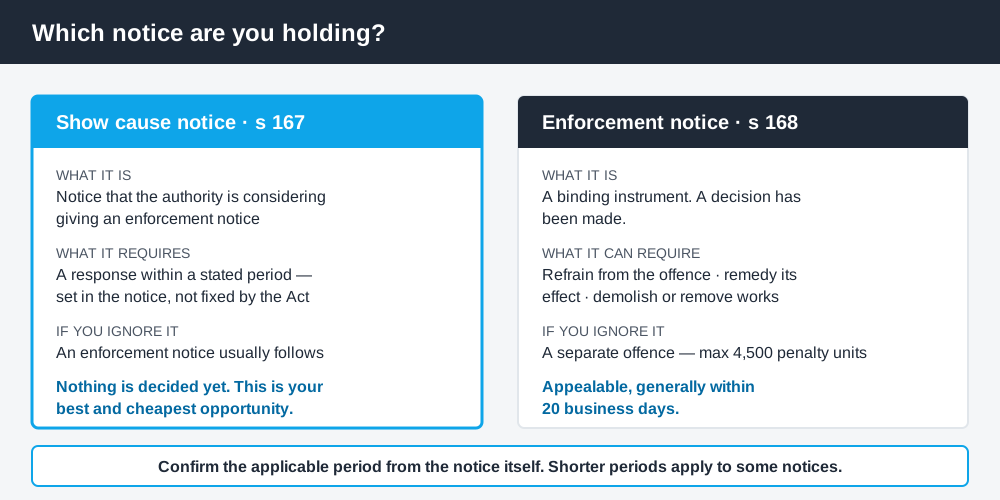
Figure 1: One asks. The other requires.
The enforcement notice
Spend 5 minutes, not 3 weeks
instantDA generates a council-ready planning report for Queensland development applications. No town planner. No waiting.
Get your report →An enforcement notice is given under section 168. It requires a person to do either or both of two things: to refrain from committing a development offence, and to remedy the effect of a development offence in a stated way.
The Act also allows the notice to require demolition or removal of all or part of works, where the enforcement authority reasonably believes it is not possible or practical to take steps to make the development accepted development, to make the works comply with a development approval, or — where the works are dangerous — to remove the danger. Demolition is not a first response. It is what remains when compliance cannot be achieved.
An enforcement notice can be given to the person who committed the offence, and where the offence involves premises and that person is not the owner, to the owner as well. That is how notices reach buyers about work carried out by previous owners.
Contravening an enforcement notice is itself an offence, with a maximum penalty of 4,500 penalty units under section 168. Fines for building without council approval in QLD explains how those maximums translate into dollars and what councils actually impose.
When the show cause stage can be skipped
The general rule is that an enforcement notice must be preceded by a show cause notice. The Act contains stated exceptions where it need not be, and the Building Act 1975 also modifies the position for private certifiers acting as enforcement authorities, who in certain circumstances need not give a show cause notice first.
The practical point for an owner is simple: if an enforcement notice has arrived without a preceding show cause notice, that is not automatically an error, but it is worth having a planning lawyer check whether the notice was validly given before you comply with it or appeal it.
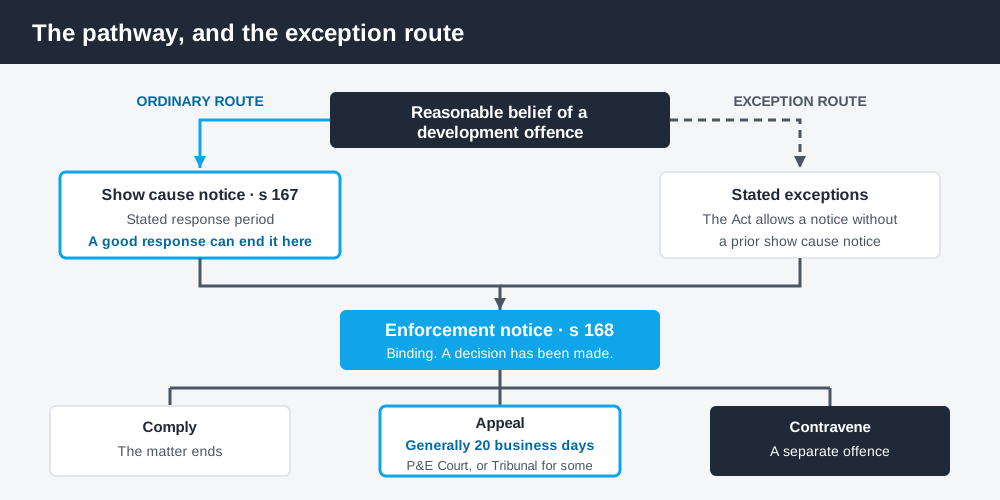
Figure 2: The ordinary pathway, and the exception route around the show cause stage.
Your appeal rights
A person given an enforcement notice may appeal the decision to give it. Under the Planning Act 2016, appeals about enforcement notices go to the Planning and Environment Court, and for certain categories prescribed by the Act, to a Development Tribunal instead. The Tribunal's jurisdiction is limited to those prescribed categories, so the forum is not a matter of preference.
The appeal period for this kind of appeal is generally 20 business days after the notice is given to you. A shorter period applies to some notices about dangerous buildings and to certain plumbing matters under other Acts, so check the notice itself and confirm the applicable period rather than assuming.
One feature of these appeals is worth knowing. In an appeal by the recipient of an enforcement notice, it is the enforcement authority that gave the notice which must establish that the appeal should be dismissed. That is a meaningfully better starting position than the applicant carries in an ordinary development application appeal, and it is a reason not to write off an appeal as hopeless before getting advice. Queensland Government publishes guidance on enforcement notice appeals to the tribunals.
What to do this week
Do not ignore it, and do not keep building. Continuing work after a notice arrives converts a resolvable compliance matter into an aggravating factor.
Establish the facts before you respond. Order the council building records search and the approved plans. Check the zone, the overlays and what the scheme actually required at the time the work was done. Some of what councils treat as unlawful turns out to have been accepted development, and demonstrating that ends the matter entirely.
Get the two professional views you need. A private building certifier on whether the work can be certified as built. A planner on whether the use or structure could be approved under the scheme. Together those two answers determine whether you are negotiating a timeframe or negotiating a demolition.
If you'd rather read the zone, the overlays and what your scheme requires for a specific address in one document than work through the scheme yourself, an instantDA planning report does that for $169, against the $800–$1,500 a town planner typically charges for a preliminary opinion. You can start a report in a few minutes.
Use Queensland Globe for lot and plan details and state-mapped layers alongside your council's scheme maps. For the wider picture on how these matters resolve, building without council approval in QLD covers your three real options. And get a planning lawyer involved before the response goes out — this is general information, not advice on your notice, and the wording of what you send matters more than anything else in the process.
Frequently asked questions
What is a show cause notice from a Queensland council?
How long do I have to respond to a show cause notice?
What can an enforcement notice make me do?
Can I appeal an enforcement notice in Queensland?
What happens if I ignore an enforcement notice?
Can a council skip the show cause notice?
Ready to generate your report?
Skip the writing. Get a council-ready planning report in 5 minutes.
Get your report