Key takeaways
- ✓Three separate protections can fail on unapproved work: home insurance, the Queensland Home Warranty Scheme, and your lender's view of the property.
- ✓Home Warranty cover attaches to the original contract. A later owner cannot buy it retrospectively.
- ✓Building work over $3,300 generally requires a QBCC-licensed contractor, and unlicensed work can fall outside the scheme entirely.
- ✓Insurer and lender positions are commercial policy rather than statute, so read your own policy wording rather than a general rule.
- ✓Regularising the work is what restores the protections. Disclosure alone does not.
Unapproved Building Work and Your Insurance in QLD
You'll usually hear this called a development application, or DA — that's the formal name for council approval under the Planning Act 2016. Most people worry about what the council will do about unapproved work. The more common financial harm arrives from a different direction entirely: the moment you need to claim, refinance, or sell, and discover that three separate protections quietly do not apply.
Get a council-ready planning report in 5 minutes — no planner, no waiting.
Get your report →The short answer
Unapproved work can sit outside three protections at once: your home insurance policy, the Queensland Home Warranty Scheme, and your lender's valuation. Home Warranty cover attaches to the original contract with a licensed contractor and cannot be obtained retrospectively. Regularising the work is what restores your position.
Home and contents insurance
Home insurance is a contract, and what it covers is a matter of the policy wording rather than planning law. But the risk with unapproved work is real enough that Queensland councils warn about it directly: unapproved building works on your property can mean your home owner insurance policy might not protect you if there is an incident.
Three mechanisms do the damage.
Exclusions for unlawful structures. Many policies exclude or limit cover for structures that were not lawfully constructed. The unapproved deck is not covered when the storm takes it.
Causation. Where the unapproved structure is central to a loss — a non-compliant retaining wall that fails, an unpermitted extension that catches fire because it was never fire-separated — an insurer can dispute the whole claim, not just the structure.
Non-disclosure. Insurance contracts carry a duty to disclose relevant matters. If you knew the extension was unapproved and did not say so, that is a separate problem from whether the structure was covered.
None of this means cover is automatically void. It means you cannot assume, and the time to find out is not after the event. Ring your insurer, describe the structure honestly, and ask them to confirm their position in writing.
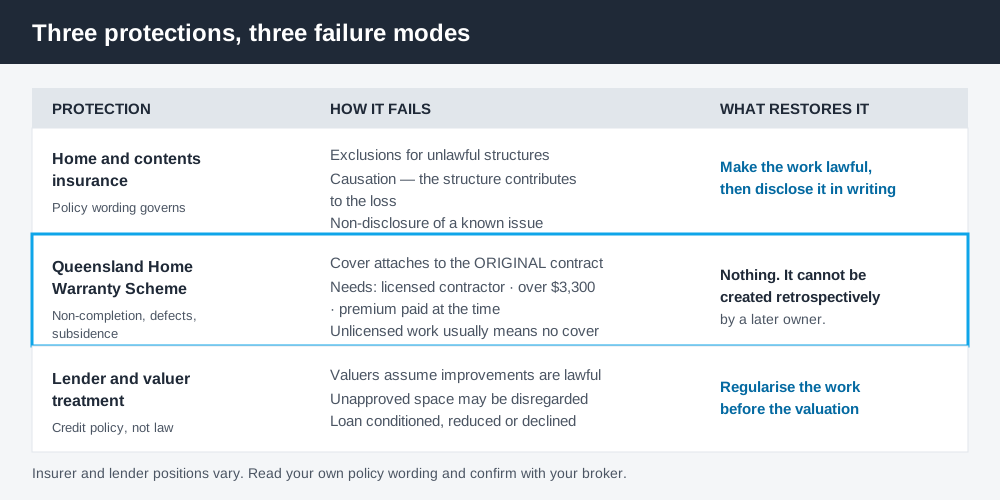
Figure 1: Three protections, three different failure modes, one fix.
The Queensland Home Warranty Scheme
Spend 5 minutes, not 3 weeks
instantDA generates a council-ready planning report for Queensland development applications. No town planner. No waiting.
Get your report →This is the one people misunderstand most, because they assume it is something they hold. It is not.
The scheme covers insurable residential construction work, protecting against non-completion, defective work and subsidence. It attaches to the original building contract, and several things must be true for it to exist at all: the work must be insurable residential construction work, the contract price must exceed $3,300, the work must have been carried out by an appropriately licensed contractor, and the head contractor must have collected and paid the premium.
The consequences follow logically. If your builder was unlicensed, there is likely no cover, because an unlicensed contractor does not pay the premium. If the work was unapproved and cannot lawfully be certified, the outcome may be demolition rather than rectification, and the QBCC's own procedures indicate that certain costs are not claimable without prior approval. And critically for buyers: a later owner cannot create cover retrospectively. You inherit whatever cover was correctly put in place at the time, and nothing more.
That is why the QBCC licensee search matters before you buy, and why asking a seller for the notice of cover on recent work is a reasonable request. The QBCC publishes guidance on checking the record of a licensee alongside its consumer material.
- ✓Was the work over $3,300
- ✓Was the contractor QBCC-licensed for that class of work
- ✓Was a notice of cover issued
- ✓Was the work approved and certified
- ✓Do you hold the paperwork for all four
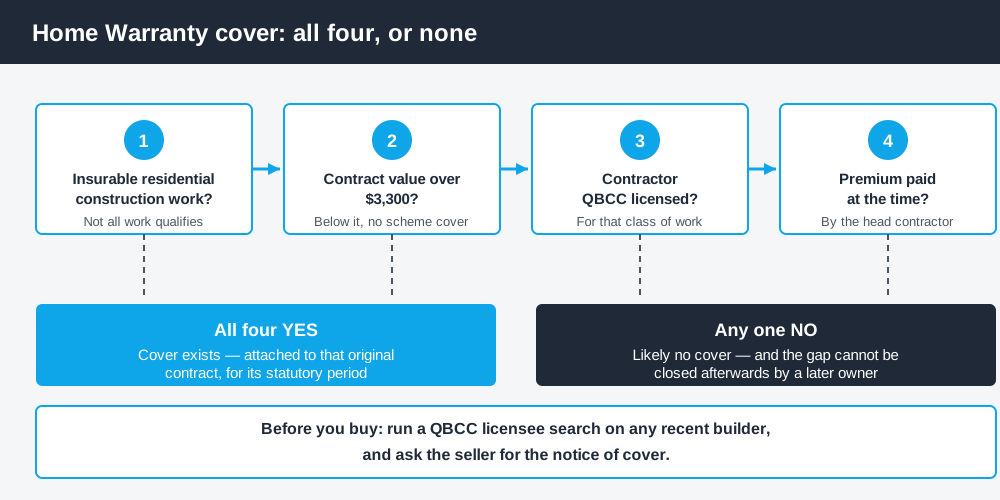
Figure 2: Four gates. Miss one and there is nothing to fall back on.
Lenders and valuers
This part is commercial practice rather than legislation, and it is worth being clear about that distinction because you will not find it written in an Act.
Valuers generally assume that improvements are lawful. When a council search or a physical inspection reveals significant unapproved habitable space or an outstanding building notice, the usual responses are to disregard the unapproved improvement in the valuation, to note the issue as a condition, or to value the property as though rectification is required. Lenders then respond to the valuation: conditions on the loan, a reduced amount, or in some cases a declined application.
The practical effect on a sale is often larger than the effect on the seller. A buyer whose finance is conditioned on rectification cannot settle on time, and a chain of dependent transactions unravels. If you are selling, that risk is worth understanding before your property is on the market rather than after a contract has been signed.
What restores your position
Only one thing genuinely does: making the work lawful.
Retrospective approval through a development application, and where relevant a building application, for the work already done. Certification where the gap is on the building side and an engineer and certifier can inspect and certify what exists — usually requiring surfaces to be opened up, because a certifier cannot certify what they cannot see. Removal, which restores the position by eliminating the structure.
Disclosure helps with the insurance duty and with the misrepresentation risk on a sale. It does not make an excluded structure covered, and it does not create Home Warranty cover that was never purchased. Retrospective building approval in QLD sets out what the first route involves, and private certifier vs council in QLD explains who you should be dealing with for the building side.
Before you commit to any of them, find out whether the work could be approved at all — which depends on the zone, the overlays and the benchmarks in your council's scheme. If you'd rather read that for your address in one document than work through a planning scheme yourself, an instantDA planning report does it for $169, against the $800–$1,500 a town planner typically charges for a preliminary opinion. You can start a report in a few minutes.
Use your council's scheme maps and Queensland Globe for the mapping. Then speak to your insurer, your broker and a private building certifier — in that order, and before you need any of them urgently. This article is general information, and your policy wording and your lender's credit policy are the documents that actually decide your position.
Frequently asked questions
Will home insurance cover an unapproved structure in Queensland?
What is the Queensland Home Warranty Scheme?
Can I get Home Warranty cover for work that is already done?
Does unlicensed building work affect my insurance?
Will a bank lend on a house with unapproved building work?
Does telling my insurer fix the problem?
Ready to generate your report?
Skip the writing. Get a council-ready planning report in 5 minutes.
Get your report