Key takeaways
- ✓Both private and council certifiers must hold a QBCC building certifier licence. The legal function is identical.
- ✓Licence level determines what a certifier can work on, so check the level matches your building class.
- ✓Where no private certifier is engaged and the application is properly made, the council must receive, assess and decide it.
- ✓The council stays involved either way — siting referrals, lodgement and archiving of the final certificate.
- ✓Choose on availability, class coverage and inspection responsiveness, not on who will approve the most.
Private Certifier vs Council in QLD: Which Should You Use?
You'll usually hear this called a development application, or DA — that's the formal name for council approval under the Planning Act 2016. Building approval is the other system, and it comes from a building certifier rather than the council's planning team. You can engage a private certifier directly, or use the council. Both are performing the same statutory function, and the choice is more practical than legal.
Get a council-ready planning report in 5 minutes — no planner, no waiting.
Get your report →The short answer
Both must hold a QBCC building certifier licence and both perform the same statutory function as assessment manager for building work. Private certifiers are engaged directly and are usually faster. Where no private certifier is engaged and the application is properly made, the council must receive, assess and decide it.
What a building certifier actually does
Not an inspector you hire for comfort. A certifier is the assessment manager for building work, exercising a statutory function.
They assess your plans against the building assessment provisions — the National Construction Code, the Queensland Development Code and the requirements that flow from them — and issue the building development approval, which sets the conditions and the mandatory inspection stages. They then carry out those inspections and issue certificates at each stage. At completion they issue the final document: a final inspection certificate for a single detached class 1a house and class 10 structures, or a certificate of occupancy for other classes, which replaced the certificate of classification on 1 October 2020.
Everything then gets lodged with the council, which archives it. That is why privately certified work still shows up on a council building records search — and why a missing record is a genuine warning sign when you are buying.
Licence levels matter
Spend 5 minutes, not 3 weeks
instantDA generates a council-ready planning report for Queensland development applications. No town planner. No waiting.
Get your report →All Queensland building certifiers are licensed by the QBCC, and the licence level determines what they can work on.
A level 1 certifier may undertake inspections for all classes of buildings and structures. A level 2 certifier may undertake inspections for class 1 and class 10 buildings and structures. A level 3 certifier is restricted to class 1 buildings and class 10 buildings and structures.
Practically: for a house, a shed, a carport or a deck, a level 2 or level 3 certifier is commonly appropriate. For a commercial fitout, a unit development or anything outside class 1 and class 10, you need someone whose licence reaches your building class. Check it on the QBCC licensee search before you engage, and check their disciplinary history while you are there.
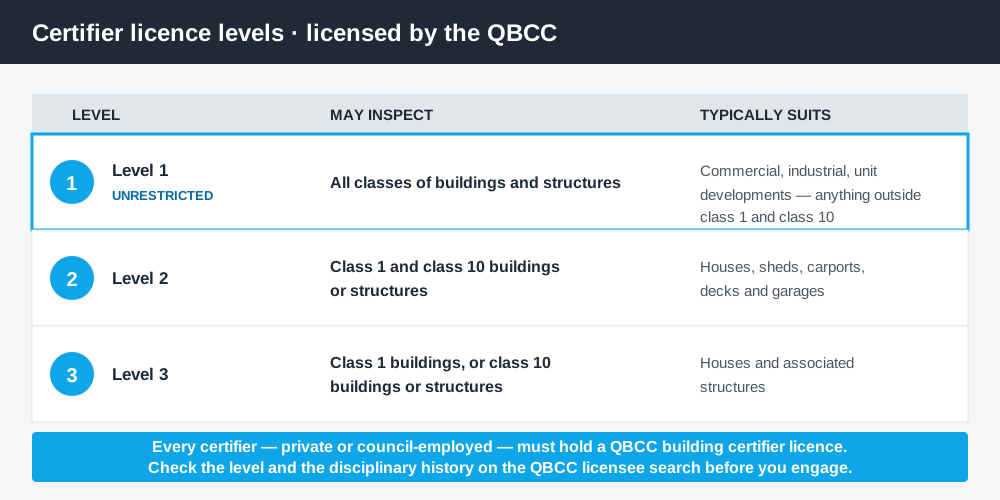
Figure 1: Match the licence level to your building class before you engage anyone.
Private certifier or council: the real differences
The legal function is identical. The differences are practical.
Availability and speed. This is the main one. A private certifier is a business competing for your work and can usually start quickly. Councils vary enormously — some offer a full certification service, others focus on their referral and records role and effectively direct residential work to the private market.
Continuity. With a private certifier you deal with a named individual through assessment and every inspection. Council services are more likely to rotate officers.
Cost. Both charge. Private fees are commercial and vary with the class and complexity of the work; council fees are published in the annual fees and charges schedule. Neither is reliably cheaper.
The council's obligation. Worth knowing as a backstop: where a private certifier has not been engaged and a building development application is properly made, the council must receive, assess and decide it, and must appoint or employ a building certifier to perform the certifying functions. You cannot be left with nobody able to certify your work.
Independence. A private certifier is engaged and paid by the owner or builder, which some owners worry about. The counterweight is that certifiers are licensed by the QBCC, subject to disciplinary oversight, and carry personal responsibility for what they certify — they refuse work that cannot be certified, and they cannot certify what they cannot see.
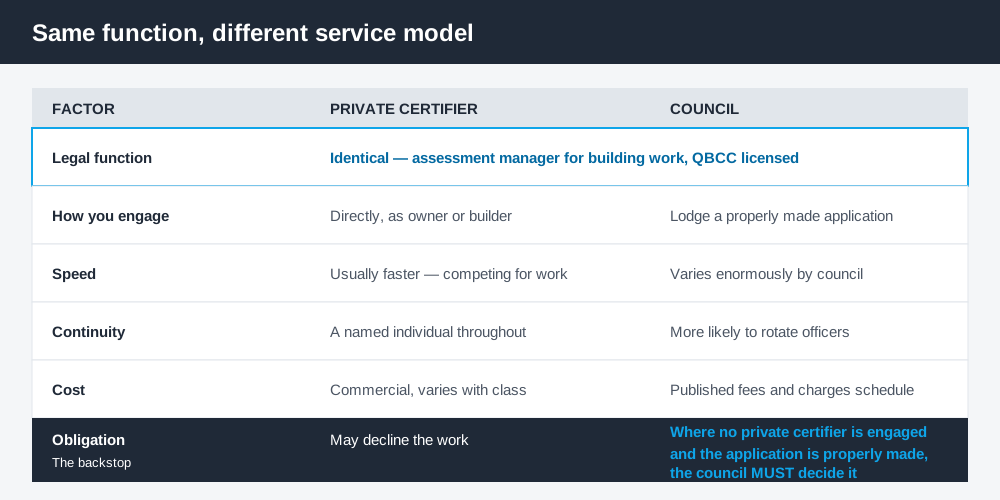
Figure 2: Same function, different service model.
What the council does either way
Choosing a private certifier does not remove the council from your project.
Siting referrals. Where your design does not meet the standard siting provisions of the Queensland Development Code — boundary setbacks, height, site cover — the certifier refers those aspects to the council, which acts as a referral agency and decides them against the QDC provisions governing siting for houses, MP1.1 and MP1.2, together with any local amenity and aesthetics criteria. That is a separate assessment with its own fee and its own timeframe, and it is a common source of unexpected delay on a tight block.
Planning approvals. The council remains the assessment manager for planning matters. Where your work also needs a development permit, the certifier cannot issue building approval ahead of it. Building approval vs development approval in QLD sets out the ordering and why it matters.
Lodgement and archiving. The application documents, notice of engagement, decision notice and final certificate all go to the council.
- ✓Confirm the licence level covers your building class
- ✓Check the QBCC licensee search and disciplinary history
- ✓Ask about availability for inspections, not just for the approval
- ✓Ask whether a siting referral is likely, and who manages it
- ✓Confirm the final certificate will be lodged with council
How to choose
Match the class first. Everything else is irrelevant if the licence does not cover your work.
Ask about inspection availability, not approval turnaround. Approval is a one-off. Inspections happen repeatedly, on your builder's schedule, and a certifier who cannot attend within a couple of days will cost you far more in trade downtime than any difference in fee.
Ask whether a siting referral is likely. If your design pushes a setback, ask up front whether they expect a referral to council, roughly how long that takes locally, and who prepares the supporting material.
Do not shop for a permissive certifier. A certifier who waves things through is a liability, not an asset. Their certificate is what a future buyer's solicitor relies on, and work that should not have been certified surfaces eventually. If you are already dealing with work that was never certified, retrospective building approval in QLD explains how hard that is to fix.
Before you engage anyone, settle the planning question — because it determines whether a certifier can act at all. Use your council's planning scheme maps for the zone and overlays, Queensland Globe for lot, plan and state-mapped layers, and Queensland Government's guidance on building certifiers.
If you'd rather read your zone, your overlays and your likely category of assessment in one document than work through a scheme yourself, an instantDA planning report does that for your address for $169, against the $800–$1,500 a town planner typically charges for a preliminary opinion. It answers the planning side, so your certifier can get on with theirs. You can start a report in a few minutes.
Frequently asked questions
Is a private certifier better than the council in Queensland?
What are the building certifier licence levels in Queensland?
Can the council refuse to certify my building work?
Does the council still get involved if I use a private certifier?
How do I check a building certifier's licence?
What should I ask a certifier before engaging them?
Ready to generate your report?
Skip the writing. Get a council-ready planning report in 5 minutes.
Get your report