Key takeaways
- ✓A certifier's fee is a market price, not a council charge, so quotes genuinely differ.
- ✓Building certifiers must be licensed with the QBCC, which makes this the one clearly regulated role in the process.
- ✓The fee is driven by complexity and inspection count, not by the value of the building.
- ✓Ask what is included: council lodgement, number of inspections, re-inspections, and any siting variation.
- ✓Building approval is separate from development approval, and a certifier only deals with the first.
What Does a Building Certifier Cost in QLD?
A building certifier is the person who assesses your building work, inspects it, and issues the approval and the final certificate. For most Queensland residential projects they are the only approval professional involved — and the only one whose role is genuinely licensed.
Their fee is a market price rather than a council charge, which is why quotes vary and why it is worth getting more than one.
Get a council-ready planning report in 5 minutes — no planner, no waiting.
Get your report →The short answer
A building certifier's fee is set by the certifier, not the council, and varies with the complexity of the work, the number of inspections and the region. Industry sources put residential certification in a broad range from several hundred dollars for small structures to several thousand for a house. Council lodgement fees sit on top.
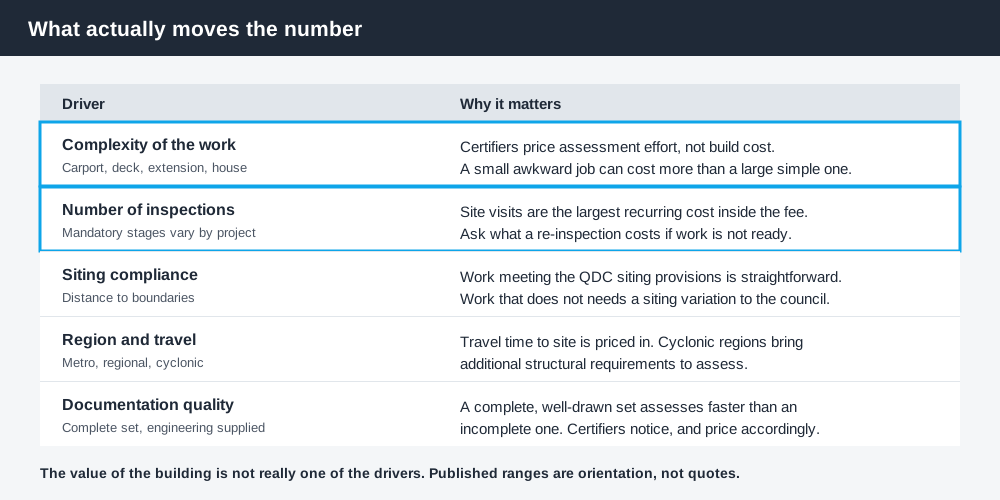
Figure 1: What actually moves the number.
What drives the fee
Five things, and the value of the building is not really one of them.
The complexity of the work. A carport is not a house. A single-storey extension on flat ground is not a raised deck on a slope. Certifiers price the assessment effort, not the build cost.
The number of inspections. Mandatory inspection stages differ by project type. More stages means more site visits, and site visits are the largest recurring cost inside a certifier's fee.
Proximity to boundaries and siting compliance. Work that meets the Queensland Development Code siting provisions is straightforward. Work that does not needs a siting variation to the council, which adds both a council fee and the certifier's time in preparing it.
Region and travel. A certifier travelling an hour each way to a rural site prices that in. Cyclonic regions bring additional structural requirements.
Engineering and documentation quality. A complete, well-drawn set with engineering already supplied assesses faster than an incomplete one. Certifiers notice, and price accordingly.
What the published ranges say
Spend 5 minutes, not 3 weeks
instantDA generates a council-ready planning report for Queensland development applications. No town planner. No waiting.
Get your report →Queensland certifiers and industry sources publish indicative ranges rather than fixed prices, because the fee is genuinely project-specific.
Broadly, the published material puts small structures — carports, patios, small sheds — at the low end, in the hundreds to low thousands, and residential projects generally across a wide band from roughly one thousand to several thousand dollars, with larger and more complex work higher again. Some certifiers publish narrower bands for defined project types.
Treat all of these as orientation, not as a quote. They are industry-published estimates, not regulated fees, and they vary by region and by year.
It is also worth understanding why the ranges are so wide. A certifier quoting a fee is pricing an unknown: how complete the documentation will be, how many times they will have to return to site because work was not ready, and whether the project will change halfway through. Certifiers who have been burned on those variables price defensively. Certifiers who trust the builder and the designer often do not. That is why the same job can come back with materially different numbers from two equally competent people, and why the cheapest quote is not automatically the one to take — a certifier who has priced tightly may be less accommodating when something needs a second look.
- ✓Get two or three quotes for the same scope
- ✓Ask each what is included and excluded
- ✓Ask how many inspections are covered
- ✓Ask what a re-inspection costs if work is not ready
What a quote should include
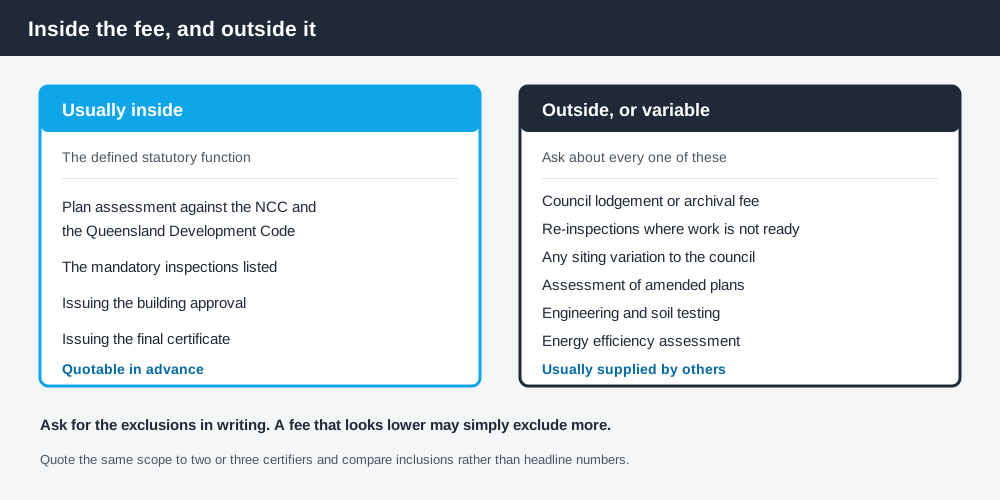
Figure 2: Inside the fee, and outside it.
The most common reason two certifier quotes are hard to compare is that one bundles the council charges and the other does not.
- ✓Council lodgement or archival fee — sometimes inside the quote, sometimes billed separately
- ✓Number of mandatory inspections included
- ✓Re-inspection charges where work is not ready or fails
- ✓Any siting variation application to council
- ✓Assessment of amended plans if the design changes
- ✓Engineering, soil testing and energy assessment — usually outside, supplied by others
Ask for the exclusions in writing. A fee that looks lower because the lodgement fee and two re-inspections are outside it is not lower.
Why the licensing matters here
This is the part worth understanding, because it distinguishes certifiers from almost everyone else you will engage.
All building certifiers must be licensed with the Queensland Building and Construction Commission (QBCC). Building certification sits under the Building Act 1975, whose chapter 6 regulates private certifiers and other building certifiers and the performance of building and private certifying functions, provides for their licensing, and provides for complaints, investigations and disciplinary proceedings against them.
Practically, that gives you three things you do not get elsewhere in this process:
- ✓A licence you can verify before engaging
- ✓A code of conduct the certifier is bound by
- ✓A complaints and disciplinary pathway if something goes wrong
Compare that with "town planner", which is not a protected or registered title in Queensland at all. If you are wondering why certifier quotes feel more standardised than planning quotes, part of the answer is that certifiers are performing a defined statutory function with defined obligations. Private certifier versus council in QLD sets out the two certification routes and what each involves.
Where the certifier's role stops
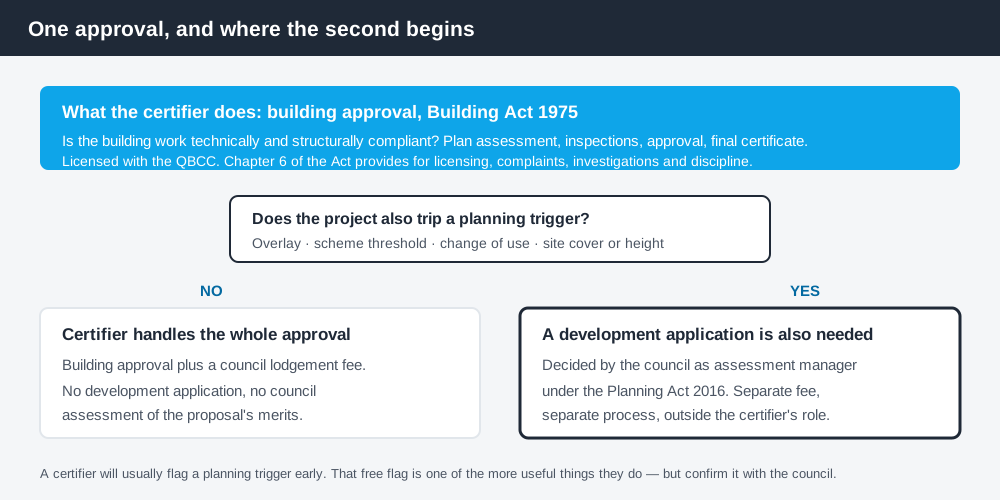
Figure 3: One approval, and where the second begins.
A certifier deals with building approval under the Building Act 1975 — whether the building work is technically and structurally compliant. They do not deal with development approval under the Planning Act 2016, which is the council's decision as assessment manager about whether the use and form of development suit the land.
Plenty of projects need only the first. Where the second is also needed, the certifier will usually tell you early, and that free flag is one of the more useful things a certifier does.
- ✓An overlay covers the work's position
- ✓The proposal exceeds a threshold in the planning scheme
- ✓The use of the land changes
- ✓Site cover or height goes beyond what the zone allows
Where any of those apply, you have a separate application with its own fee. What shed approval costs in QLD and what extension approval costs in QLD work through how the two approvals stack up for those specific projects.
Queensland's planning schemes follow the Queensland Planning Provisions structure, but each council layers its own overlays and thresholds on top. They are not uniform, so a certifier's read on whether a planning trigger applies should still be confirmed with the council.
What to do next
Establish the scope precisely before asking for quotes — what is being built, how far from the boundary, how many storeys, whether engineering is already supplied. A certifier quoting against a vague description will either pad the fee or revise it later.
Then get two or three quotes on identical scope and compare inclusions rather than headline numbers.
If you'd rather see your zone, your overlays and your likely category of assessment set out in one document than work through a planning scheme yourself, an instantDA planning report does that for your address for $169 — against the $800–$1,500 a town planner typically charges for a preliminary opinion. You can start a report in a few minutes.
Finally, verify the licence before engaging. It takes a minute and it is the one credential in this process that is genuinely checkable.
Frequently asked questions
How much does a building certifier cost in Queensland?
Is a certifier's fee set by the council?
Are building certifiers licensed in Queensland?
What should a certifier's quote include?
Does a certifier deal with council planning approval?
Why do certifier quotes differ so much?
Ready to generate your report?
Skip the writing. Get a council-ready planning report in 5 minutes.
Get your report