Key takeaways
- ✓A very small shed can be exempt from building approval, so the first question is whether you need to pay anything at all.
- ✓The private certifier's fee is a market price, not a council fee, and it is worth getting more than one quote.
- ✓Council charges are usually modest: a lodgement or archival fee, plus any siting variation.
- ✓Siting is the most common reason a simple shed becomes an expensive one, through a variation application.
- ✓A development application on top is unusual for a domestic shed but normal where an overlay or a change of use is involved.
What Does Shed Approval Cost in QLD?
You'll usually hear council approval called a development application, or DA — that's the formal name for it under the Planning Act 2016. For a domestic shed, though, a DA is usually not what you are buying. What you are usually buying is building approval, assessed by a private building certifier under the Building Act 1975, plus a small number of council charges around it.
Get a council-ready planning report in 5 minutes — no planner, no waiting.
Get your report →The short answer
Most of the cost is the private certifier's fee, which is a market price rather than a council charge. Council usually adds a modest lodgement or archival fee. Soil testing and engineering are separate. A siting variation or a development application, where required, are the two things that push the total up materially.
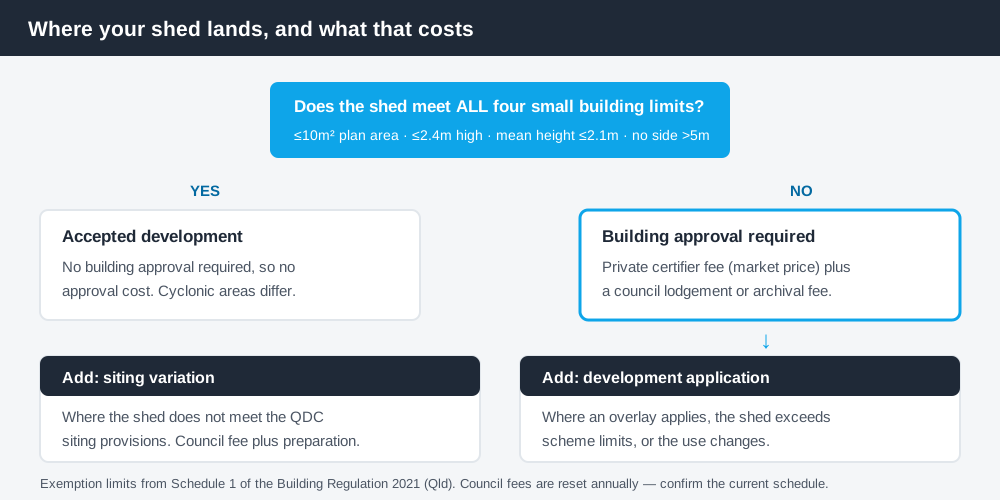
Figure 1: Where your shed lands, and what that costs you.
First, check whether you need approval at all
The cheapest approval is the one you do not need. Schedule 1 of the Building Regulation 2021 declares certain small buildings and structures to be accepted development, meaning no building approval is required. A class 10a shed sits inside that exemption only if it satisfies all four limits.
- ✓Plan area no more than 10m²
- ✓Height no more than 2.4m
- ✓Mean height no more than 2.1m
- ✓No side longer than 5m
All four, not any one. A 10m² shed that is 2.7m tall is outside it, and so is a long narrow structure with a 6m side. Different rules apply in designated cyclonic areas, so confirm the position for your region.
For anything larger — which is most sheds people actually want — you need building approval, and the costs below apply. The biggest shed you can build without council approval in QLD works through the exemption in detail.
Component one — the private certifier
Spend 5 minutes, not 3 weeks
instantDA generates a council-ready planning report for Queensland development applications. No town planner. No waiting.
Get your report →This is the largest line item and the one most people do not shop around on.
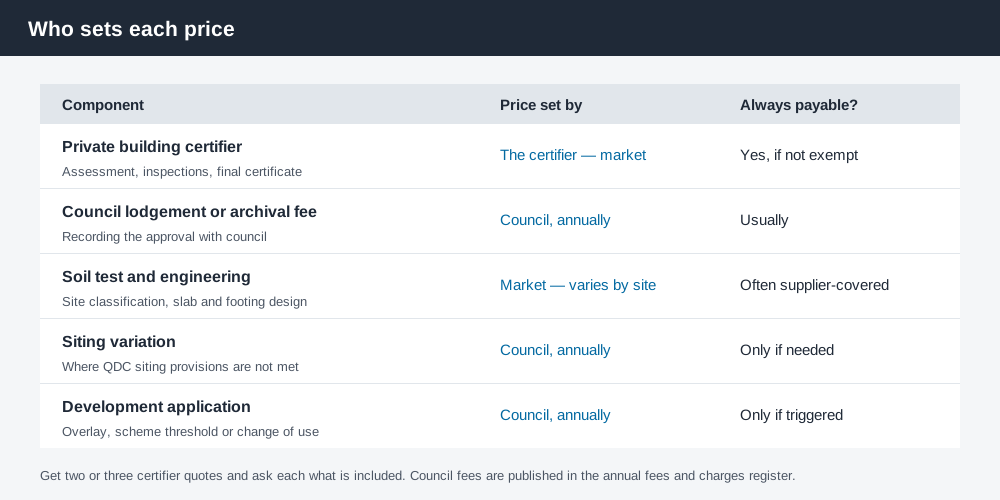
Figure 2: The components, and who sets each price.
A private building certifier assesses the plans, carries out the required inspections, and issues the approval and the final certificate. The fee is set by the certifier, not by your council — it is a professional service in a competitive market. Queensland certifiers publish indicative ranges that vary widely with the size and complexity of the structure, whether the site is in a cyclonic region, how many inspections are needed, and whether the shed is close to a boundary.
Practical consequences of that: get two or three quotes, and ask each one what is and is not included. Some quote a fee that includes lodging documents with council and some quote it separately, which makes an apples-to-apples comparison harder than it looks.
- ✓Ask whether council lodgement or archival fees are included
- ✓Ask how many inspections are in the fee
- ✓Ask what a siting variation would add
- ✓Ask whether engineering is expected from you or from the shed supplier
If you want a fuller picture of what certifiers charge across project types, what a building certifier costs in QLD covers it.
Component two — council charges
Even with private certification, the council has a role, and it charges for it. The two you will encounter most often are a lodgement or archival fee for the building approval documents, and, where relevant, a siting variation fee.
These are published annually in each council's fees and charges register and they differ considerably between councils. Some councils charge no building application fee directly to the applicant at all, recovering everything through the certifier. Others itemise lodgement, assessment and inspections separately. Because these are reset each financial year, the only reliable figure is the one on your own council's current schedule — treat any number you find in an article, including a comparison written for another council, as indicative only.
Component three — siting, and the variation that follows
This is where sheds get expensive, and it is entirely avoidable at the design stage.
Siting standards for a house and its associated class 10 buildings — sheds, garages, carports — sit in the Queensland Development Code. Two parts do the work, split by lot size:
- ✓MP1.1 — design and siting standard for single detached housing on lots less than 450m²
- ✓MP1.2 — design and siting standard for single detached housing on lots 450m² and over
The Queensland Government's background page on the Queensland Development Code confirms that these parts contain the siting standards for single detached dwellings and associated class 10 buildings and structures. You can read MP1.1 itself directly.
If your shed meets the acceptable siting provisions — setbacks from boundaries, height, site cover, length along a boundary — the certifier can approve it without involving council on that point. If it does not, you need a siting variation (some councils call it a siting relaxation), which is a separate application to council with its own fee and its own assessment. Councils publish these fees; they are typically in the order of several hundred dollars, plus whatever your certifier or a planner charges to prepare the submission.
Moving the shed a metre is usually cheaper than applying to leave it where it is. Where boundaries are tight, boundary setbacks in QLD sets out what the standards actually require before you commit to a position on the plan.
Component four — engineering and soil testing
These are technical costs, not council fees, and they do not vary by council. They vary by site.
- ✓Soil test and site classification
- ✓Slab and footing design
- ✓Structural certification of the shed frame, where not supplied by the manufacturer
Many shed suppliers provide engineering for standard soil classifications, which removes a cost. A reactive, sloping, filled or flood-affected site usually will not fit a standard design, and custom engineering follows. Queensland soil testing firms publish indicative pricing that varies with region, access and whether footing design is included; get a quote against your actual site rather than assuming.
Component five — a development application, where one is needed
For an ordinary domestic shed on a suburban block, a development application is usually not required. It becomes required in a handful of situations.
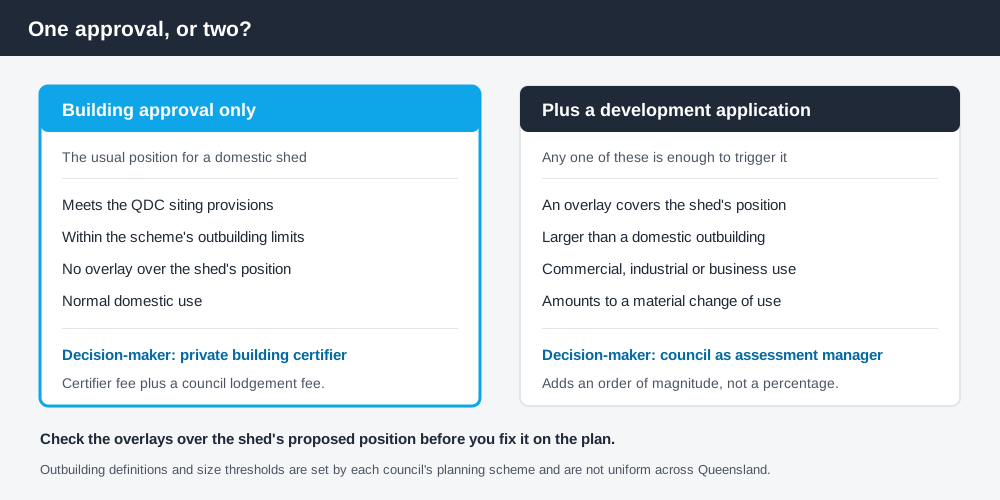
Figure 3: Building approval only, or building approval plus a development application.
- ✓An overlay applies — flood, bushfire, character, heritage, vegetation or similar
- ✓The shed is large enough that the planning scheme treats it as more than a domestic outbuilding
- ✓The shed supports a use the scheme does not allow as of right — a workshop, a business, storage for a commercial operation
- ✓The proposal amounts to a material change of use
Council development application fees are set by each council and vary with the type of development, the floor area and the level of assessment. Brisbane, for instance, publishes its development application fees and calculates many of them using a points system. Where a state referral is involved, referral fees apply on top. As a rule of thumb, a development application on a shed adds an order of magnitude, not a percentage.
Queensland's planning schemes follow the Queensland Planning Provisions structure, but each council layers its own outbuilding definitions, size thresholds and overlay codes on top. They are not uniform. Confirm with your council before assuming a shed of a given size is exempt from planning assessment.
What to do next
Work in this order: check the exemption, then check the siting against the relevant Queensland Development Code part, then check whether any overlay covers the shed's proposed position. Only then get certifier quotes. Most shed budgets that blow out do so because the position on the plan was fixed before anyone checked the setbacks.
If you'd rather see your zone, your overlays and your likely category of assessment set out in one document than work through a planning scheme yourself, an instantDA planning report does that for your address for $169 — against the $800–$1,500 a town planner typically charges for a preliminary opinion. You can start a report in a few minutes.
If you have not yet established whether your shed needs approval at all, do you need council approval for a shed in QLD is the place to start, and it will tell you which of the costs above are even relevant to you.
Then confirm the current fees with your own council. They are reset every financial year.
Frequently asked questions
How much does shed approval cost in Queensland?
Do I need council approval for a shed in QLD?
What is a siting variation and what does it cost?
Which Queensland Development Code part covers shed setbacks?
Do I need a development application for a shed in Queensland?
Does the certifier's fee include council fees?
Ready to generate your report?
Skip the writing. Get a council-ready planning report in 5 minutes.
Get your report