Key takeaways
- ✓A low, freestanding, unroofed deck often needs no building approval at all, which makes the approval cost zero.
- ✓Once approval is needed, the private certifier's fee is the main cost, and it is a market price rather than a council charge.
- ✓Council charges are usually limited to a lodgement or archival fee, plus a siting variation where setbacks are not met.
- ✓Attaching the deck to the house or roofing it changes the answer regardless of height, and usually the cost with it.
- ✓An overlay over the deck's position is what most often adds a development application on top.
What Does Deck Approval Cost in QLD?
You'll usually hear council approval called a development application, or DA — that's the formal name for it under the Planning Act 2016. For a deck, though, the cost question is almost never about a DA. It is about whether you need building approval from a private certifier, and about two design decisions that quietly change the answer.
Get a council-ready planning report in 5 minutes — no planner, no waiting.
Get your report →The short answer
A low, freestanding, unroofed deck is commonly exempt, so approval costs nothing. Once building approval is needed, the main cost is the private certifier's fee, which is a market price. Council usually adds only a lodgement fee. A siting variation or an overlay-driven development application are what push the total up.
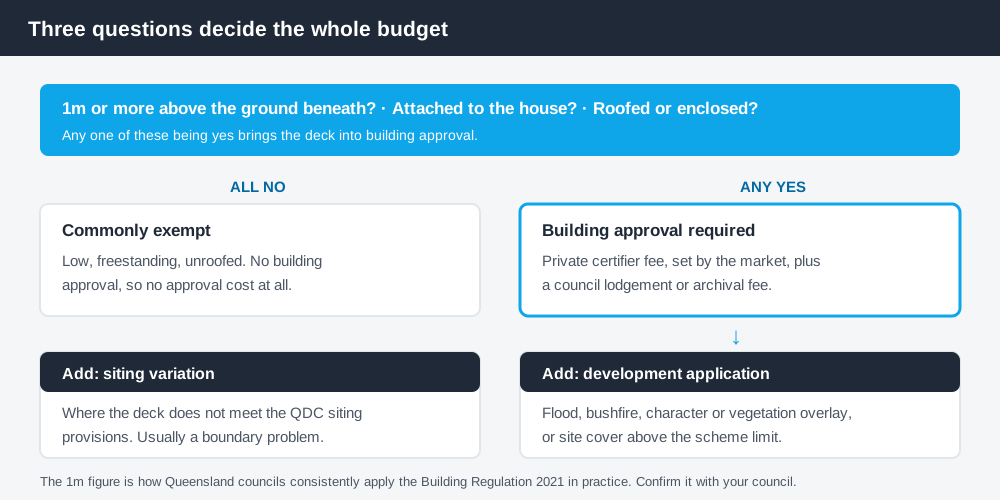
Figure 1: Where your deck lands, and what that costs.
Step one — establish whether you pay anything
The cheapest approval remains the one you do not need, and a lot of decks genuinely do not.
Queensland councils applying the Building Regulation 2021 generally treat a deck as needing building approval once the deck surface sits at or above about 1m above the surface below. That figure is how councils across the state consistently explain and apply the provisions in practice. It is a reliable working rule rather than a universal statutory guarantee, so check your own council's building page before designing to it.
Two things override the height test entirely.
- ✓Attaching the deck to the dwelling brings it into the building's structure, and approval follows
- ✓Roofing or enclosing the deck adds wind uplift, changes site cover and creates a new stormwater path
If your deck is low, freestanding and unroofed, the approval cost is likely to be nil, and everything below is academic. Do you need council approval for a deck in QLD works through that test in detail before you commit to a design.
Step two — the private certifier
Spend 5 minutes, not 3 weeks
instantDA generates a council-ready planning report for Queensland development applications. No town planner. No waiting.
Get your report →Where building approval is required, a private building certifier assesses the plans, inspects the work and issues the approval and final certificate.
The important point for budgeting is that the certifier's fee is not a council charge. It is a professional service in a competitive market, and Queensland certifiers publish indicative ranges that vary with the deck's height, size, whether it is attached, whether engineering is needed for the footings, and how many inspections are required. Get two or three quotes, and ask what each one includes.
- ✓Does the quote include lodging documents with council?
- ✓How many inspections are covered?
- ✓What would a siting variation add?
- ✓Is engineering expected from you or included?
For a broader view of what certifiers charge across project types, what a building certifier costs in QLD covers the range.
Step three — the council's own charges
Even with private certification, your council charges for its part. For a deck, that is usually short.
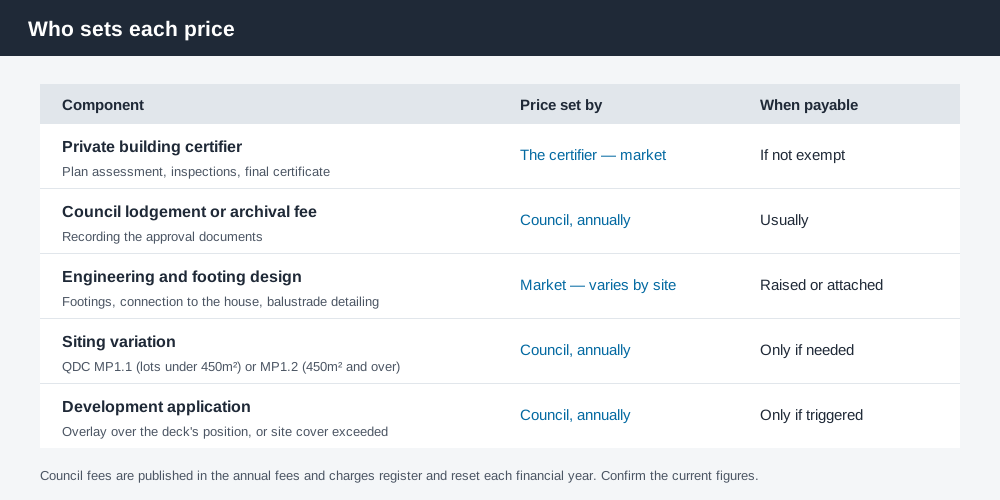
Figure 2: The components, and who sets each price.
The routine charge is a lodgement or archival fee for recording the building approval documents. It is published in each council's annual fees and charges register and varies between councils — some charge nothing directly to the applicant and recover it through the certifier instead. Because these are reset each financial year, the only figure worth relying on is the one on your own council's current schedule.
The charge that is not routine is a siting variation, sometimes called a siting relaxation. That applies where the deck does not meet the acceptable siting provisions in the Queensland Development Code — MP1.1 for lots less than 450m², MP1.2 for lots of 450m² and over. Both parts cover a dwelling and its associated class 10 structures. Councils publish the variation fee annually; it is typically in the order of several hundred dollars, plus whatever it costs to prepare the submission.
A deck that runs close to a side boundary is the classic trigger. Pulling it back is nearly always cheaper than applying to leave it where it is, and boundary setbacks in QLD sets out what the standards actually require.
Step four — engineering, and the things that are not council fees
Some costs have nothing to do with approval and everything to do with the deck standing up.
- ✓Footing design where the deck is raised or on reactive soil
- ✓Structural certification of the connection where the deck is attached to the house
- ✓Balustrade and fall protection detailing once you are up off the ground
- ✓Waterproofing and flashing at the house connection
These are market prices that vary by site rather than by council. They are also the costs most often left out of a comparison between a "cheap" and an "expensive" quote, so ask what each builder has assumed.
There is one more cost worth naming, because it only appears later. A deck built without the building approval it needed remains unapproved, and that surfaces when you sell, insure or refinance. Regularising it afterwards costs more than approving it at the time, because a certifier is being asked to assess work that is already covered up, and some of it may need to be exposed again to be assessed at all. Where a deck sits anywhere near the height threshold, the cheap decision is to have the certifier confirm the position in writing before the frame goes down.
When a development application is added
This is the scenario that changes the order of magnitude, and it is almost always driven by an overlay.
- ✓A flood hazard overlay affects the deck's position or floor level
- ✓A bushfire hazard overlay applies
- ✓A character or heritage overlay controls what can be added to the dwelling
- ✓Vegetation controls apply to the trees you would need to remove
- ✓The deck takes site cover above what the scheme allows
Where any of these bite, you are into a planning application on top of the building approval, with a council application fee set by the scheme's own schedule and, usually, professional fees to prepare it. Flood mapping is the most common of these for decks, particularly on older suburban lots near a creek — the flood hazard overlay in QLD explains what it typically requires.
Queensland's planning schemes follow the Queensland Planning Provisions structure, but each council layers its own overlay codes and site cover rules on top. They are not uniform. Confirm the position with your council before assuming your deck is clear.
What to do next
Take three measurements before you get quotes: the height of the deck surface above the ground beneath it at its highest point, the distance to the nearest boundary, and whether the deck attaches to the house. Those three answers determine which of the costs above apply to you, and a builder's quote obtained before you know them is a quote for an unresolved project.
If you'd rather see your zone, your overlays and your likely category of assessment set out in one document than work through a planning scheme yourself, an instantDA planning report does that for your address for $169 — against the $800–$1,500 a town planner typically charges for a preliminary opinion. You can start a report in a few minutes.
Then confirm the current fees with your own council. They change every financial year, and the difference between councils is real.
Frequently asked questions
How much does deck approval cost in Queensland?
Do I need approval for a deck in QLD?
Is the certifier's fee set by the council?
What is a siting variation for a deck?
When does a deck need a development application?
Does roofing a deck change the cost?
Ready to generate your report?
Skip the writing. Get a council-ready planning report in 5 minutes.
Get your report