Key takeaways
- ✓Subdivision is not one bill — it is a sequence of separate bills that fall in a set order over months or years.
- ✓The two items that usually decide whether a project stacks up are the infrastructure charges and the civil construction, and neither can be priced from a website.
- ✓Infrastructure charges are levied by council under the Planning Act 2016 in line with its charges resolution, and are commonly required to be paid before council will seal the plan.
- ✓Civil works are driven far more by slope, rock, flooding and distance to services than by how many lots you create.
- ✓Real numbers come from four places: the council's fees and charges schedule, its infrastructure charges resolution, a surveyor's fee proposal and a civil contractor's quote.
What Does Subdivision Cost in QLD?
Most people search for a subdivision cost calculator hoping for one number. Queensland doesn't work that way. What you'll usually hear called subdividing is, in the planning system, called reconfiguring a lot, or ROL — and it is not a single purchase. It is a sequence of separate bills, paid to different parties, falling in a particular order over a period usually measured in years rather than months. Learn more about the cost of subdivision per lot.
Get a council-ready planning report in 5 minutes — no planner, no waiting.
Get your report →The short answer
There is no single subdivision price in Queensland. Costs arrive in stages: feasibility and advice, the council application fee and consultant reports, the infrastructure charges notice, operational works design and civil construction, survey and plan sealing, then registration with Titles Queensland. Infrastructure charges and civil works usually dominate.
When each cost lands
The order matters more than most people expect, because the largest commitments sit in the middle of the process — after you have already spent money, and before you have anything you can sell.
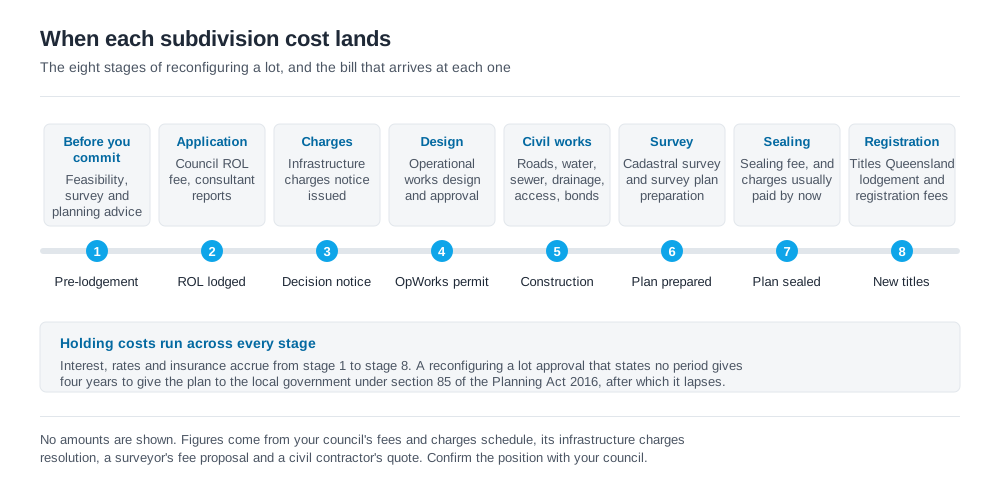
Figure 1: Where each cost falls across the eight stages of a Queensland subdivision.
The eight stages run: the ROL development application; the decision notice granting approval with conditions; an operational works approval where required; construction of the civil works; the cadastral survey and survey plan; plan sealing by council; lodgement with Titles Queensland; and registration, at which point each new lot becomes a separate indefeasible title. If you want the stages explained rather than their costs, start with our walkthrough of reconfiguring a lot in Queensland.
What you spend before you commit
Spend 5 minutes, not 3 weeks
instantDA generates a council-ready planning report for Queensland development applications. No town planner. No waiting.
Get your report →The cheapest stage is the one before you are committed. It typically covers three things: a feasibility check on whether the lot can be reconfigured at all under your council's planning scheme, early advice from a registered cadastral surveyor on how the boundaries could realistically fall, and planning advice on the level of assessment and likely conditions.
- ✓Zone, overlays and minimum lot size under your council's planning scheme
- ✓Preliminary boundary options from a surveyor
- ✓Planning advice on level of assessment and likely conditions
- ✓Service authority advice on where water, sewer and power actually run
- ✓An early view of the infrastructure charges exposure
Councils also offer pre-lodgement meetings. These are an administrative service rather than a statutory stage under the Planning Act 2016, and the advice is not binding on council. Fees vary and are published in each council's fees and charges schedule. This stage is worth spending on precisely because it is the only point at which walking away is cheap.
The application stage
Two distinct costs sit here. The first is the council's application fee for the ROL, which is set in that council's fees and charges schedule and varies between local governments. The second, and usually larger, is technical reports.
Which reports you need depends on what the scheme and its overlays require, and on what council asks for in an information request. Depending on the site, that can include ecology, flooding and stormwater, traffic, geotechnical, bushfire, acoustic, contaminated land or heritage assessments. A flat suburban infill lot with no overlays may need almost none; a sloping lot on the edge of a waterway can need several.
Under the Development Assessment Rules, council may make one information request, within 10 business days after the confirmation period ends, and you then have three months to respond. That response window is where unbudgeted consultant work most often appears.
The infrastructure charges notice
This is the item most likely to be underestimated, and the single best reason to get advice early.
Infrastructure charges are levied by the local government under the Planning Act 2016 to help fund trunk infrastructure. Each council adopts a charges resolution setting its adopted charges, then issues an infrastructure charges notice with the development approval, stating the amount and when it is payable. For a subdivision, the charges are commonly required to be paid before council will seal the plan — so they fall due when you have already built the civil works and have no saleable title yet.
Because charges are set council by council and vary with the type and number of lots created, no website can tell you the number. Model it against your council's resolution before you commit, not after the decision notice arrives. Our guide to infrastructure charges in Queensland explains how the notice works.
Operational works design and civil construction
Where the ROL approval requires physical works — roads, water and sewer reticulation, stormwater, earthworks, access, landscaping — you generally need a separate development permit for operational works. That brings a design cost (engineering drawings and approval) and then the construction cost itself.
Civil construction is usually the largest line item, and it is not really driven by lot count. It is driven by the site: slope, rock, flood immunity, soil conditions, whether reticulated water and sewer already run past the frontage, and how far connections must be extended. Two identical two-lot subdivisions in one suburb can differ enormously on that factor alone. Councils also commonly require a maintenance period with a bond held over it. See operational works in Queensland for what the permit covers.
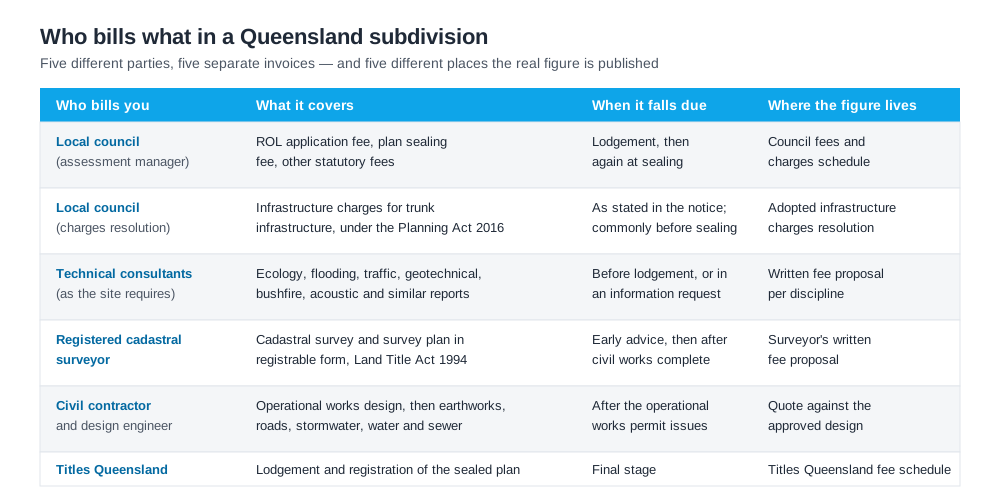
Figure 2: Who issues which bill across a Queensland subdivision.
Survey, plan sealing, registration — and the cost of delay
Only a registered cadastral surveyor may carry out the cadastral survey and certify a survey plan for registration in a registrable format under the Land Title Act 1994. That is a professional fee, quoted against your site. Plan sealing then sits with council, which certifies that the approval conditions have been met and charges paid before endorsing the plan. Lodgement and registration fees are payable to Titles Queensland, which operates the Queensland Titles Registry and issues the new indefeasible titles.
The quiet cost through all of this is time. Holding costs — interest, rates, insurance — run for the entire period the plan sits unsealed. There is also a hard limit: under section 85 of the Planning Act 2016, where a reconfiguring a lot approval states no period, you have four years to give the plan to the local government, after which the approval lapses. An extension can be requested, but only before it lapses.
What makes one subdivision cheap and another expensive
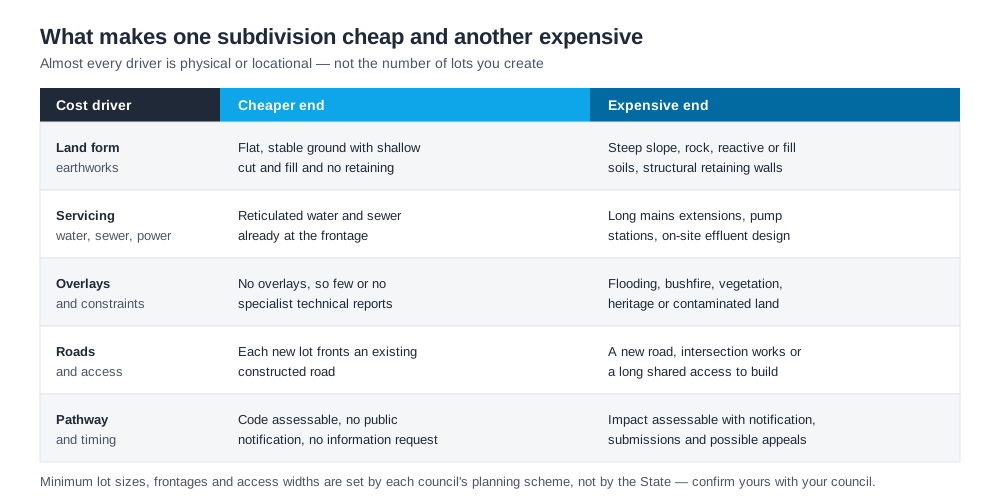
Figure 3: The site and servicing factors that drive a subdivision's cost.
Almost every driver is physical or locational rather than administrative. Flat land with services at the frontage, no overlays, a code assessable pathway and no new road is the cheap end. Slope, rock, flooding, bushfire, vegetation, long service extensions, a new road or an impact assessable pathway with public notification is the expensive end.
If you want the zone, overlays and likely level of assessment worked out against your actual address before you start commissioning reports, an instantDA planning report does that for $169 — against the $800–$1,500 a town planner typically charges for a preliminary opinion. You can start a report in a few minutes.
Then get your real numbers from the four places that hold them: your council's fees and charges schedule, its infrastructure charges resolution, a surveyor's written fee proposal, and a civil contractor's quote priced against the approved operational works design. Queensland schemes follow the Queensland Planning Provisions structure, but each council layers its own codes, overlays and charges on top — they are not uniform, so confirm the position with your council. Brisbane's subdividing land page is a useful example of how a council sets this out.
Frequently asked questions
Is there a subdivision cost calculator for Queensland?
What is usually the biggest cost in a Queensland subdivision?
When do I have to pay infrastructure charges?
Do I need consultant reports for a small subdivision?
How long is a subdivision approval valid in Queensland?
Can I get the council's fees before I apply?
Ready to generate your report?
Skip the writing. Get a council-ready planning report in 5 minutes.
Get your report