Key takeaways
- ✓Subdividing is not one approval. It is a reconfiguring a lot application, then operational works, then plan sealing, then titling.
- ✓The council application fee is the smallest and most predictable part of the stack.
- ✓Civil works and infrastructure charges are almost always the two largest costs, and both scale with the number of lots.
- ✓Infrastructure charges for a subdivision are generally payable before the council endorses the plan of survey.
- ✓Cost per lot falls as lot numbers rise, because the fixed costs spread. A one-into-two split is the least efficient version.
Cost to Subdivide Land in QLD: The Full Stack
In Queensland, subdividing is called reconfiguring a lot, or ROL, and it needs council approval — a development application, or DA, under the Planning Act 2016. But the application is only the first of four things you pay for, and it is comfortably the cheapest.
Most subdivision budgets fail because they price the application and treat everything after it as a detail.
Get a council-ready planning report in 5 minutes — no planner, no waiting.
Get your report →The short answer
Subdividing runs through four stages: the reconfiguring a lot application, operational works for the civil construction, plan sealing by the council, and registration with Titles Queensland. Council application fees are the smallest part. Civil works and infrastructure charges are almost always the largest.
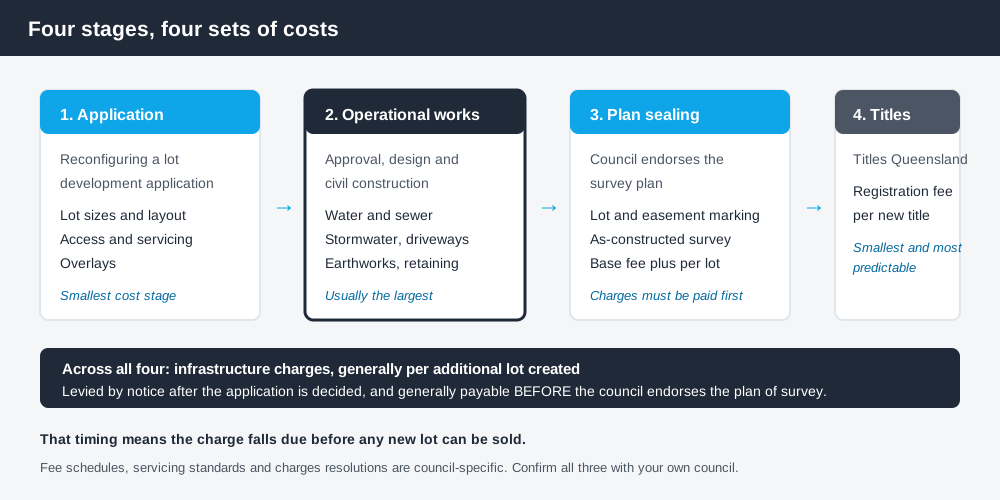
Figure 1: Four stages, four sets of costs.
Stage one — the reconfiguring a lot application
The council assesses whether the subdivision can happen at all: lot sizes and dimensions against the zone, access, servicing, and any overlay affecting the land.
- ✓Council application fee, set by resolution and published annually
- ✓Town planning input and a proposal plan
- ✓Contour and detail survey
- ✓Concept civil and stormwater response where the council requires it
The application fee depends on the number of lots, the zone and whether the application is code or impact assessable. Code assessment applies to straightforward subdivision that complies with the zone's lot size and layout standards; impact assessment applies where the proposal is out of pattern or environmentally sensitive, and it adds public notification that the applicant pays for.
The Development Assessment Rules set the decision periods. Councils commonly describe a decision period of 35 business days for code assessment, with impact assessment adding a public notification period of at least 15 business days plus time to consider submissions. Confirm the current periods against the Development Assessment Rules, since information requests extend both.
If you have not yet established whether your land can be subdivided at all, subdivision in QLD covers the lot size and access tests that decide it.
Stage two — operational works and civil construction
Spend 5 minutes, not 3 weeks
instantDA generates a council-ready planning report for Queensland development applications. No town planner. No waiting.
Get your report →This is usually the largest single cost, and it is the one that has nothing to do with paperwork.
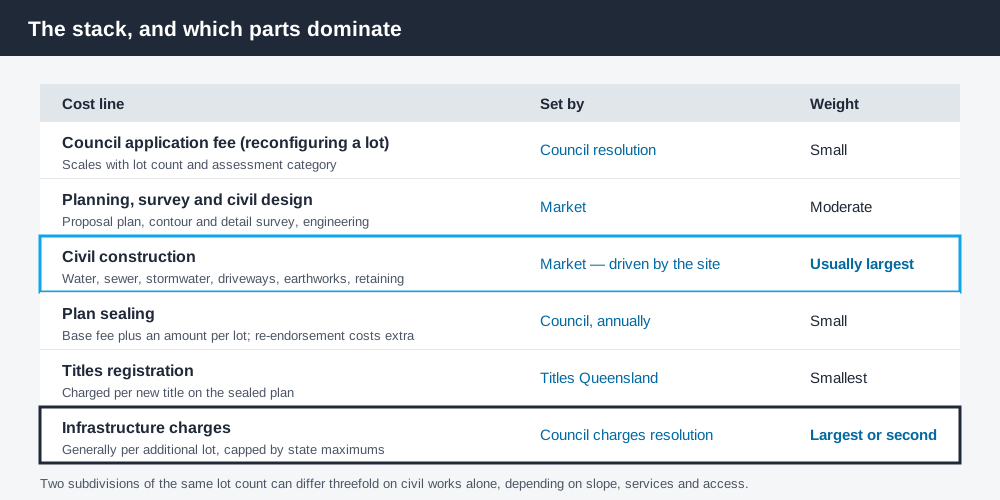
Figure 2: The stack, and which parts dominate.
Operational works approval covers the physical work needed to create serviced lots.
- ✓Water and sewer connections to each new lot
- ✓Stormwater drainage and any detention
- ✓Driveways, crossovers and any new road
- ✓Earthworks and retaining
- ✓Electricity and telecommunications servicing
- ✓Landscaping and street trees where conditioned
You pay twice here: once for the operational works application and engineering design, and again for the civil construction itself. Councils often stack operational works fees on top of the reconfiguring a lot fees rather than bundling them.
What drives this cost is not the number of lots so much as the site. Flat land with services at the frontage is cheap. Sloping land needing retaining, or a site where sewer has to be extended a long way, is not. This is why two subdivisions of the same size can differ by a factor of three.
Stage three — plan sealing
Once the civil works are built and inspected, a licensed cadastral surveyor prepares the survey plan, and you apply to the council to seal — endorse — it. The council checks compliance with the approval conditions and that the infrastructure charges have been paid, then seals the plan.
Costs at this stage are:
- ✓Final lot and easement marking by the surveyor
- ✓As-constructed survey of the new services
- ✓Council plan sealing fee, usually a base fee plus an amount per lot
- ✓Any re-endorsement fee if the plan has to go back
Council plan sealing fees are published and structured per lot. Noosa Shire Council, for example, publishes an endorsement of survey plans fee comprising a base fee plus a further amount for each lot including parks and balance lots, with a separate re-endorsement fee. Figures like these are set annually and vary considerably between councils, so read your own council's current schedule rather than budgeting from another one.
There is also a timing trap worth knowing: a sealed survey plan needs to be lodged with Titles Queensland within a limited window, and industry guidance points to six months. Let that lapse and the sealing process can have to be repeated. Confirm the current requirement before you plan around it.
Stage four — titling with Titles Queensland
The sealed survey plan is lodged with Titles Queensland, which registers the new lots and issues the titles. Registration fees are charged per new title and are published by Titles Queensland. This is the smallest and most predictable stage in the whole process.
The charge that sits across it all — infrastructure charges
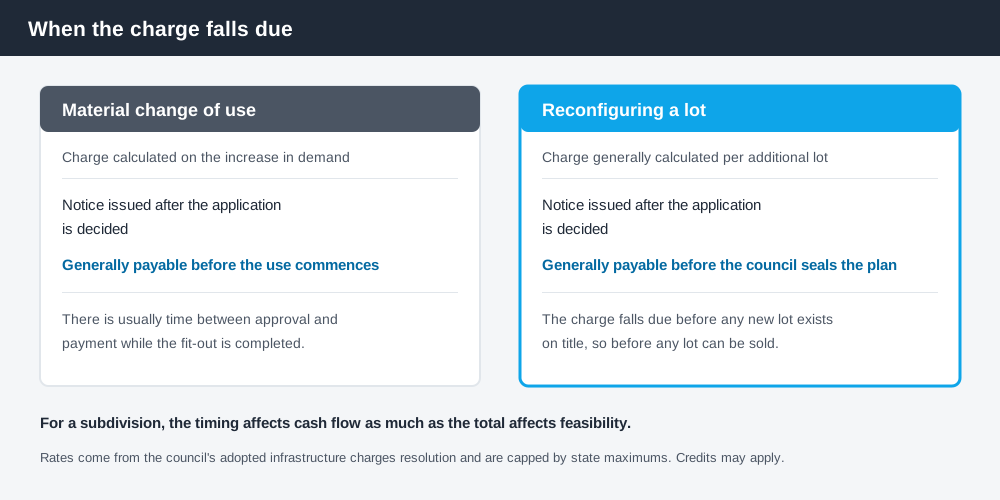
Figure 3: When the charge falls due, and why the timing matters.
Under the Planning Act 2016 framework, councils levy adopted infrastructure charges for the increased demand a development places on trunk infrastructure. For a subdivision, that charge is generally calculated per additional lot created, at the rate in the council's adopted infrastructure charges resolution and capped by state-set maximums.
The council issues an infrastructure charges notice after deciding the application, setting out the charge, how it was calculated and when it is payable. For reconfiguring a lot, the charge is generally payable before the council endorses the plan of survey — that is, before stage three completes.
That timing matters more than the amount to some projects, because it means the charge is due before any lot can be sold. Cash flow, not just total cost, is what catches people.
Rates vary substantially between councils, and credits may apply for the existing lot's demand. Infrastructure charges in QLD explains the calculation and what a notice contains.
Why cost per lot falls as lots rise
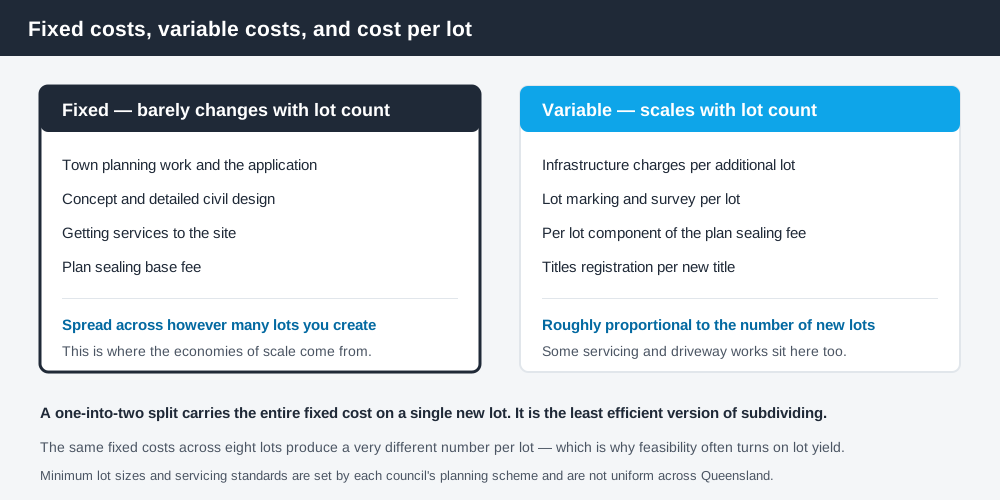
Figure 4: Fixed costs, variable costs, and the effect on cost per lot.
Some costs are effectively fixed regardless of lot count.
- ✓The town planning work and the application itself
- ✓Concept and detailed civil design
- ✓Getting services to the site
- ✓The plan sealing base fee
Others scale with the number of lots.
- ✓Infrastructure charges, generally per additional lot
- ✓Lot marking and survey per lot
- ✓The per-lot component of the plan sealing fee
- ✓Titles registration per new title
- ✓Some servicing and driveway works
A one-into-two split carries the whole fixed cost on a single new lot, which is why it is the least efficient version of subdividing and why so many of them do not stack up financially. The same fixed costs across eight lots produce a very different number per lot.
Queensland's planning schemes follow the Queensland Planning Provisions structure, but each council layers its own minimum lot sizes, servicing standards, fee schedules and charges resolution on top. They are not uniform. Numbers from another council are a shape, not a budget.
What to do next
Build the estimate in stage order, and put the two big items in first: a civil engineer's opinion on servicing and earthworks, and the council's infrastructure charge per lot. Those two decide whether the project works. The application fee, the plan sealing fee and the titles fees are rounding by comparison.
If you'd rather see your zone, your overlays and your likely category of assessment set out in one document than work through a planning scheme yourself, an instantDA planning report does that for your address for $169 — against the $800–$1,500 a town planner typically charges for a preliminary opinion. You can start a report in a few minutes.
For a broader view of what subdividing involves before you price it, subdivision costs in QLD covers the same ground from the feasibility side.
Then confirm the fee schedule and the current charges resolution with your own council. Both are reset regularly, and both are where the real money sits.
Frequently asked questions
How much does it cost to subdivide land in Queensland?
What are the stages of subdividing in QLD?
When are infrastructure charges payable for a subdivision?
What is plan sealing?
Is a one-into-two subdivision cheaper per lot?
Does subdivision need code or impact assessment?
Ready to generate your report?
Skip the writing. Get a council-ready planning report in 5 minutes.
Get your report