Key takeaways
- ✓There is no regulated fee scale for town planners in Queensland. Every figure you see is a market rate.
- ✓Consultant fees and Brisbane City Council application fees are separate. Budget for both, plus infrastructure charges.
- ✓Preliminary advice is the cheapest and most useful thing you can buy, and it is often skipped.
- ✓The single biggest driver of cost is whether your proposal is code assessable or impact assessable.
- ✓Ask for a fixed fee for a defined scope, and ask what triggers a variation.
How Much Does a Town Planner Cost in Brisbane?
You'll usually hear this called a development application, or DA — that's the formal name for council approval under the Planning Act 2016. If you are pricing up a project in Brisbane, the honest starting point is that there is no regulated fee scale for private town planners in Queensland. Every figure quoted to you is a commercial rate, set by the firm, and it varies with complexity and risk more than with the size of your building.
Get a council-ready planning report in 5 minutes — no planner, no waiting.
Get your report →The short answer
There is no set fee scale in Queensland. Preliminary planning advice for a residential site typically runs from a few hundred dollars for a basic desktop review into the low thousands for a detailed one. Preparing and lodging a code assessable application usually costs several thousand in consultant fees, with council fees on top.
Four services, four price points
Planners sell distinct things, and mixing them up is how budgets go wrong.
Preliminary advice or due diligence. A written opinion on what your land allows: zone, overlays, likely category of assessment, and the obvious obstacles. At the basic end this is a desktop review costing a few hundred dollars. A more thorough constraints analysis with a written pathway typically sits in the low thousands. A full planning assessment report against the relevant codes can run into five figures on a complex site.
Preparing and lodging a code assessable application. The bulk of residential work — a secondary dwelling, a small extension, a dual occupancy where the scheme allows it. Consultant fees for a straightforward one commonly sit in the low-to-mid thousands, with moderately complex applications higher.
Impact assessable applications. A different order of magnitude, because the assessment opens the whole scheme, the application must be publicly notified, and submitters can appeal. Consultant fees commonly run to five figures, and considerably more where the application is large, contested or requires several other experts.
Hourly work. Where scope cannot be defined, planners bill by the hour. Published Queensland rate cards for 2024–26 put planners in the low-to-mid hundreds per hour, senior planners higher again, and directors higher still.
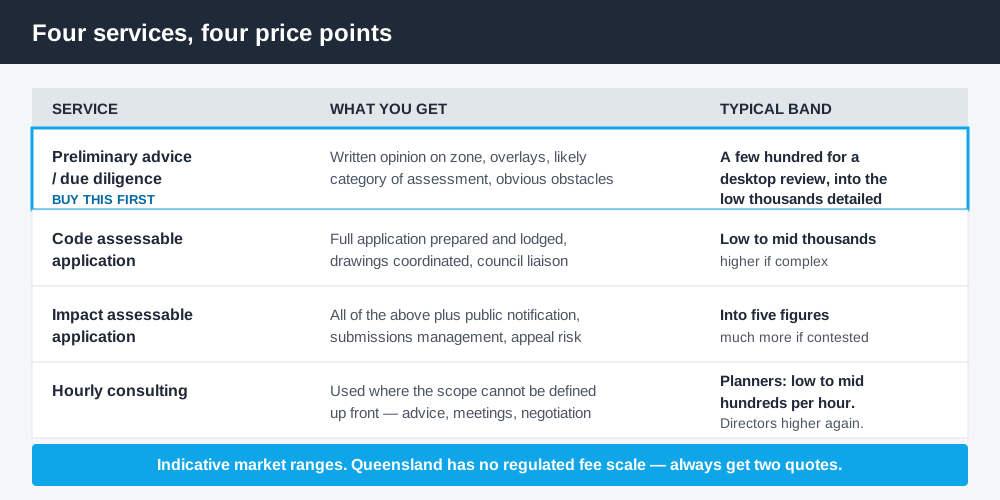
Figure 1: Four services, four price points. Indicative market ranges, not a regulated scale.
Council fees are separate, and people forget them
Spend 5 minutes, not 3 weeks
instantDA generates a council-ready planning report for Queensland development applications. No town planner. No waiting.
Get your report →This is the most common budgeting mistake. Your planner's fee buys you their work. Brisbane City Council's application fee is a separate payment to the council, and infrastructure charges can be a third.
Brisbane City Council publishes a Schedule of Fees and Charges on its website, updated each financial year, with the development assessment fees set out by application type, use and gross floor area. That schedule is the only authoritative source for what your particular application will cost, and the fee varies enormously by type: a minor building work application sits at one end, a multiple dwelling or commercial application at the other.
There is also a pre-lodgement meeting fee, which is worth paying. A pre-lodgement meeting puts your proposal in front of the assessing officer before you spend money on a full application, and it is the single most efficient way to find out whether your approach is going to work.
- ✓Consultant fee for the planning work
- ✓Brisbane City Council application fee from the current schedule
- ✓Infrastructure charges, where they apply
- ✓Other consultants — surveyor, engineer, architect, landscape
- ✓Pre-lodgement meeting fee
Infrastructure charges are the one that surprises people most, because they are levied by the council on development that increases demand on infrastructure and can dwarf every other number in the list on a subdivision or a multi-dwelling project.
What actually drives the price
Category of assessment. Code or impact. This is the dominant variable. Code assessment is bounded — the assessment manager considers only the assessment benchmarks, there is no public notification and no submitter appeal rights. Impact assessment opens the whole scheme, requires notification, and gives submitters a right to appeal. Accepted vs code vs impact assessable in QLD explains how your category is determined, and it is worth knowing before you brief anyone.
Overlays. Each overlay affecting the site adds assessment benchmarks, and often a specialist report. Flood hazard, bushfire hazard, heritage, character, biodiversity and coastal hazard all have this effect.
How many other consultants are needed. Engineers, surveyors, traffic, acoustic, ecology, arborists, bushfire. Each is a separate fee, and your planner co-ordinating them is time billed.
Whether the proposal complies. A proposal that meets every acceptable outcome is a documentation exercise. One that relies on performance outcomes requires a written argument, which is skilled work and takes longer.
Whether anyone objects. Submissions extend timeframes, generate further information requests, and can lead to appeals.
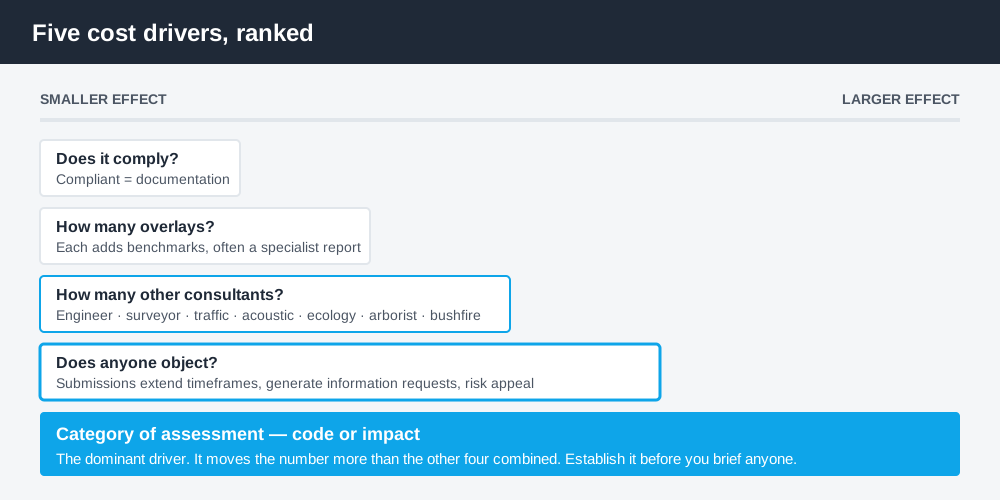
Figure 2: The last one moves the number more than the other four combined.
How to buy it well
Get the category first. Almost every expensive mistake in this space is someone briefing a planner to prepare an application for a proposal that was never going to be supported in that zone. Knowing your zone, your overlays and your likely category before you engage anyone means you brief accurately, and it tells you whether to proceed at all.
Ask for a fixed fee against a defined scope. Most Queensland firms will quote fixed fees for preliminary reviews and for straightforward code assessable applications. Ask what is included, what is excluded, and specifically what triggers a variation — an information request from council is the usual one.
Ask who does the work. A rate card with a director's rate on it does not mean the director writes your report. Ask which level of planner will be doing the drafting.
Buy the cheap thing first. Preliminary advice costs a fraction of an application and can save you the application entirely. It is routinely skipped by people who then spend ten times as much finding out the same information the hard way.
If you'd rather read your zone, your overlays and your likely category of assessment in one document than commission a preliminary opinion, an instantDA planning report does that for your address for $169, against the $800–$1,500 a town planner typically charges for a preliminary opinion. It is not a substitute for a planner on a complex or contested proposal — it is the step before you decide whether you need one. You can start a report in a few minutes.
Check Brisbane City Council's current Schedule of Fees and Charges for the council side, use Queensland Globe and the City Plan mapping for your zone and overlays, and get at least two quotes on any application work. For the state-wide picture on planner fees, town planner fees in Queensland covers how Brisbane compares with the rest of the state.
Frequently asked questions
How much does a town planner cost in Brisbane?
Are council fees included in a town planner's fee?
Why is an impact assessable application so much more expensive?
What do town planning consultants charge per hour in Queensland?
Do I need a town planner for a small extension in Brisbane?
Is a pre-lodgement meeting with Brisbane City Council worth the fee?
Ready to generate your report?
Skip the writing. Get a council-ready planning report in 5 minutes.
Get your report