Key takeaways
- ✓Almost nothing that goes wrong with a Queensland DA is a refusal. It is delay, and most of it is self-inflicted.
- ✓The three stall points are: not properly made, an information request, and a referral trigger nobody checked.
- ✓Assuming the category of assessment instead of reading the table of assessment is the single most expensive shortcut.
- ✓An unanswered information request stops the clock — the application isn't being assessed while you sit on it.
- ✓Building approval and development approval are separate systems. Getting one does not get you the other.
10 Mistakes That Delay QLD Council Approval
You'll usually hear this called a development application, or DA — that's the formal name for council approval under the Planning Act 2016. Ask anyone who has lodged one what went wrong and you rarely hear "it was refused". You hear "it took eight months". Refusal is uncommon. Delay is close to universal, and most of it traces back to a handful of avoidable decisions made before lodgement.
Get a council-ready planning report in 5 minutes — no planner, no waiting.
Get your report →The short answer
Most delay comes from three points: an application that isn't properly made, material that doesn't answer the assessment benchmarks so an information request issues, and a referral trigger nobody checked. All three are cheaper to avoid before lodgement than to fix afterwards.
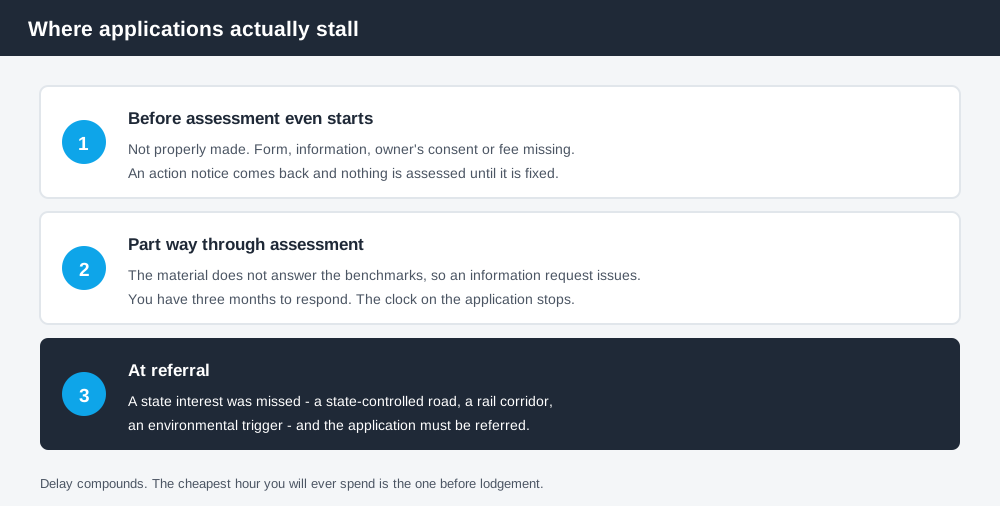
Figure 1: Three stall points. Each one costs weeks to months.
Where the time actually goes
The Queensland process has a shape. An application is lodged; the assessment manager checks whether it is properly made and issues either a confirmation notice or an action notice; if it proceeds, there may be a referral to a referral agency, an information request, and — for impact assessable applications — public notification; then a decision, given by a decision notice.
Delay attaches to those junctions, not to the assessment itself. An officer assessing a complete, well-argued application against benchmarks it actually addresses is doing routine work. The queue forms where the file has to go back to the applicant.
The ten
Spend 5 minutes, not 3 weeks
instantDA generates a council-ready planning report for Queensland development applications. No town planner. No waiting.
Get your report →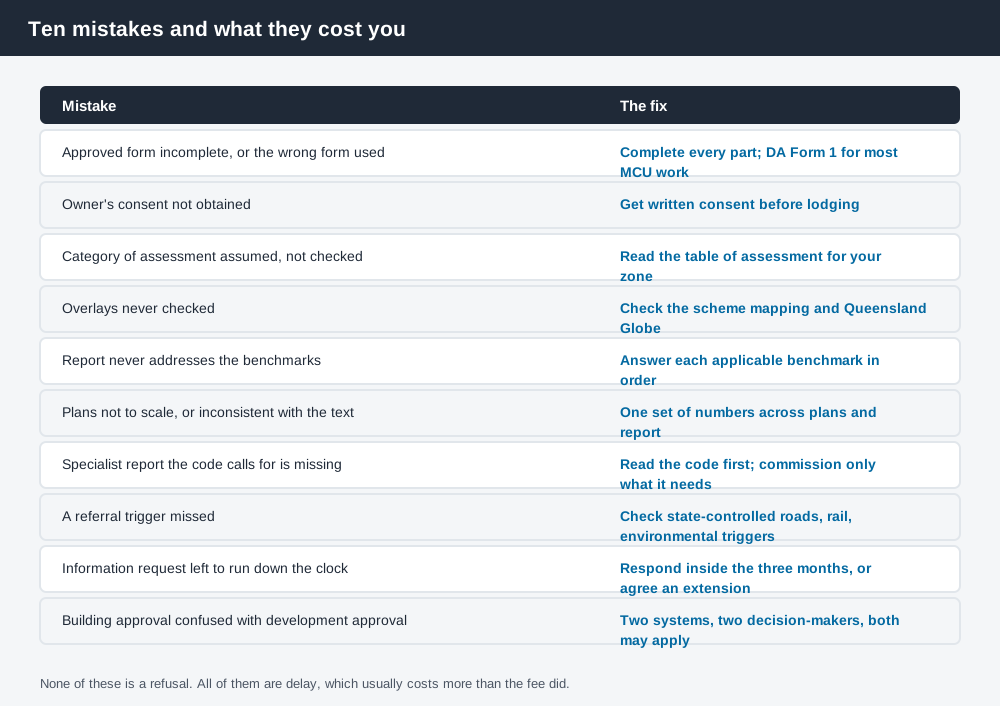
Figure 2: Ten mistakes, ten fixes. None of them expensive at the front end.
1. The approved form is incomplete, or it's the wrong form. Most applications involving code or impact assessment go on DA Form 1, and the form itself states all parts must be completed in full and all required supporting information must accompany the application. Applications involving only building work use a different form. Getting this wrong stops the file before anyone reads it.
2. Owner's consent wasn't obtained. If you're not the owner — a tenant fitting out a shop, a buyer under contract — you need the owner's written consent to make the application. This is one of the four properly-made requirements and it surprises people every week.
3. The category of assessment was assumed rather than checked. People decide their project "should be" code assessable because it seems modest. The scheme's table of assessment for your zone decides, and it does not care about modesty. Get this wrong and you have either over-prepared or, worse, discovered mid-process that your application is impact assessable and will be publicly notified. Accepted versus assessable development in QLD sets out how to find your category properly.
4. Overlays were never checked. Flood, bushfire, character, heritage, coastal hazard, acid sulfate soils, waterway corridors. Overlays layer additional codes and additional benchmarks on top of the zone, and they are invisible unless you look. Check your council's planning scheme mapping and the Queensland Globe before you design anything.
5. The report never addresses the benchmarks. A document that describes the building beautifully and never engages a single assessment benchmark is not supporting information — it's a brochure. This is the most common substantive failure and the most reliable generator of information requests.
6. Plans aren't to scale, or contradict the written material. Two different setback figures on the plan and in the report is an automatic query. So is a plan without a scale bar, dimensions or a north point.
7. The specialist report the code calls for isn't there. Acoustic, traffic, stormwater, contamination, ecology. The trick is to read the code first and commission only what its benchmarks actually require — under-doing this causes delay, over-doing it just costs money.
8. A referral trigger was missed. New or changed access to a state-controlled road, proximity to a rail corridor, certain environmental matters — these can require referral to a referral agency, which assesses against state codes. Discovering this after lodgement adds a whole stage.
9. The information request is left to run down the clock. Once an information request issues, you have three months to respond, extendable by agreement. Applicants routinely treat that as slack time. It isn't — the application simply isn't progressing.
10. Building approval and development approval get confused. These are separate systems: development approval under the Planning Act 2016 with council as assessment manager, and building approval under the Building Act 1975, usually through a private certifier. One does not deliver the other, and each can be required without the other. Building approval versus development approval in QLD untangles the two.
What the fixes have in common
- ✓Find your zone and overlays before you design
- ✓Read the table of assessment, don't assume
- ✓Read the codes the table points you at
- ✓Design to the benchmarks, then write to them
- ✓Lodge complete, with consent and fee
- ✓Answer information requests fast and completely
There is also a pattern in what goes wrong. Nine of the ten are failures of sequence rather than failures of judgement: something that should have been established first was established last, or assumed. The design was drawn before the overlays were checked. The lease was signed before the lawful use was confirmed. The consultant was engaged before anyone read the table of assessment. Reordering the same work, at the same cost, removes most of the delay.
Every fix on that list happens before lodgement, and none of them is expensive. That is the actual lesson: the leverage in a Queensland DA is almost entirely front-loaded, and the hour spent reading the applicable code is worth more than any amount of chasing afterwards.
Queensland's planning schemes follow the Queensland Planning Provisions structure, but each council layers its own codes and overlays on top. They are not uniform — so advice from a friend in another local government area, however confident, may not survive contact with your scheme.
What to do next
Get the constraints on the table first. Zone, overlays, category of assessment, applicable codes. If you want to see what a realistic timeline looks like once you're in the system, DA timeframes in QLD sets out the stages and where the time sits.
If you'd rather see your zone, your overlays and your likely category of assessment set out for your address than work through a planning scheme yourself, an instantDA planning report does that for $169 — against the $800–$1,500 a town planner typically charges for a preliminary opinion. You can start a report in a few minutes.
Then confirm the requirements with your council before you lodge. A ten-minute conversation with a duty planner has saved more applications than any template ever has.
Frequently asked questions
Why is my development application taking so long in Queensland?
What happens if I don't answer an information request?
Can I lodge a development application without owner's consent in Queensland?
Do I need both development approval and building approval?
How do I find out if my application needs to be referred to the state?
Is it cheaper to fix an application after lodgement or before?
Ready to generate your report?
Skip the writing. Get a council-ready planning report in 5 minutes.
Get your report