Key takeaways
- ✓Councils assess against assessment benchmarks — the matters the planning scheme sets out for an assessment manager to measure the application against.
- ✓The category of assessment sets the scope: code assessment is narrower than impact assessment.
- ✓An assessing officer cannot consider matters outside the benchmarks in a code assessable application, however strongly a neighbour feels.
- ✓Most approvals are conditional. Conditions are the normal outcome, not a sign something went wrong.
- ✓The commonest cause of delay is not refusal — it is an application that doesn't answer the benchmarks, which triggers an information request.
What QLD Councils Actually Look For in an Application
You'll usually hear this called a development application, or DA — that's the formal name for council approval under the Planning Act 2016. When a council assesses one, it is not forming a general opinion about whether your project is a good idea. It is doing something much narrower and much more mechanical: measuring your proposal against a defined set of criteria that the planning scheme already published, before you ever thought of building anything.
Those criteria are the assessment benchmarks. Understanding that they exist, and that they are the whole game, changes how you put an application together.
Get a council-ready planning report in 5 minutes — no planner, no waiting.
Get your report →The short answer
Councils assess a DA against assessment benchmarks — the matters the planning scheme sets out for the assessment manager to measure assessable development against. The category of assessment sets the scope: code assessment works against the benchmarks, while impact assessment may also weigh other relevant matters.
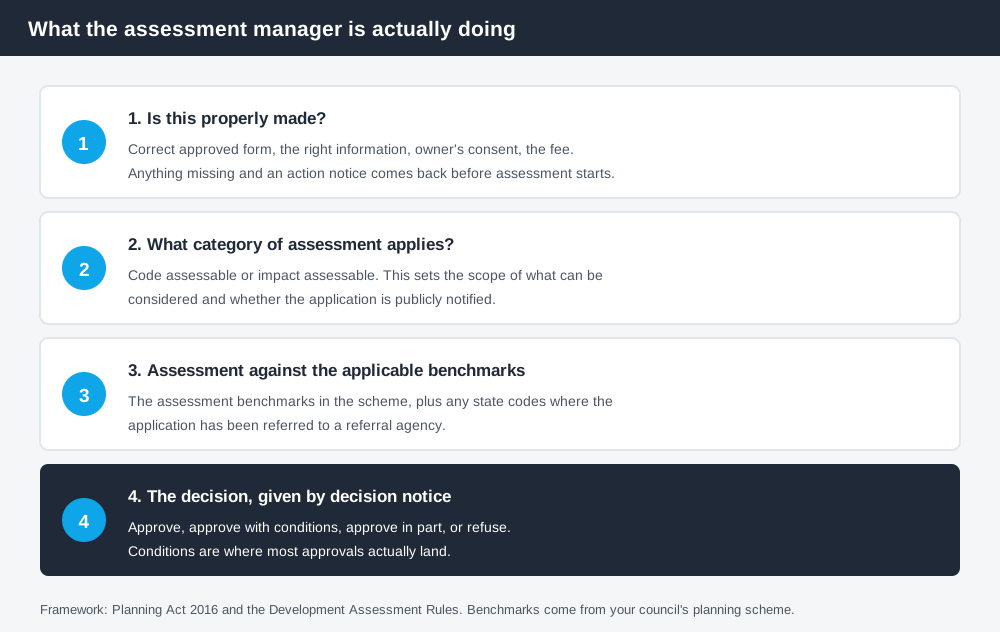
Figure 1: Four questions, in order. Each one gates the next.
Step one: is it properly made?
Before anything is assessed, the assessment manager checks whether the application is properly made. The state's own development assessment guidance frames this as four things: use the correct form, supply the right information, obtain the owner's consent, and pay the fee.
Fall short and you get an action notice telling you what to fix. Nothing is assessed until you fix it. This is unglamorous and it is where a surprising number of applications lose their first fortnight.
Step two: the category of assessment sets the scope
Spend 5 minutes, not 3 weeks
instantDA generates a council-ready planning report for Queensland development applications. No town planner. No waiting.
Get your report →This is the part most people never internalise, and it governs everything.
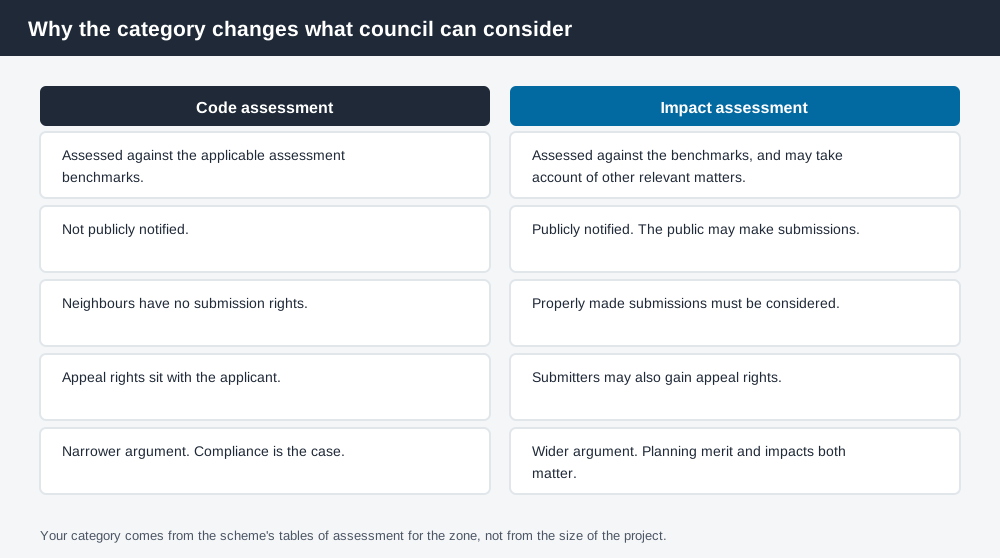
Figure 2: Same council, same officer, very different scope.
Under a code assessable application, the assessment is carried out against the applicable assessment benchmarks. If you meet them, the case is largely made. Neighbours are not notified and have no submission rights, because the scheme has already decided that this use, in this zone, at this scale, is anticipated.
Under an impact assessable application, the assessment is carried out against the benchmarks and may also take account of other relevant matters. The application is publicly notified, submissions can be made, and submitters can gain appeal rights. The argument becomes about planning merit, not just compliance.
Accepted development and accepted subject to requirements sit outside all of this — they need no application at all, though "subject to requirements" means exactly that: comply with the stated requirements or the exemption evaporates. Our guide to accepted versus assessable development in QLD sets the four categories side by side.
Step three: the benchmarks themselves
The Planning Act 2016 describes a categorising instrument as setting out the matters — the assessment benchmarks — that an assessment manager must assess assessable development against. Those benchmarks live in your council's planning scheme codes, and where a state interest is triggered, in state codes assessed by a referral agency.
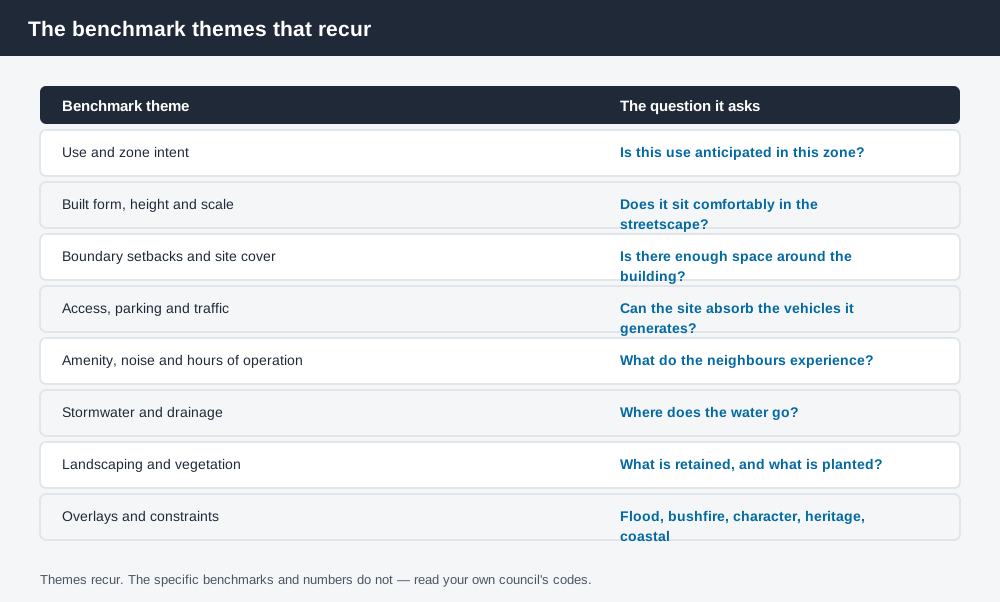
Figure 3: The themes recur across schemes. The numbers behind them do not.
Queensland's planning schemes follow the Queensland Planning Provisions structure, but each council layers its own codes and overlays on top. They are not uniform. A setback that passes in one local government area may fail two suburbs away under a different scheme.
Most Queensland codes are drafted as performance outcomes with acceptable outcomes underneath. The acceptable outcome is the prescriptive path — a number you either meet or don't. The performance outcome is the objective behind it. Missing an acceptable outcome is not automatically fatal, provided you can demonstrate the performance outcome is achieved some other way. That structure is what gives a well-argued application room to move.
What a council cannot consider
Just as important, and rarely said out loud.
- ✓Property values — not a planning benchmark
- ✓Who the applicant is, or that a neighbour dislikes them
- ✓Loss of a private view, unless the scheme actually protects it
- ✓Business competition from a similar use nearby
- ✓Matters outside the benchmarks entirely, in a code assessable application
There is a reason for that list, and it is not indifference. The scheme is the community's settled position on what should happen where, arrived at through a public planning process years before your application. Reopening that argument case by case, at the counter, would make the scheme meaningless. So the assessment manager is confined to the criteria the scheme actually adopted — which cuts both ways, protecting applicants from arbitrary objection and neighbours from arbitrary approval.
Neighbours often assume objections are votes. In a code assessable application there is no notification stage at all, and in an impact assessable one a submission carries weight only to the extent it engages a matter the assessment manager can lawfully consider. A submission that says "this will devalue my house" does less than one that says "this proposal fails the acoustic benchmark in the applicable code, for these reasons".
The decision, and what it usually looks like
The assessment manager decides by giving a decision notice: approve, approve with conditions, approve in part, or refuse. Conditional approval is the normal outcome. Conditions are how a council reconciles a proposal it can live with against benchmarks it can't waive — drainage upgrades, landscaping, hours of operation, car parking numbers, an infrastructure charges notice.
If the material in front of the officer isn't enough to decide, you get an information request instead, and the clock stops until you respond. That is the real cost of a thin application. Information requests in QLD covers what triggers them and how to answer one without losing months, and decision notices in QLD explains what arrives at the end and what your options are.
What to do next
Work backwards. Find your zone and overlays on your council's planning scheme mapping or the Queensland Globe, find the table of assessment for that zone, read the codes it points you to, and then build the application around answering them. The state's development assessment guidance sets out the process at a state level.
If you'd rather see your zone, your overlays and your likely category of assessment set out for your address than work through a scheme yourself, an instantDA planning report does that for $169 — against the $800–$1,500 a town planner typically charges for a preliminary opinion. You can start a report in a few minutes.
Then confirm the applicable codes with your council before you lodge, because the officer assessing your application is the person whose reading of the scheme decides it.
Frequently asked questions
What are assessment benchmarks in Queensland?
Can a council refuse a code assessable application?
Do neighbours get a say in a Queensland DA?
Does council consider the effect on my property value?
What is the difference between an information request and a refusal?
Are conditions on an approval negotiable?
Ready to generate your report?
Skip the writing. Get a council-ready planning report in 5 minutes.
Get your report