Key takeaways
- ✓Schedule 1 of the Planning Act 2016 sets out what can be appealed, to which forum, and who the parties are.
- ✓The Development Tribunal handles a defined list, largely building-related and smaller matters. Everything else goes to the Planning and Environment Court.
- ✓The general appeal period is 20 business days after the decision notice. A deemed refusal can be appealed at any time.
- ✓Only an eligible submitter can appeal an approval, which is why making a submission during notification matters.
- ✓Change representations and a negotiated decision notice usually beat an appeal on cost, speed and relationship.
Council Refused Your Application: Appeals in Queensland
A refusal is not the end of the process, and for most applicants it should not be the start of a court case either. Queensland gives you a structured set of options, most of which are cheaper and faster than an appeal, and the right move depends less on how unfair the decision feels than on what specifically went wrong.
There is a deadline, though, and it is short. Whatever you decide, decide it inside 20 business days.
Get a council-ready planning report in 5 minutes — no planner, no waiting.
Get your report →The short answer
Schedule 1 of the Planning Act 2016 sets out appeal rights. The Development Tribunal hears a defined list of mostly building-related and smaller matters; everything else goes to the Planning and Environment Court. The general appeal period is 20 business days after the decision notice, and a deemed refusal can be appealed at any time.
First: read why you were refused
The decision notice must state the reasons for refusal, and whether a referral agency directed the refusal. That distinction changes everything.
If a referral agency directed the refusal, the assessment manager had no choice. Appealing the council will not help; the substantive issue sits with that agency and is best addressed there or by redesigning around it.
If the refusal is the assessment manager's own, the reasons tell you whether the problem is fixable. A refusal grounded in a single unmet benchmark is very different from one grounded in the proposal being fundamentally at odds with the zone. Your decision notice explained covers how to read it, and why councils refuse applications covers the recurring causes.
Try these before you appeal
Spend 5 minutes, not 3 weeks
instantDA generates a council-ready planning report for Queensland development applications. No town planner. No waiting.
Get your report →Change representations. During the appeal period the applicant may make change representations to the assessment manager under section 75 of the Planning Act 2016. If the assessment manager agrees, it gives a negotiated decision notice, and the appeal period starts again the day after that notice is given. This is the standard route for unacceptable conditions and it costs almost nothing.
Note the limits: you cannot use change representations to alter a matter stated because of a referral agency's response, or a condition imposed under a ministerial direction.
A fresh application. Where the refusal reasons are specific and addressable, an amended application is frequently faster and dramatically cheaper than an appeal, and it starts with a council that has already told you exactly what it wanted.
An appeal is the right answer when the disagreement is genuinely about planning merits and the project cannot be redesigned around the objection.
Which forum
Schedule 1 of the Planning Act 2016 does the sorting, and it is more prescriptive than most applicants expect.
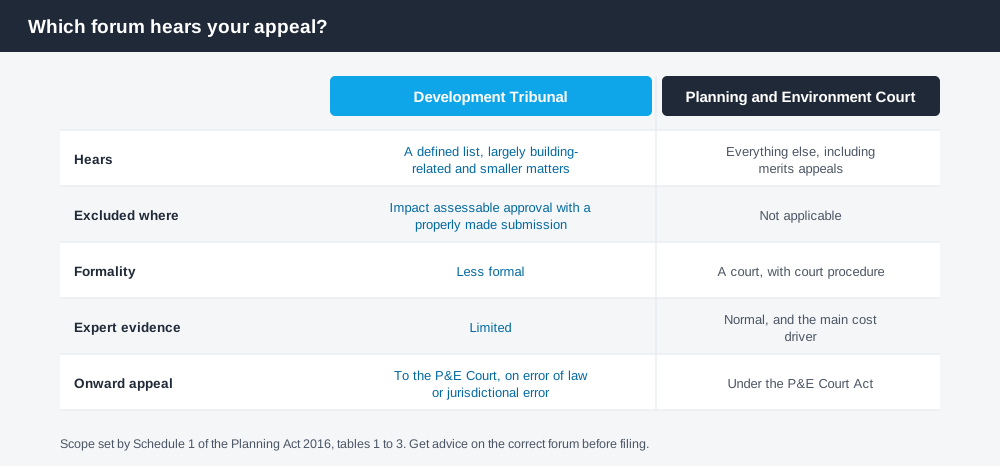
Figure 1: Two forums, quite different in scope and formality.
Table 1 matters may go to either the Planning and Environment Court or a tribunal — but the tribunal option only applies where the matter involves a defined list. That list includes the refusal or deemed refusal of an application for a material change of use for a classified building, or for operational work associated with building work, a retaining wall or a tennis court; certain development conditions on small class 2 buildings of not more than three storeys and not more than 60 sole-occupancy units; decisions on extension and change applications for a classified building; matters relating to the Building Act other than those for the QBCC; enforcement notices for those matters or under the Plumbing and Drainage Act 2018; and infrastructure charges notices.
Importantly, the tribunal is excluded where the development approval came from an application that required impact assessment and the assessment manager received a properly made submission. Contested impact assessable matters go to the court.
Table 2 matters go to the Planning and Environment Court only. That includes appeals from a tribunal decision on the ground of an error or mistake in law or jurisdictional error, eligible submitter appeals, compensation claims and certain local law decisions.
Table 3 matters go to a tribunal only — mostly building certifier decisions, inspection of building work, and decisions or failures to decide under the Building Act and the Plumbing and Drainage Act 2018.
Who can appeal
Not everyone who is unhappy.
For a development application, the applicant may appeal against the refusal of all or part of the application, a deemed refusal, a provision of the development approval, or a decision to give a preliminary approval where a development permit was applied for.
An eligible submitter may appeal a decision to approve an application, to the extent the decision relates to any part that required impact assessment or to a variation request. That right belongs only to people who made a submission during public notification — which is the practical reason public notification matters so much to neighbours.
Referral agencies, advice agencies and other parties may be respondents or co-respondents, and some may elect to join.
The deadlines
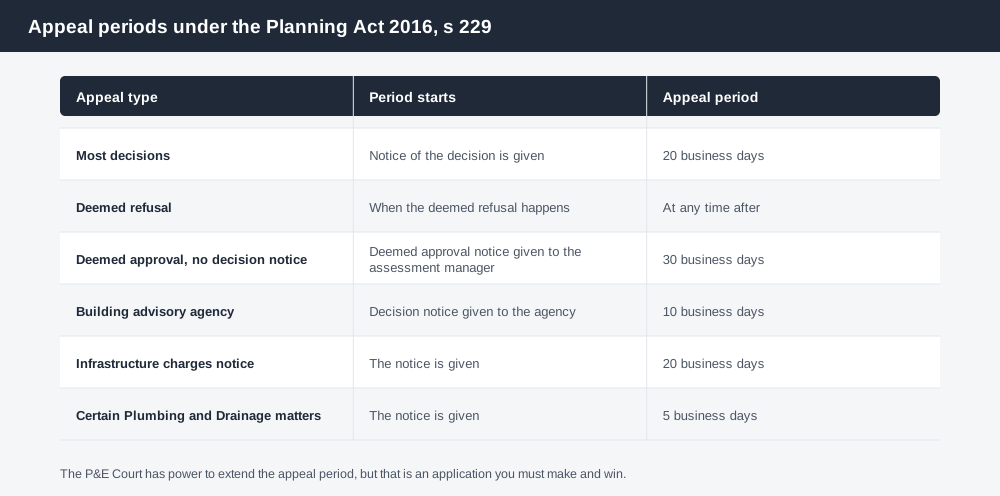
Figure 2: Appeal periods under section 229 of the Planning Act 2016.
Section 229 sets the appeal period. For most matters it is 20 business days after a notice of the decision is given to the person. Several matters run differently:
An appeal against a deemed refusal may be started at any time after the deemed refusal happens. An appeal about a deemed approval where no decision notice was given is 30 business days after the applicant gives the deemed approval notice. An appeal by a building advisory agency is 10 business days. An appeal against an infrastructure charges notice is 20 business days after the notice is given. Certain Plumbing and Drainage Act 2018 matters run on 5 business days.
The Planning and Environment Court Act gives the court power to extend the appeal period, but that is an application you have to make and win, not a safety net to plan around.
- ✓Diarise the appeal period the day the decision notice arrives
- ✓Confirm whether the refusal was directed by a referral agency
- ✓Decide between change representations, re-lodging and appealing
- ✓Get advice on the correct forum before filing
- ✓Remember a negotiated decision notice restarts the appeal period
What an appeal involves
An appeal to the Planning and Environment Court is a merits hearing, not a review of council's paperwork. The court considers the proposal against the assessment benchmarks and, for impact assessment, the other relevant matters. Expert evidence — planning, traffic, acoustic, visual amenity — is normal, and it is the main cost driver.
The tribunal is a less formal forum dealing with a narrower list of matters, which is reflected in the cost and the speed. A tribunal decision can itself be appealed to the court, but only on an error or mistake in law or jurisdictional error.
Costs and timeframes vary too much between matters to quote a figure honestly, and neither the court nor the tribunal publishes a schedule you can rely on for your case. Get advice from a planning lawyer before committing, and confirm the position with your council in the meantime — many refusals settle once the specific objection is addressed. How long council approval takes covers the timeline you are trying to protect.
What to do next
The cheapest appeal is the one you never need. An instantDA planning report works through your zone, your overlays and your council's applicable codes benchmark by benchmark before you lodge, for $169 — against $800–$1,500 for a town planner preparing the same document.
Start with a planning report, or go straight to creating your report.
Frequently asked questions
Can I appeal a council refusal in Queensland?
Do I go to the Development Tribunal or the Planning and Environment Court?
How long do I have to appeal?
Can my neighbour appeal my approval?
Is there anything cheaper than appealing?
What does an appeal cost?
Ready to generate your report?
Skip the writing. Get a council-ready planning report in 5 minutes.
Get your report