Key takeaways
- ✓Refusals are rarer than people think. Most weak applications get conditioned or withdrawn rather than refused.
- ✓For code assessment, if the proposal complies with all relevant benchmarks the assessment manager must approve it. Refusal means a benchmark was not met or not demonstrated.
- ✓A large share of refusals are evidentiary, not architectural — the proposal was fine, the case for it was not made.
- ✓Your decision notice must give reasons, and those reasons are the roadmap for what to do next.
- ✓A refusal directed by a referral agency is a different problem, and appealing your council will not fix it.
Why Councils Refuse Applications in Queensland
Refusal feels arbitrary from the outside and almost never is. Queensland's assessment framework is unusually structured about what an assessment manager may and may not consider, which means most refusals trace back to a small number of identifiable causes — and most of those causes are visible before lodgement to anyone who looks.
It is also worth saying at the outset that outright refusal is less common than the anxiety around it suggests. Weak applications more often get heavily conditioned, or withdrawn once council signals its position, than formally refused.
Get a council-ready planning report in 5 minutes — no planner, no waiting.
Get your report →The short answer
For code assessment, if a proposal complies with all the relevant assessment benchmarks the assessment manager must approve it — so a code refusal means a benchmark was not met, or not demonstrated. Impact assessment is broader and considers other relevant matters, including submissions. Most refusals are avoidable at lodgement.
What council is allowed to refuse for
The constraint matters, because it tells you what is actually in play.
Code assessment is carried out only against the assessment benchmarks in a categorising instrument for the development, plus matters prescribed by regulation. The decision rules follow: where the development complies with all the relevant benchmarks, the assessment manager must approve it. Where it does not, they may approve it with conditions bringing it to compliance or to an acceptable outcome, or refuse it where compliance cannot be achieved.
So on a code assessable application, "the neighbours don't like it" is not a reason, and neither is "we'd prefer something else here". Refusal means a benchmark was not met, or was not shown to be met.
Impact assessment is a different animal. It is assessed against the relevant benchmarks and having regard to any other relevant matter, which brings in the strategic framework, planning need, amenity and the submissions the public made. The discretion is much wider, which is why impact assessable proposals are refused more often.
The causes that actually produce refusals
Spend 5 minutes, not 3 weeks
instantDA generates a council-ready planning report for Queensland development applications. No town planner. No waiting.
Get your report →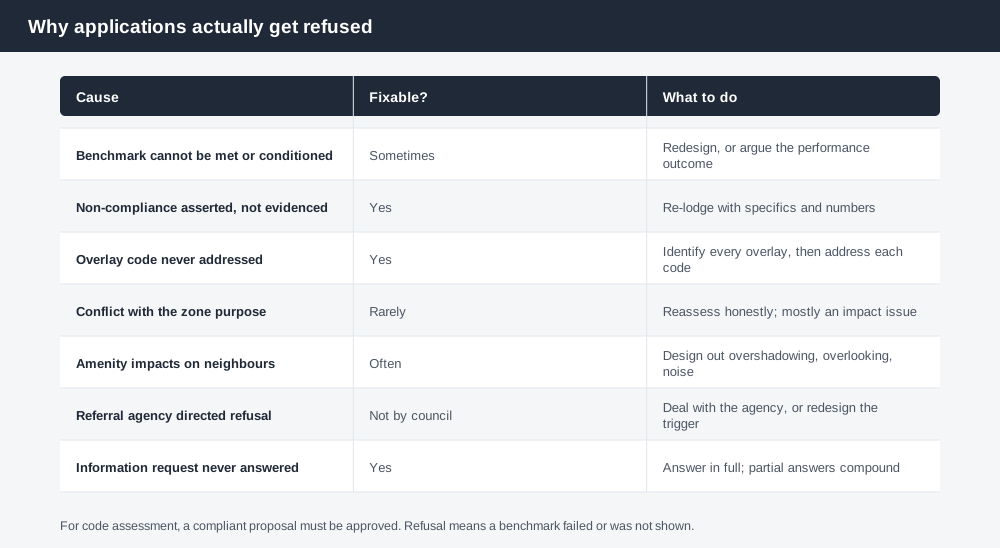
Figure 1: Most refusals are one of these, and most are visible before lodgement.
A benchmark that cannot be met and cannot be conditioned around. Height, setbacks, site cover, density, car parking. Where the shortfall is fundamental to the design, conditions cannot fix it.
A non-compliance asserted rather than argued. Covered below — the largest avoidable category.
An overlay code not addressed. Flooding, bushfire, character, heritage, vegetation, acoustic. The application never engaged with a code that applied, so the assessment manager cannot find compliance with it.
Conflict with the zone purpose. Chiefly an impact assessment problem: the proposal is not what the zone is there for, and the strategic framework says so.
Amenity impacts on neighbours. Overshadowing, overlooking, noise, traffic, hours of operation. Weighed heavily in impact assessment and reachable through overlay and use codes in code assessment.
A referral agency direction to refuse. Not your council's decision at all. The decision notice must say whether the assessment manager was directed to refuse and whether the refusal was solely because of that direction.
An information request never adequately answered. Where the missing material was needed to demonstrate compliance, its absence is the refusal.
The evidentiary refusal
This is the one worth dwelling on, because it is the largest genuinely avoidable category and it does not look like a refusal reason at all.
Queensland codes are written as performance outcomes with acceptable outcomes underneath. Meeting an acceptable outcome is one way of achieving the performance outcome — not the only way. Where you cannot meet an acceptable outcome, you are entitled to demonstrate that the performance outcome is still achieved.
That entitlement is only as good as the demonstration.
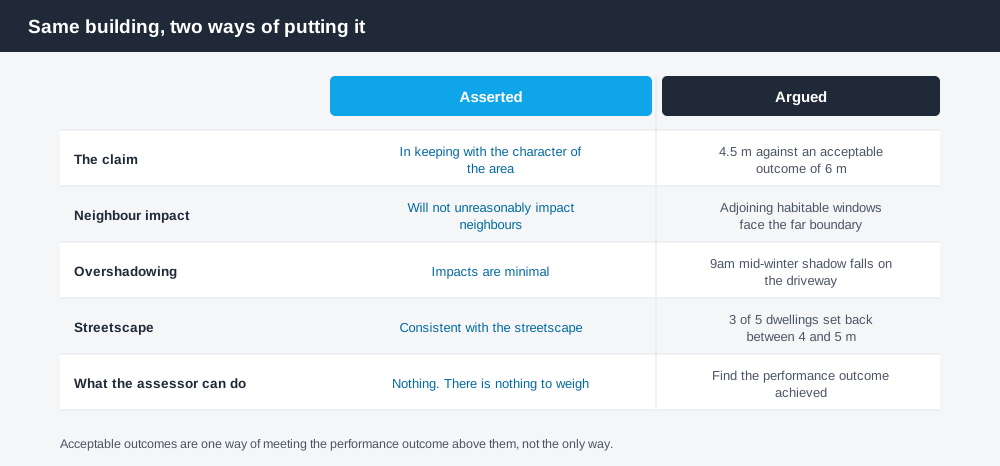
Figure 2: The same proposal, two ways of putting it. Only one gives the assessor something to rely on.
An asserted non-compliance says the reduced setback "is in keeping with the character of the area" and "will not unreasonably impact neighbouring properties". An assessor cannot approve on that. There is nothing to weigh.
An argued non-compliance says the setback is 4.5 metres against an acceptable outcome of 6; the adjoining dwelling's habitable room windows face the opposite boundary; the mid-winter 9am shadow falls across the neighbour's driveway rather than any private open space; three of the five dwellings in the block have front setbacks between 4 and 5 metres; and the retained front garden maintains the streetscape rhythm the code is protecting.
That is the same building. One version gets refused. Planning reports for builders sets out where this work belongs in the document.
Avoiding it
- ✓Identify every overlay before design, not after
- ✓Read the performance outcome above every acceptable outcome you cannot meet
- ✓Design out the non-compliances you cannot evidence
- ✓Evidence the ones you keep, specifically and with numbers
- ✓Answer information requests in full
- ✓Talk to the assessing officer before lodging
- ✓Check whether a referral agency is in play
The single highest-value habit is talking to the council before lodging. Most councils offer a pre-lodgement discussion, and an officer telling you in advance that a particular non-compliance will not fly is worth considerably more than finding out in a decision notice. How to speed up council approval covers the wider process habits.
If it has already happened
Read the reasons first. The decision notice must state the reasons for refusal, and where the assessment manager is a local government and the application involved a material change of use, reconfiguring a lot or certain building work, the reasons must also be published on the council's website. Your decision notice explained covers how to read it.
Then work out which situation you are in.
A referral agency directed the refusal. Your council had no choice. Deal with the agency or redesign around the trigger.
A specific benchmark failed and the design can change. An amended fresh application is usually faster and much cheaper than an appeal, and you are re-applying to a council that has told you exactly what it wanted.
A specific benchmark failed and you disagree on the merits. This is what appeals are for. Note the appeal period runs from the decision notice, and change representations sit inside it. Appealing a council refusal in QLD sets out the forums and the deadlines.
The proposal is fundamentally at odds with the zone. The hardest case, and the one where an honest reassessment saves the most money.
What to do next
Nearly every avoidable refusal is a planning assessment that was not done properly before lodgement. An instantDA planning report works through your zone, your overlays and every applicable code, benchmark by benchmark, for $169 — against $800–$1,500 for a town planner preparing the same document.
Start with a planning report, or go straight to creating your report.
Frequently asked questions
Can a Queensland council refuse a code assessable application that complies?
What are the most common reasons for refusal?
Does council have to tell me why it refused?
My application did not comply with an acceptable outcome. Was refusal inevitable?
Should I appeal or re-apply?
What if a referral agency directed the refusal?
Ready to generate your report?
Skip the writing. Get a council-ready planning report in 5 minutes.
Get your report