Key takeaways
- ✓The statutory clock is fixed. Almost all of the variable time sits with the applicant, not the council.
- ✓Avoiding an information request is the single largest lever. It is worth more than every other tactic combined.
- ✓Staying code assessable rather than impact assessable can save months, and is sometimes a design decision.
- ✓Pre-lodgement discussion is free, and it surfaces the objection while you can still redesign around it.
- ✓Waiving your right to an information request is the shortcut most likely to backfire.
How to Speed Up Council Approval in Queensland
The premise of this question is usually wrong, which is why it is worth answering carefully. People asking how to speed up a DA are generally imagining a council that could go faster if it wanted to. That is rarely where the time is.
Queensland's statutory periods are fixed and published — the assessment manager has 10 business days to confirm the application and 35 business days to decide it. What varies, sometimes by months, is everything around those periods, and most of it is decided by the applicant.
Get a council-ready planning report in 5 minutes — no planner, no waiting.
Get your report →The short answer
Lodge complete. The statutory decision period is fixed at 35 business days, but an information request hands the clock to you for up to three months and is the largest source of delay. Avoiding one — by identifying every overlay and addressing every applicable code before lodgement — beats every other tactic combined.
Where the time actually goes
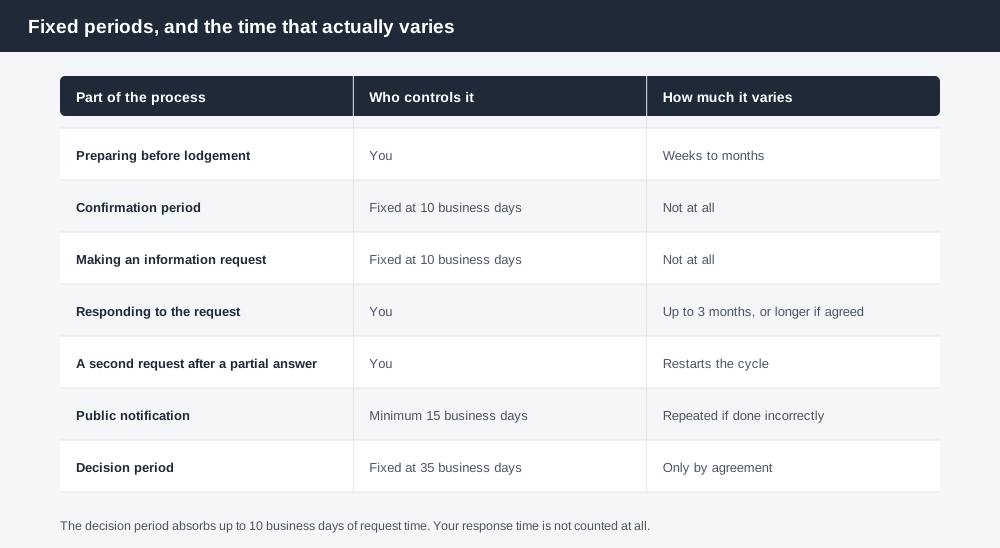
Figure 1: Fixed periods on the left, variable time on the right — and the variable time is yours.
The confirmation period is 10 business days and does not move. The decision period is 35 business days and moves only by agreement. Public notification has a statutory minimum. None of these are negotiable, and none of them are where a slow application gets slow.
The variable time is: how long you take preparing the application before lodgement; how long you take responding to an information request, which can be up to three months; whether a second information request follows a partial response; and whether public notification has to be repeated because it was done incorrectly.
Note the asymmetry. The decision period absorbs up to 10 business days of the time the assessment manager took to make an information request — but the time you take responding is not counted against council at all. How long council approval takes works through the full timeline.
Lever 1: avoid the information request
Spend 5 minutes, not 3 weeks
instantDA generates a council-ready planning report for Queensland development applications. No town planner. No waiting.
Get your report →This is worth more than everything else combined, and it is almost entirely within your control.
Information requests trace back to a short list of causes: an overlay never addressed, plans that are not dimensioned or contradict each other, a planning report that lists the applicable codes without assessing against them, a non-compliance asserted without evidence, or a technical report the overlay code required and nobody read.
- ✓Identify EVERY overlay affecting the premises before design
- ✓Read what each overlay code requires you to demonstrate
- ✓Address every applicable code, individually
- ✓Evidence every non-compliance with specifics, not adjectives
- ✓Cross-check the plan set for internal contradictions
- ✓Confirm the supporting information list with your council
None of that is difficult. It is just work that is easy to skip when a job feels routine, and the routine jobs are where overlays get missed.
Lever 2: get the category right, and early
The difference between code assessable and impact assessable is months, not weeks. Impact assessment adds public notification of at least 15 business days, a submissions period, and the assessment manager's consideration of submissions — plus submitter appeal rights that can extend the timeline well past the decision.
Sometimes the category is fixed by the use and the zone and nothing can change it. Sometimes it is not: scale, siting, the exact defined use, or which part of a site the development sits on can be the difference. Where that choice exists, it is worth making deliberately at concept stage rather than discovering it at lodgement.
Lever 3: talk to council before lodging
Free, underused, and it surfaces problems while they are still cheap to fix.
Most Queensland councils offer a pre-lodgement discussion. An officer telling you in advance that a particular non-compliance will not be supported, or that a particular technical report will be required, is worth far more than the same information arriving as an information request eight weeks later.
Come with specifics. A pre-lodgement meeting with concept plans, the codes you think apply and a clear question produces a useful answer. One with a vague description produces a vague answer.
Book early — availability, not willingness, is usually the constraint.
Lever 4: respond fast, and completely
When a request does arrive, treat the response as a priority rather than a background task.
Answer item by item, using the request's own numbering. Where you are not providing something, say so and say why, rather than leaving a silence for the assessor to interpret. Where you are supplying amended plans, mark clearly which drawings are superseded — councils assessing two versions of the same elevation generate a second request.
Partial responses are the main cause of second requests, and a second request restarts the whole cycle. Responding to an information request sets out how to do it well.
Lever 5: sequence planning in parallel
Planning does not have to sit on the critical path. Run the category check at quote stage. Progress the planning work alongside engineering and building documentation rather than after them. Where a state referral looks likely, resolve the trigger before the design is locked, because a referral adds a second decision-maker with its own information request power.
The builder's council approval checklist turns this into a repeatable process.
What does not work
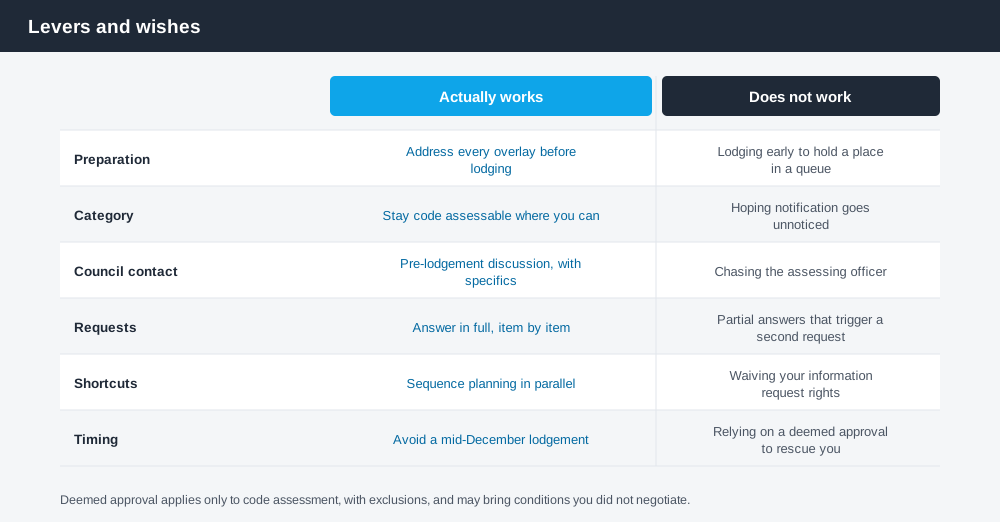
Figure 2: The difference between a lever and a wish.
Chasing the assessment officer. They are working to a statutory period. Calls do not shorten it, and a good relationship is worth more than a fast one.
Lodging early with an incomplete package "to get in the queue". This is the most common false economy. An incomplete application does not hold a place; it collects an action notice or an information request, and lands you further back than if you had spent another fortnight preparing.
Waiving your right to an information request. DA Form 1 lets you elect not to receive one, which prevents the assessment manager and referral agencies from asking for anything further. It genuinely saves time when the package is complete. When it is not, you have removed the only mechanism by which a gap could be fixed before the decision — and the decision is then made on what you sent. This is the shortcut most likely to backfire.
Assuming a deemed approval will rescue you. It exists, but only for applications requiring only code assessment, with several exclusions, and it can bring standard conditions you did not negotiate. It is a remedy for a stalled application, not a strategy.
Lodging in mid-December. Business days under the rules exclude the days between 26 December and 1 January, so a December lodgement runs longer in calendar terms than the day counts suggest.
What to do next
The fastest DA is a complete one, and completeness is a planning question. An instantDA planning report works through your zone, your overlays and every applicable code before you lodge, for $169 — against $800–$1,500 for a town planner preparing the same document. Confirm current processing times with your council when planning your program.
Start with a planning report, or go straight to creating your report.
Frequently asked questions
What is the fastest way to get a DA approved in Queensland?
Can I ask council to process my application faster?
Should I waive my right to an information request to save time?
Does staying code assessable really save time?
Is it worth lodging early with an incomplete package?
Why do December applications take longer?
Ready to generate your report?
Skip the writing. Get a council-ready planning report in 5 minutes.
Get your report