Key takeaways
- ✓Queensland law does not require a town planner. An owner can lodge their own development application.
- ✓The council's own free tools and planning enquiry service answer more questions than most people expect.
- ✓A building certifier handles building approval, and a great many projects never need planning approval at all.
- ✓The realistic alternatives differ by what they cover, not just by price — know where each one stops.
- ✓Complexity, not cost, is the right test. Impact assessable and contested proposals are where a planner earns their fee.
Alternatives to Hiring a Town Planner in QLD
There is a widespread assumption that dealing with a Queensland council means hiring a town planner. It does not. Nothing in Queensland law requires you to use one, and for a large share of residential projects a planner is not the most efficient way to get the answer you need. Learn more about the ai-generated planning reports.
That is not an argument against planners. It is an argument for matching the tool to the problem.
Get a council-ready planning report in 5 minutes — no planner, no waiting.
Get your report →The short answer
Queensland law does not require a town planner. A property owner can lodge their own development application using the state's DA Form 1. The realistic alternatives are the council's free tools and enquiry service, a building certifier, a building designer, a planning report, or doing it yourself.
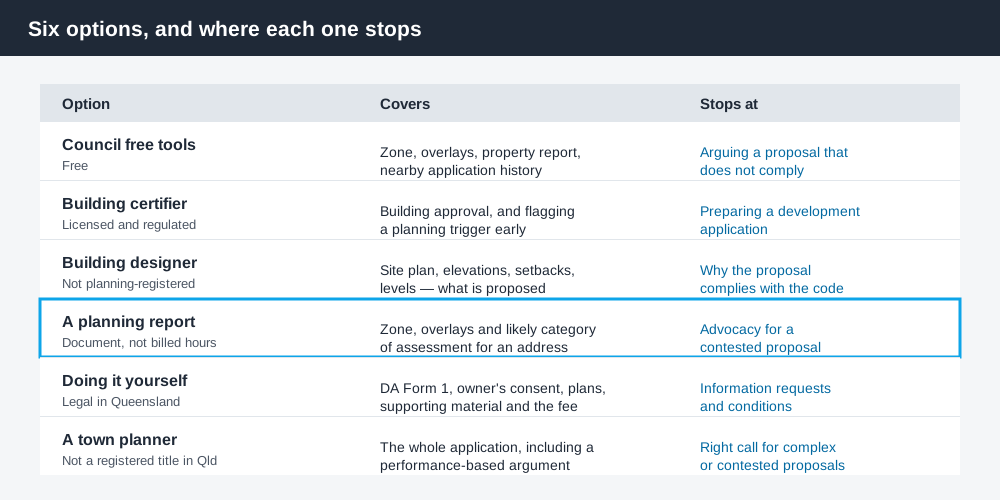
Figure 1: Six options, and what each actually covers.
First: the rule that surprises people
"Town planner" is not a protected or registered title in Queensland. There is no statutory register, and professional membership of the Planning Institute of Australia is voluntary accreditation rather than a licence to practise.
Contrast that with building certifiers, who are a genuinely regulated profession — licensed, with registration requirements, conduct obligations and continuing professional development, operating under the Building Act 1975 framework. If you want a rule of thumb: the person who can issue you a building approval is licensed to do it; the person who writes your planning report is not required to be.
A development application may be made by the owner of the land, or by another person with the owner's written consent. Nothing narrows that to a profession.
Alternative one — the council's own free tools
Spend 5 minutes, not 3 weeks
instantDA generates a council-ready planning report for Queensland development applications. No town planner. No waiting.
Get your report →This is the alternative most people skip, and it answers more than it should.
- ✓Interactive planning scheme mapping — your zone and every overlay
- ✓A property or parcel report summarising both
- ✓development.i — basic property information and the application history in your street
- ✓The council's planning enquiry service, which will answer category-of-assessment questions
Reading three decision notices from similar applications near you tells you what your council actually asked for, which is more useful than a general description of what councils typically ask for. It costs nothing.
Where this stops: free tools tell you the constraints. They will not tell you how to argue a proposal that does not comply.
Alternative two — a building certifier
Many projects that people assume need a planner need building approval, not planning approval. A shed, a deck, a carport, an internal renovation, a straightforward extension in a clean zone — these are building matters, assessed by a private building certifier.
A certifier will also tell you, early and free in most cases, whether your project trips a planning trigger they cannot deal with. That is a genuinely useful filter and it costs a phone call.
Where this stops: a certifier assesses building work against the building framework. They do not prepare or argue a development application.
Alternative three — a building designer or draftsperson
For many code assessable applications, the substance of what the council needs is drawings: an accurate site plan, elevations, setbacks, levels, and a clear description of the proposal. A competent building designer produces that as part of their normal work.
Where this stops: drawings answer "what is proposed". They do not answer "why this complies with the code", which is what a planning response does. For a simple compliant proposal, the drawings may carry most of the weight. For a proposal seeking a departure, they will not.
Alternative four — a planning report
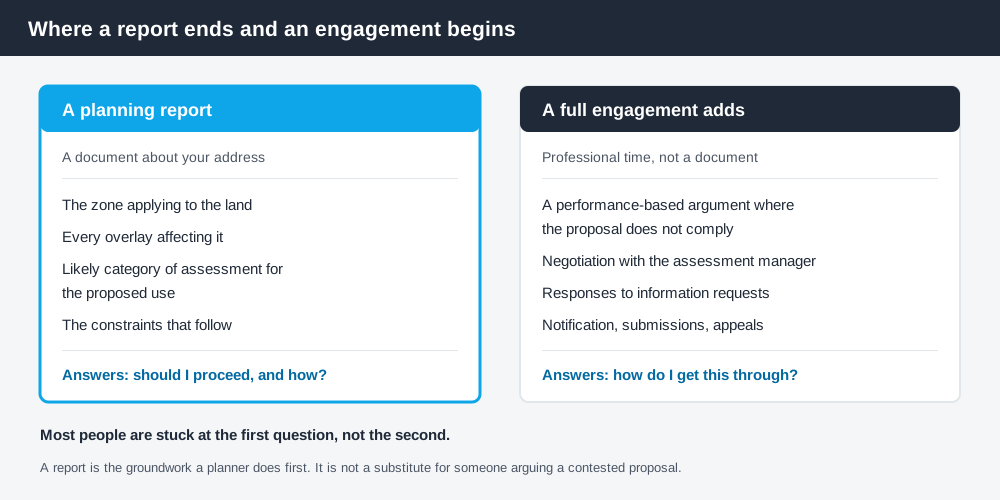
Figure 2: Where a report ends and an engagement begins.
A planning report sets out what applies to a specific address — the zone, the overlays, the likely category of assessment for a proposed use, and the constraints that follow. It is the same groundwork a planner does first, delivered as a document rather than as billed hours.
That is genuinely useful at the point where most people are stuck: deciding whether a project is viable, and whether they need an application at all. It is not a substitute for someone arguing a contested proposal.
Alternative five — doing it yourself
Lodging your own application is legal and, for straightforward proposals, entirely realistic.
The state mandates the forms, and they apply to every council. The one most commonly used is DA Form 1 — Development application details, published by the Queensland Government alongside the other development assessment forms and templates.
- ✓The approved form, usually DA Form 1
- ✓Owner's consent where you are not the owner
- ✓Plans and supporting material the codes require
- ✓The relevant application fee — without it the application is not properly made
Where this stops: information requests and conditions. A council that asks for something you do not understand is where self-lodged applications stall. How to lodge a DA in QLD walks through the mechanics if you want to weigh it up honestly, and instantDA versus doing it yourself compares the two paths directly.
When a planner is actually the right call
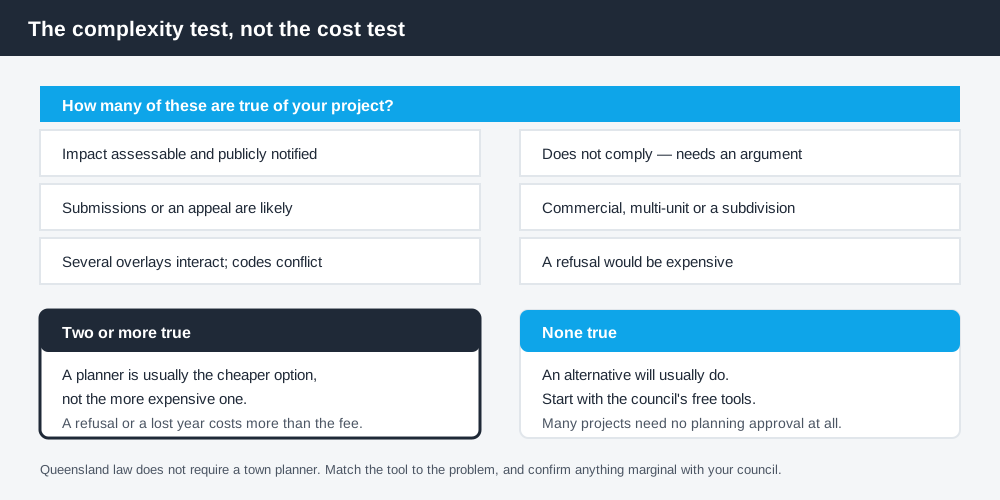
Figure 3: The complexity test, not the cost test.
The honest test is not price. It is complexity and contest.
- ✓The application is impact assessable and will be publicly notified
- ✓The proposal does not comply and needs a performance-based argument
- ✓Submissions or an appeal are likely
- ✓The project is commercial, multi-unit or a subdivision of any scale
- ✓Several overlays interact and the codes conflict
- ✓The money at stake makes a refusal expensive
Where two or more of those are true, a planner is usually the cheaper option, not the more expensive one — because the cost of a refusal, or of a year lost, dwarfs the fee. A town planner typically charges $800–$1,500 for a preliminary opinion, and considerably more for a full application, which is money well spent on a proposal that would otherwise fail.
Where none of them are true, paying for a full engagement to be told your shed is fine is not good value.
Queensland's planning schemes follow the Queensland Planning Provisions structure, but each council layers its own codes, overlays and tables of assessment on top. They are not uniform, and that is precisely why the free council tools are the right starting point regardless of which path you take. If you are still weighing it up, do you actually need a town planner in QLD works through the decision.
What to do next
Work out which problem you have before you buy a solution. If you do not yet know your zone, your overlays and whether your project needs an application, that is the question to answer — and it is answerable without hiring anyone.
If you'd rather see your zone, your overlays and your likely category of assessment set out in one document than work through a planning scheme yourself, an instantDA planning report does that for your address for $169 — against the $800–$1,500 a town planner typically charges for a preliminary opinion. You can start a report in a few minutes.
Then confirm anything marginal with your council directly. Their planning enquiry service is free, and the answer in writing is worth having whichever route you take.
Frequently asked questions
Do I need a town planner to lodge a DA in Queensland?
Is "town planner" a registered profession in Queensland?
What is DA Form 1?
What are the alternatives to hiring a town planner?
When is a town planner worth the cost?
Can a building certifier deal with planning approval?
Ready to generate your report?
Skip the writing. Get a council-ready planning report in 5 minutes.
Get your report