Key takeaways
- ✓Reliability depends on what the report claims. Mapped facts are reliable; predictions about a decision are not.
- ✓The four failure modes are stale mapping, boundary ambiguity, wrong use definition, and overstated certainty.
- ✓No automated report is a decision. Only your council, as assessment manager, decides an application.
- ✓A report that hedges honestly is more useful than one that sounds certain.
- ✓Check any report against your council's own mapping before you rely on it.
Are Automated Planning Reports Reliable in Queensland?
You'll usually hear this called a development application, or DA — that's the formal name for council approval under the Planning Act 2016. Automated planning reports have become common: you enter an address, and a document comes back describing the zone, the overlays and what your council's scheme means for your project. The reasonable question is whether you can trust it. We publish one, so treat this as an interested party's answer — and judge it on whether it is specific about the limits rather than on the conclusion.
Get a council-ready planning report in 5 minutes — no planner, no waiting.
Get your report →The short answer
It depends on what the report claims. Mapped facts — zone, overlays, lot and plan — are reliable because they come from published council and state data. Predictions about how your council will decide are not, because no document can make that call. Judge a report on how honestly it separates the two.
What is genuinely reliable
The factual layer, because it is not being invented.
Zone, precinct and local plan. Published in your council's planning scheme and its mapping. A report reading that mapping correctly is as accurate as the mapping.
Overlays affecting the premises. Same source. Heritage, character, flood hazard, bushfire hazard, biodiversity, coastal hazard, acid sulfate soils — all mapped, all public.
Lot and plan details and state-mapped layers. Available through Queensland Globe and the state's spatial data.
The structure of the scheme. Which codes apply to which zones, what the tables of assessment say, and what the assessment benchmarks require. This is text in a published document.
The building exemption thresholds. Numbers in the Building Regulation 2021 — a shed at 10 m² or less, 2.4 m or lower, mean height 2.1 m or less, no side over 5 m; a fence at 2 m or under; a retaining wall at 1 m or less with no surcharge and 1.5 m clear. Fixed figures, correctly quoted or not.
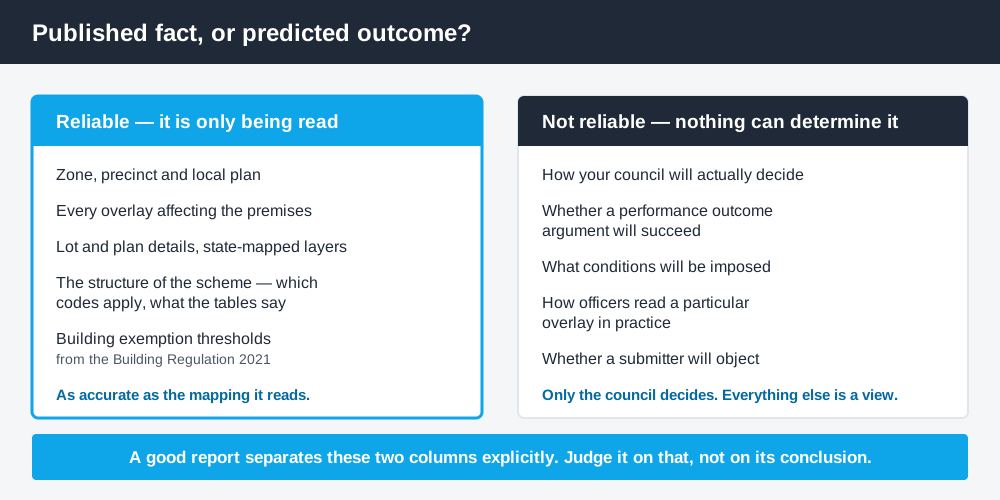
Figure 1: The line runs between published fact and predicted outcome.
The four failure modes
Spend 5 minutes, not 3 weeks
instantDA generates a council-ready planning report for Queensland development applications. No town planner. No waiting.
Get your report →1. Stale mapping. Planning schemes are amended, overlays are remapped, and temporary local planning instruments come into force. A report built on last quarter's data can describe a property accurately as it was. Check when the underlying data was current, and cross-check the live scheme mapping on anything that matters.
2. Boundary ambiguity. Overlay boundaries are drawn at a scale that does not always resolve cleanly to a single lot. A property clipped by the edge of a flood hazard overlay may be reported as affected, unaffected, or both, depending on how the geometry is read. Where a boundary runs through your land, treat any automated answer as a prompt to check with the council, not as a finding.
3. The wrong use definition. Queensland schemes define uses precisely, and the definition determines which table of assessment applies. Whether your proposal is a secondary dwelling or a dual occupancy, a home based business or something else, is a judgement about your specific facts. A report working from a general description of your project can pick the wrong one, and everything downstream then answers the wrong question.
4. Overstated certainty. The most consequential and the hardest to spot. A report that says "your proposal is code assessable" reads as settled, when the honest statement is usually "on this reading of the tables, your proposal appears code assessable — confirm with your council". Confident phrasing is a presentation choice, and it is not evidence.
- ✓When was the underlying data current
- ✓Does an overlay boundary clip the property
- ✓Which defined use has been assumed
- ✓Does the report distinguish facts from predictions
- ✓Does it tell you to confirm with the council
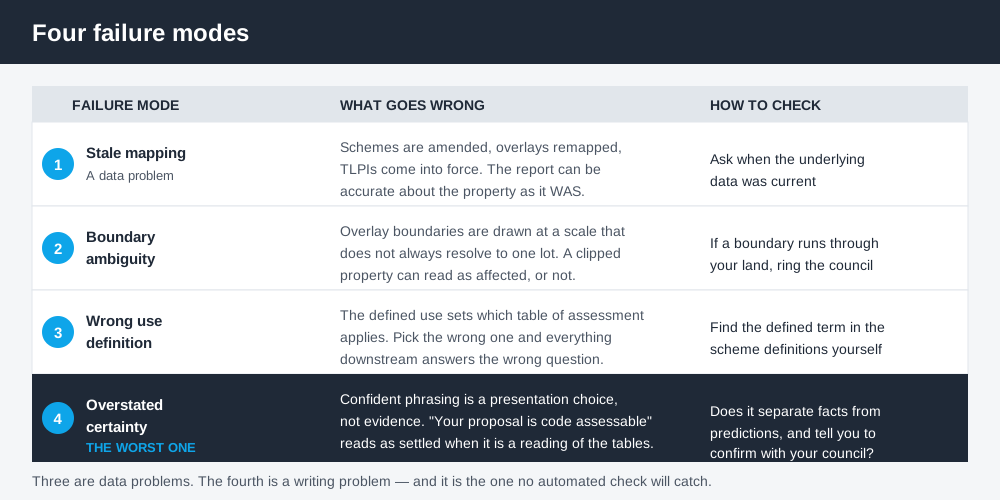
Figure 2: Three are data problems. The fourth is a writing problem, and it is the worst.
What no report can do
True of automated reports, and equally true of a consultant's.
None of them is a decision. Only your council, as assessment manager, decides a development application. Every report is a view.
None of them is a building approval. Building approval is a separate system under the Building Act 1975, given by a building certifier. Building approval vs development approval in QLD sets out the split.
None of them knows your council's habits. How officers read a particular overlay, which performance outcome arguments have been accepted before, what conditions get imposed. That is what a planner who works your scheme weekly brings, and it is not in any dataset.
None of them is legal advice. For enforcement, appeals or contract questions, that is a planning lawyer.
How to check one in ten minutes
Open your council's scheme mapping and compare. Zone, precinct, every overlay. If they match, the factual layer is doing its job. If they do not, stop relying on the report.
Check the lot and plan. Confirm against Queensland Globe that the report is describing your land and not the neighbouring parcel — a real risk on battle-axe lots and recently subdivided titles.
Find the use. Locate the defined use term in the scheme's administrative definitions and satisfy yourself it matches what you actually intend to do.
Read the hedging. A report that tells you where it is uncertain, and directs you to confirm with your council, is being straight with you. One that reads as uniformly certain across facts and predictions alike is the one to be careful with.
Ring the council. Ten minutes on the development enquiries line, with the zone and your proposal in hand, confirms or corrects most of it for nothing.
What they are actually for
Used correctly, an automated report is a fast, cheap way to establish what your land is before you spend money finding out. That is a real job, and for a lot of Queensland homeowners it ends the enquiry — because the answer is that no approval is needed.
Used incorrectly, it becomes a substitute for the professional advice a difficult proposal needs. If you are relying on performance outcomes, or your proposal is impact assessable, no report at any price replaces a planner. Is a town planner worth it in QLD works through where that line sits.
An instantDA planning report sets out your zone, your overlays and your likely category of assessment for your address for $169, against the $800–$1,500 a town planner typically charges for a preliminary opinion. It is a research document, it says so, and it tells you to confirm your position with your council — because that is the accurate thing to say. You can start a report in a few minutes.
Then check it against your council's own mapping. Any report worth buying will survive that, and a report that discourages you from checking is telling you something.
Frequently asked questions
Are automated planning reports accurate in Queensland?
What can go wrong with an automated planning report?
Can an automated report replace a town planner?
Does a planning report guarantee my approval?
How do I check a planning report is right?
Should I trust a report that sounds very certain?
Ready to generate your report?
Skip the writing. Get a council-ready planning report in 5 minutes.
Get your report