Key takeaways
- ✓"Planning report" covers four different documents at four very different prices. Confirm which one you are being quoted.
- ✓A due diligence report answers what your land allows. A planning assessment report argues a case to council.
- ✓Only the assessment report goes to council with a development application. The others are for you.
- ✓Price tracks the number of benchmarks that must be argued, not the number of pages.
- ✓Buy the cheapest document that answers your actual question, then escalate if you have to.
What Does a Planning Report Cost in Queensland?
You'll usually hear this called a development application, or DA — that's the formal name for council approval under the Planning Act 2016. Ask what a planning report costs in Queensland and the honest first answer is a question back: which of four quite different documents do you mean? They range from a desktop summary to a full assessment lodged with a DA, and the price range across them is wide enough that a quote is meaningless without knowing which one it covers. Learn more about the ai-generated planning reports. Learn more about the cost of subdivision per lot in qld.
Get a council-ready planning report in 5 minutes — no planner, no waiting.
Get your report →The short answer
"Planning report" covers four documents. A desktop property or zoning summary is the cheapest. A due diligence report is more thorough. A planning assessment report supporting a development application is the most expensive because it argues a case against benchmarks. Only the last goes to council.
The four documents
1. A property or zoning summary. What the land is: zone, precinct or local plan, overlays affecting the premises, and the basic constraints. Machine-assembled from council and state mapping, and priced accordingly — this is the cheapest tier and it answers a narrow but genuinely useful question.
2. A due diligence report. A planner reviews the site properly, works out the category of assessment for your specific proposal, identifies the codes and benchmarks that will apply, and gives a view on feasibility and the obvious obstacles. This is what most people mean when they ring a planner and say "can you tell me if I can do this". Fixed fee, low thousands typically, more on a complex site.
3. A planning assessment report. The document that accompanies a development application. It describes the proposal, addresses each applicable assessment benchmark in turn, and where an acceptable outcome cannot be met, argues that the proposal achieves the performance outcome above it. This is the expensive one, because it is written advocacy rather than research.
4. A specialist report. Traffic, acoustic, ecology, bushfire, flood, arborist, heritage. Not planning reports at all, but often bundled into the same conversation and quoted alongside. Each is a separate consultant and a separate fee.
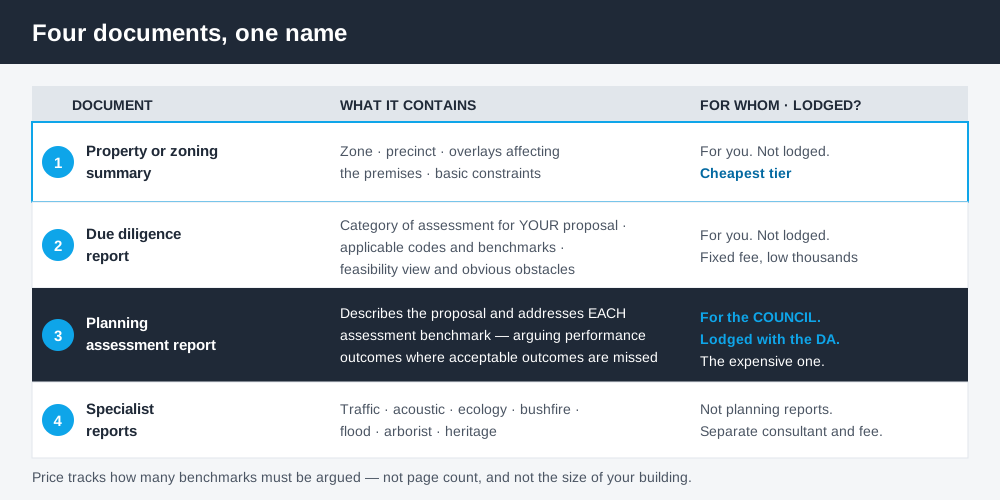
Figure 1: Four documents that share a name and very little else.
What actually drives the price
Spend 5 minutes, not 3 weeks
instantDA generates a council-ready planning report for Queensland development applications. No town planner. No waiting.
Get your report →Not page count, and not the size of your building.
How many benchmarks have to be argued. A proposal that meets every acceptable outcome is a documentation exercise — state the requirement, state your figure, done. A proposal that fails an acceptable outcome must address the performance outcome above it on its own terms, and that argument is the skilled and slow part. Two proposals of identical scale can differ several-fold in report cost for this reason alone.
Your category of assessment. Code assessment is bounded: assessed only against the assessment benchmarks, no public notification, no submitter appeal rights. Impact assessment opens the whole planning scheme and must be notified. That difference changes the scope of the report entirely. Accepted vs code vs impact assessable in QLD sets out how your category is worked out.
How many overlays apply. Each overlay adds its own code, its own benchmarks and often a specialist input to co-ordinate.
How well briefed the planner is. A client who arrives with the zone, the overlays and clear drawings buys fewer hours than one who arrives with a photo of a shed. This is entirely within your control.
Which council. Queensland schemes follow the Queensland Planning Provisions structure, but each council layers its own codes and overlays on top and they are not uniform. A planner working in an unfamiliar scheme spends longer, whatever their hourly rate.
- ✓Which of the four documents am I being quoted
- ✓Is it fixed fee or hourly
- ✓Does it cover responding to an information request
- ✓Which benchmarks will actually need arguing
- ✓Is any specialist report assumed but not included
Which one do you actually need
Work down the list and stop at the first one that answers your question.
If you are asking whether you need approval at all — a shed, a deck, a carport, a fence — you need the zone, the overlays and the exemption thresholds. That is the cheapest tier, and for a large share of homeowners it ends the enquiry.
If you are buying a property and want to know whether an intended use is realistic before going unconditional, the summary or due diligence tier is the right level. Commissioning a full assessment report on a property you may not buy makes no sense.
If you are proceeding with an application that complies with everything, you may need very little written advocacy. A building designer and a certifier can carry a lot of straightforward code assessable work.
If you are relying on performance outcomes, or the proposal is impact assessable, you need the assessment report and you need a planner writing it. This is the point where saving money on the document costs you the approval.
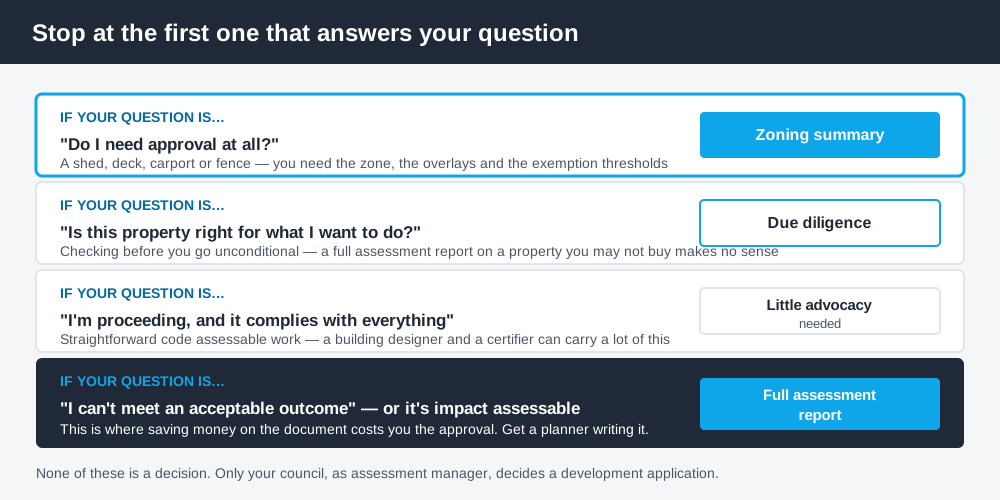
Figure 2: Stop at the first document that answers your question.
What no planning report does
Worth stating plainly.
None of them is a decision. Only your council, as assessment manager, decides a development application. A report is a view, however well-informed.
None of them is a building approval. Building approval is a separate system under the Building Act 1975, given by a building certifier. Building approval vs development approval in QLD explains the split.
None of them replaces confirming with your council. Schemes are not uniform, officers interpret, and a pre-lodgement meeting is often worth more than another paragraph of report.
Getting it priced properly
Establish your zone, your overlays and your likely category of assessment before you ask anyone for a quote. That single step makes every quote cheaper and more accurate, because there is less discovery work to bill — and it sometimes reveals that no report is needed at all.
Use your council's planning scheme maps and Queensland Globe for lot, plan and state-mapped layers. The state's guidance on local planning schemes explains how the documents fit together.
If you'd rather buy that first tier than assemble it yourself, an instantDA planning report sets out your zone, your overlays and your likely category of assessment for your address for $169, against the $800–$1,500 a town planner typically charges for a preliminary opinion. It is the research document, not the assessment report that gets lodged with a DA, and it is honest about that boundary. You can start a report in a few minutes.
For the wider market on professional fees, town planner fees in Queensland covers what planners charge across the state. And confirm anything you rely on with your council before you commit money.
Frequently asked questions
How much does a planning report cost in Queensland?
What is the difference between a due diligence report and a planning assessment report?
Do I need a planning report to lodge a DA in Queensland?
Why do quotes for the same job vary so much?
Does a planning report guarantee approval?
Is a cheap planning report worth buying?
Ready to generate your report?
Skip the writing. Get a council-ready planning report in 5 minutes.
Get your report