Key takeaways
- ✓Lodging your own development application in Queensland is entirely legal and often the right choice.
- ✓The hard part of doing it yourself is not the form. It is knowing which codes apply and what the council will ask for.
- ✓A planning report front-loads the research; you still lodge the application yourself.
- ✓Neither option helps with a proposal that does not comply and needs to be argued.
- ✓Decide by where you are stuck: the paperwork, or the research behind it.
instantDA vs Doing It Yourself in QLD
Let's start with the part that matters most: you can lodge your own development application in Queensland. Nothing requires you to buy anything, from us or anyone else. A development application may be made by the owner of the land, or by another person with the owner's written consent, and there is no requirement that the applicant hold a planning qualification.
So this is not an argument that you need help. It is a comparison of two honest paths, and a description of where each one actually saves you something.
Get a council-ready planning report in 5 minutes — no planner, no waiting.
Get your report →The short answer
Doing it yourself is legal and workable for straightforward proposals. The hard part is not the form — it is working out which codes apply and what the council will expect. A planning report front-loads that research; you still lodge the application yourself. Neither path argues a non-compliant proposal for you.
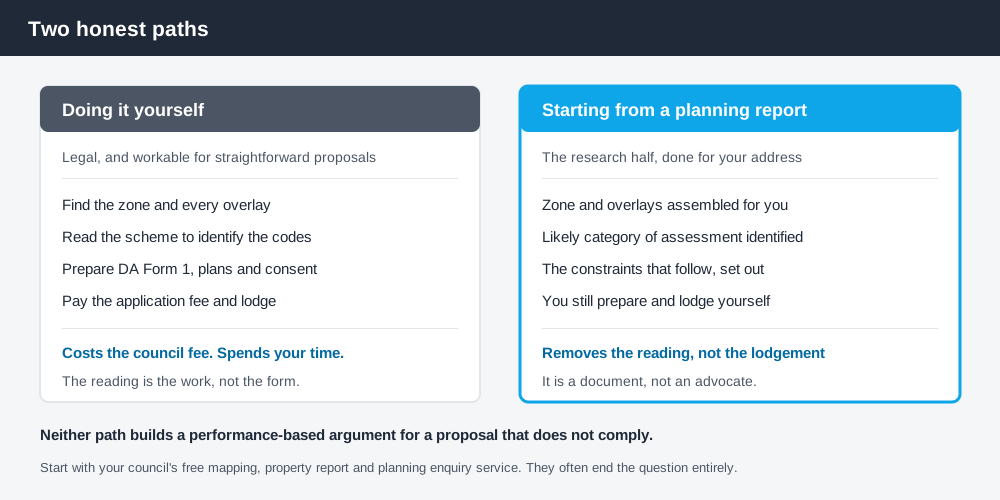
Figure 1: What each path covers.
What doing it yourself actually involves
The mechanics are more approachable than people expect. The state mandates the forms and they apply across every council. The one most commonly used is DA Form 1 — Development application details, published by the Queensland Government with the other development assessment forms and templates.
- ✓The approved form, usually DA Form 1
- ✓Owner's consent where you are not the owner
- ✓Plans and drawings that describe the proposal accurately
- ✓The supporting material the relevant codes require
- ✓The application fee — without it the application is not properly made
Get those five right and the application is properly made, which is what starts the assessment clock. How to lodge a DA in QLD sets out the sequence in detail, and DA Form 1 in QLD covers the form itself.
None of that is the hard part.
Where self-lodged applications actually get stuck
Spend 5 minutes, not 3 weeks
instantDA generates a council-ready planning report for Queensland development applications. No town planner. No waiting.
Get your report →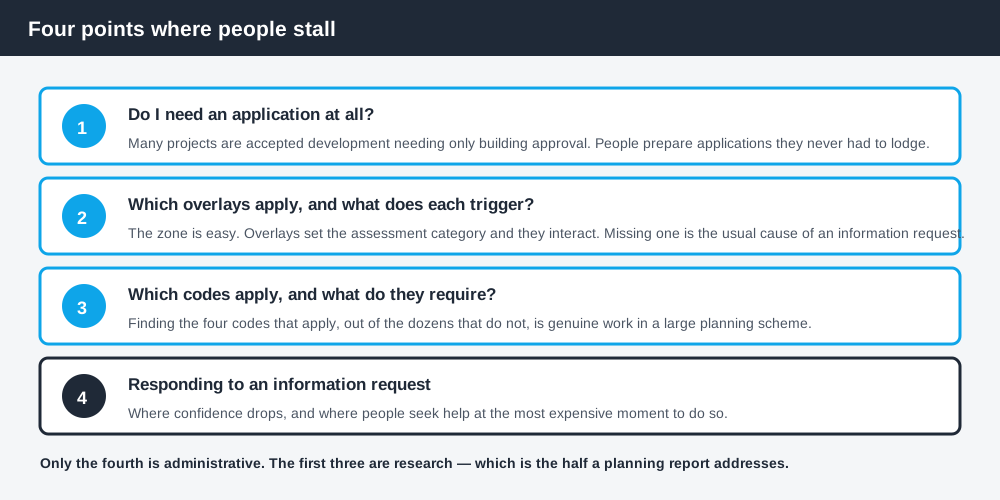
Figure 2: Four points where people stall.
In practice, self-lodged applications stall at four points, and only one of them is administrative.
Knowing whether you need an application at all. A surprising share of projects are accepted development and need only building approval. People spend weeks preparing an application they never had to lodge — or, worse, skip an application they did need.
Identifying every overlay and what each one triggers. The zone is easy. Overlays are where the assessment category actually gets set, and they interact. Missing one is the most common cause of an information request.
Knowing which codes apply and what they require. A planning scheme is a large document. Finding the four codes that apply to your proposal, out of the dozens that do not, is genuine work.
Responding to an information request. This is where confidence drops. A council asking for something in unfamiliar language is the point at which many people stop and go looking for help — usually at the most expensive moment to do so.
What a planning report changes
A planning report does the research half. For a specific address it sets out the zone, the overlays, the likely category of assessment for what you want to do, and the constraints that follow from all three.
- ✓Your zone and what it contemplates
- ✓Every overlay affecting the land
- ✓The likely category of assessment for your proposal
- ✓The constraints and codes that follow
That directly addresses the first three stalling points. It does not lodge anything for you, and it is not an advocate.
An instantDA planning report does that for your address for $169 — against the $800–$1,500 a town planner typically charges for a preliminary opinion covering similar ground. You can start a report in a few minutes.
What neither path does
This is the part comparison articles usually leave out, so here it is plainly.
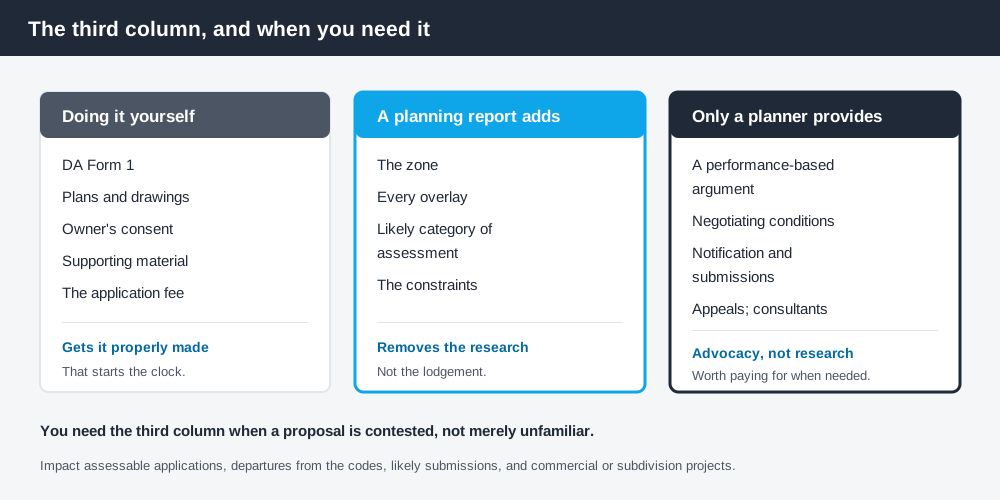
Figure 3: The third column, and when you need it.
Neither doing it yourself nor buying a report will:
- ✓Build a performance-based argument for a proposal that does not comply
- ✓Negotiate conditions with the assessment manager
- ✓Manage public notification and respond to submissions
- ✓Represent you if a decision is appealed
- ✓Coordinate specialist consultants on a complex site
Those are professional services, and where they are needed they are worth paying for. A town planner is the right call when the application is impact assessable, when the proposal departs from the codes, when submissions or an appeal are likely, or when the project is commercial or a subdivision of any scale. Do you actually need a town planner in QLD works through that decision honestly.
How to choose
The useful question is not "which is better" but "where am I stuck".
- ✓Stuck on the paperwork, but you know your constraints — do it yourself
- ✓Stuck on the research, unsure what applies to your address — a report resolves that
- ✓Stuck because your proposal does not comply — you need a planner
- ✓Not sure whether you need an application at all — that is the cheapest question to answer, and free tools often answer it
That last one is worth pressing. Your council's interactive mapping, property report and planning enquiry service cost nothing, and for many homeowners they end the question entirely. Use them first regardless of which path you choose. Alternatives to hiring a town planner in QLD sets out the full range of options if you want to weigh them side by side.
A note on why this is harder in Queensland than people expect
Queensland's planning schemes follow the Queensland Planning Provisions structure, but each council layers its own codes, overlay names, definitions and tables of assessment on top. They are not uniform.
That matters for anyone doing their own research, because most of what you find online was written for a different council. A rule about secondary dwelling floor area, or an outbuilding size threshold, or a setback figure, may be exactly right in one local government area and wrong next door. Always trace a rule back to your own council's scheme before relying on it — and where the scheme is ambiguous, ask the council and keep the answer.
The other Queensland-specific trap is the split between building approval and development approval. They sit under different Acts, with different decision-makers — a private building certifier for the first, the council as assessment manager for the second. Plenty of projects need one and not the other, and treating them as the same thing is how people end up preparing the wrong application.
What to do next
Answer the free questions first: your zone, your overlays, and whether the work is accepted development. If those answers settle the matter, you are done and you should spend nothing.
If they do not, decide whether your gap is research or advocacy. A planning report addresses the first for $169 — against the $800–$1,500 a town planner typically charges for a preliminary opinion. Advocacy is a planner's job, and worth it where the proposal is genuinely contested.
Then, whichever path you take, confirm the position with your council before you lodge. It is free, and it is the single best predictor of an application that goes through without an information request.
Frequently asked questions
Can I lodge my own development application in Queensland?
What do I need to lodge a DA myself?
What is the hardest part of doing it yourself?
What does a planning report do that I cannot do myself?
When do I need a town planner instead?
Why is online advice about Queensland rules so inconsistent?
Ready to generate your report?
Skip the writing. Get a council-ready planning report in 5 minutes.
Get your report