Key takeaways
- ✓Planning fees vary because the scope varies, not because some planners are simply cheaper.
- ✓Ask what a quote excludes. Specialist reports, notification and information request responses are the usual exclusions.
- ✓Town planner is not a registered title in Queensland, so credentials are worth checking rather than assuming.
- ✓The cheapest correct outcome is often not hiring anyone, because many projects need no planning approval at all.
- ✓Compare quotes on scope and deliverables, not on headline price.
Cheap Town Planners in QLD: What You Actually Get
Searching for a cheap town planner is a reasonable thing to do. Planning fees are opaque, quotes vary wildly for what sounds like the same job, and it is hard to tell whether you are comparing like with like.
The uncomfortable answer is that you usually are not. Most of the variation between planning quotes is scope, not rate.
Get a council-ready planning report in 5 minutes — no planner, no waiting.
Get your report →The short answer
Planning quotes vary mainly because the scope varies. A low quote often covers the application only, excluding specialist reports, public notification, information request responses and any negotiation. Compare quotes on what is included and excluded, not on headline price.
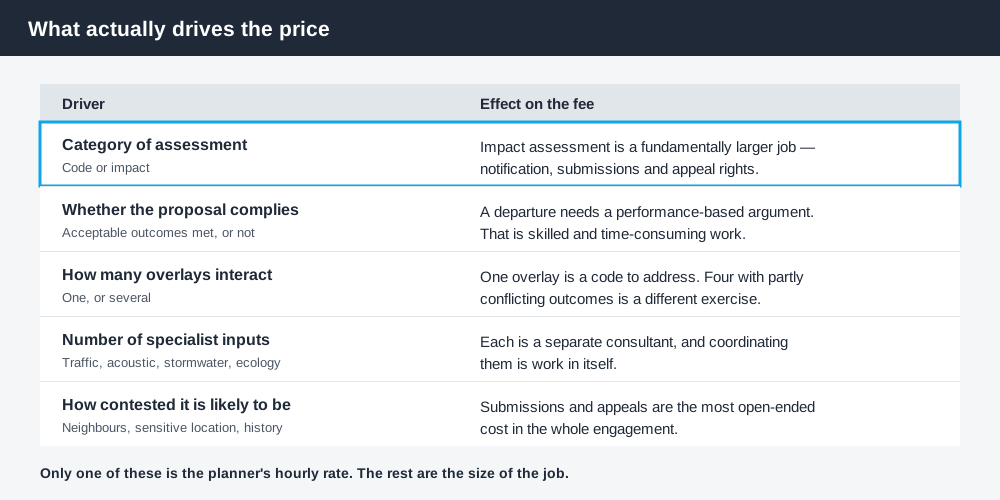
Figure 1: What actually drives the price.
What drives the price
Five things move a planning fee, and only one of them is the planner's rate.
The category of assessment. A code assessable application is assessed against nominated codes. An impact assessable one is assessed against the whole scheme, must be publicly notified, and can attract submissions and appeals. That is a fundamentally larger job.
Whether the proposal complies. A compliant proposal needs a clear planning response. A proposal that departs from an acceptable outcome needs a performance-based argument, which is where planning work becomes genuinely skilled and genuinely time-consuming.
How many overlays interact. One overlay is a code to address. Four interacting overlays with partly conflicting outcomes is a different exercise.
The number of specialist inputs. Traffic, acoustic, stormwater, ecology, bushfire, heritage. Each is a separate consultant, and coordinating them is work in itself.
How contested it is likely to be. Neighbours, a sensitive location, a use the area has resisted before.
What a low quote usually excludes
Spend 5 minutes, not 3 weeks
instantDA generates a council-ready planning report for Queensland development applications. No town planner. No waiting.
Get your report →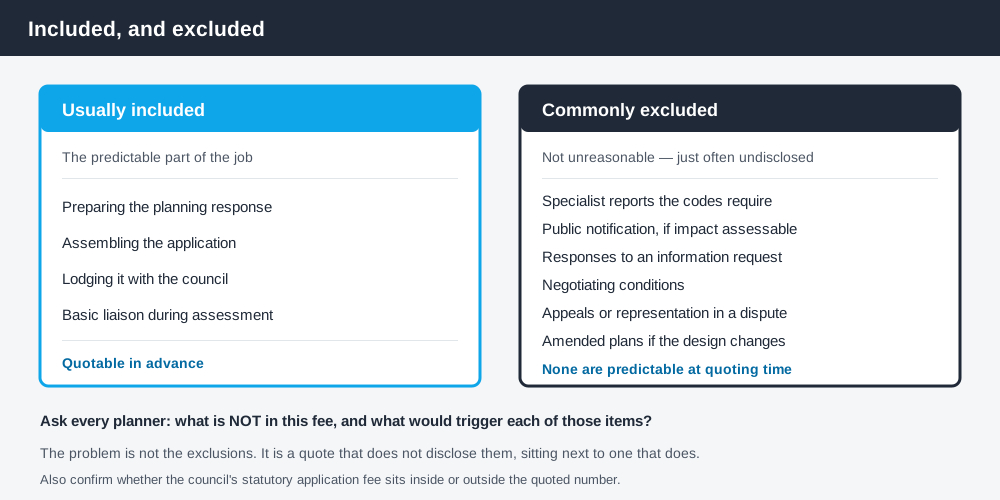
Figure 2: Included, and excluded.
This is the practical question to ask, and most people never do.
- ✓Specialist reports the codes require — usually excluded, quoted separately or by the consultants directly
- ✓Public notification for impact assessable applications — usually excluded, and the applicant pays for it
- ✓Responses to an information request — often charged as an additional item
- ✓Negotiation with the assessment manager over conditions
- ✓Any appeal, or representation in a dispute
- ✓Amended plans where the design has to change
None of those exclusions are unreasonable, because none of them are predictable at quoting time. The problem is not that they are excluded. The problem is when a quote does not say so, and the difference between two quotes turns out to be that one disclosed them.
Ask every planner the same question: "What is not in this fee, and what would trigger each of those items?" The answer tells you more than the number.
The credential question
"Town planner" is not a protected or registered title in Queensland. There is no statutory register, and professional membership of the Planning Institute of Australia is voluntary accreditation rather than a licence to practise.
That is worth knowing when you are comparing on price, because it means credentials are not guaranteed by the job title. It also means the range of people offering planning services is genuinely wide — from experienced former council assessment officers to people with no planning qualification at all.
Contrast that with building certifiers, who are licensed and regulated under the Building Act 1975 framework, with registration and conduct requirements. If your project is actually a building matter, you are dealing with a regulated profession and the credential question answers itself.
- ✓Ask what planning qualifications the person holds
- ✓Ask whether they hold professional accreditation, and with whom
- ✓Ask how many applications of your type they have taken through your specific council
- ✓Ask for the reference number of a recent comparable approval, which you can look up yourself
That last one is the strongest test available and it costs nothing. Development application records are public — you can read the decision notice and see what the council actually required.
Comparing quotes properly
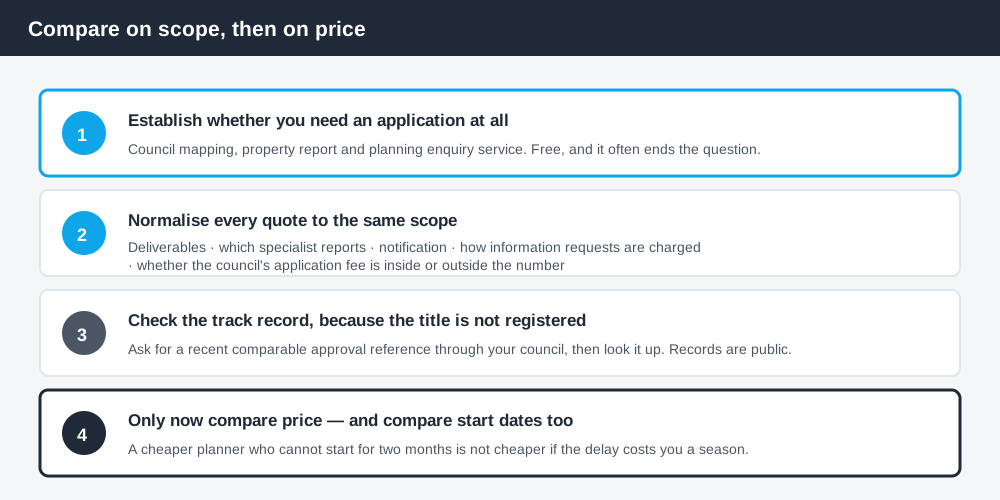
Figure 3: Compare on scope, then on price.
Put every quote into the same shape before you look at the numbers.
- ✓What deliverables are produced, specifically
- ✓Which specialist reports are included, and which are not
- ✓Whether notification is included, if the application will be notified
- ✓How information requests are charged
- ✓What happens to the fee if the application is refused
- ✓Whether the council's application fee is included or separate
The last one catches people constantly. The council's application fee is a statutory charge that you pay regardless of who prepares the application, and quotes differ on whether it sits inside or outside the number.
Do the same for timing. A planner who is cheaper but cannot start for two months is not cheaper if the delay costs you a season.
There is one more thing worth asking, and almost nobody does: what happens if the application is refused. A refusal is not necessarily anyone's fault — councils refuse compliant-looking applications for reasons that only emerge during assessment — but it is worth knowing in advance whether a resubmission is charged again in full, at a reduced rate, or not at all. Firms differ on this, and the answer tells you something about how confident they are in the advice they are about to give you. It also tells you whether the quote in front of you is a fee for a document or a fee for an outcome, which is the real distinction between a cheap quote and a good one.
When the cheapest correct answer is nobody
This is the part a planning firm will not tell you, so here it is.
A meaningful share of the projects people seek planning quotes for do not need planning approval at all. A shed within the exemption, a low freestanding deck, an internal renovation that does not touch structure, a straightforward extension in a clean zone — these are building matters, or nothing at all.
Before you collect quotes, establish four things using free tools:
- ✓Your zone
- ✓Every overlay affecting the land, and whether each covers your building envelope
- ✓Whether the work is accepted development under the scheme
- ✓Whether a building certifier alone can deal with it
Your council's interactive mapping, property report and planning enquiry service will answer all four at no cost. Alternatives to hiring a town planner in QLD sets out the full range of options, and is a town planner worth it in QLD works through the value question directly.
Queensland's planning schemes follow the Queensland Planning Provisions structure, but each council layers its own codes, overlays and thresholds on top. They are not uniform, which is exactly why a planner who knows your specific council is worth more than one who is cheaper.
What to do next
Establish whether you need an application before you shop for someone to prepare one. If you do need one, get three quotes and normalise them on scope before you compare price — and ask each one what is excluded.
If you'd rather see your zone, your overlays and your likely category of assessment set out in one document than work through a planning scheme yourself, an instantDA planning report does that for your address for $169 — against the $800–$1,500 a town planner typically charges for a preliminary opinion. You can start a report in a few minutes.
If your project does turn out to be complex, do not optimise for the cheapest quote. Optimise for the person most likely to get it approved — what a town planner costs in QLD sets out the realistic range so you can tell an underquote from a bargain.
Then confirm the scheme position with your council in writing before anyone starts work.
Frequently asked questions
Why do town planning quotes vary so much in Queensland?
What does a cheap planning quote usually exclude?
Is "town planner" a registered title in Queensland?
How do I check a town planner's track record?
Does a planning quote include the council's application fee?
Do I need a town planner at all?
Ready to generate your report?
Skip the writing. Get a council-ready planning report in 5 minutes.
Get your report