Key takeaways
- ✓Signage is regulated in up to four separate ways and each one has to be checked separately.
- ✓Your planning scheme, or in some councils a dedicated advertising devices local law, sets the category of assessment.
- ✓A sign detached from a building, no higher than 2m and no wider than 1.2m is accepted development for building approval purposes.
- ✓An A-frame on the footpath sits on the road reserve and usually needs a separate local law permit.
- ✓Advertising in a state-controlled road corridor needs approval from Transport and Main Roads under the Transport Infrastructure Act 1994.
- ✓Changing the sign face on an approved structure is often fine — changing the structure usually is not.
Do You Need Council Approval for Business Signage in QLD?
You'll usually hear this called a development application, or DA — that's the formal name for council approval under the Planning Act 2016. For signage, though, a DA is only one of the approvals in play. Queensland councils call signs advertising devices, and an advertising device can be caught by up to four separate rulebooks at once.
Get a council-ready planning report in 5 minutes — no planner, no waiting.
Get your report →The short answer
Usually yes, but check four things rather than one. Your planning scheme decides whether the sign is accepted development, code assessable or impact assessable. A substantial freestanding sign may also need building approval. Footpath signs need a local law permit. Signs near a state-controlled road need approval from Transport and Main Roads.
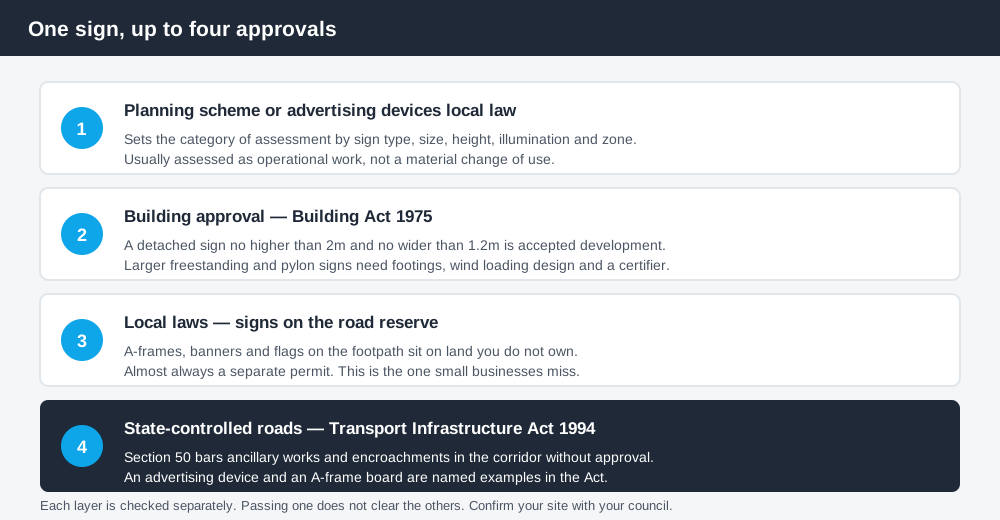
Figure 1: Four separate approvals can apply to one sign.
Which rulebook actually applies to your sign
There is no single Queensland signage rule. Planning schemes follow the Queensland Planning Provisions structure, but every council layers its own codes, overlays and local laws on top, and signage is among the least standardised areas of the lot.
Most councils regulate advertising devices through an advertising devices code in the scheme. Brisbane instead uses a dedicated Advertising Devices Local Law 2021, under which a device may be prohibited outright, allowed if it meets stated self-assessment requirements, or allowed only with council approval. So the first job is not to look up a threshold. It is to find out which instrument your council uses.
- ✓Search your council's planning scheme for an advertising devices code
- ✓Check whether your council also has an advertising devices or local law permit
- ✓Check the zone and any overlays affecting the site
- ✓Check whether the frontage road is state-controlled
What your planning scheme decides
Spend 5 minutes, not 3 weeks
instantDA generates a council-ready planning report for Queensland development applications. No town planner. No waiting.
Get your report →Where the scheme governs, an advertising device is usually assessed as operational work rather than a material change of use, because you are not changing what the premises are used for — you are placing a structure on them.
The categories matter. Accepted development means no application at all. Accepted development subject to requirements means no application either, but only while the sign complies with every stated requirement — miss one and it becomes assessable. Code assessable means a DA judged against benchmarks; impact assessable means a publicly notified DA judged against the whole scheme. If that distinction is new, accepted versus assessable development in QLD sets out how the four categories behave.
Codes key the category to the type of sign — fascia, under-awning, window, wall, projecting, pylon, freestanding, roof or billboard — and then to its dimensions, height above ground, illumination or animation, and the zone. Flat signs attached to a building in a centre zone sit at the permissive end; pylon signs, roof signs, billboards and third-party advertising sit at the assessable or prohibited end. The figures are council-specific, so read your own code rather than a number you found online.
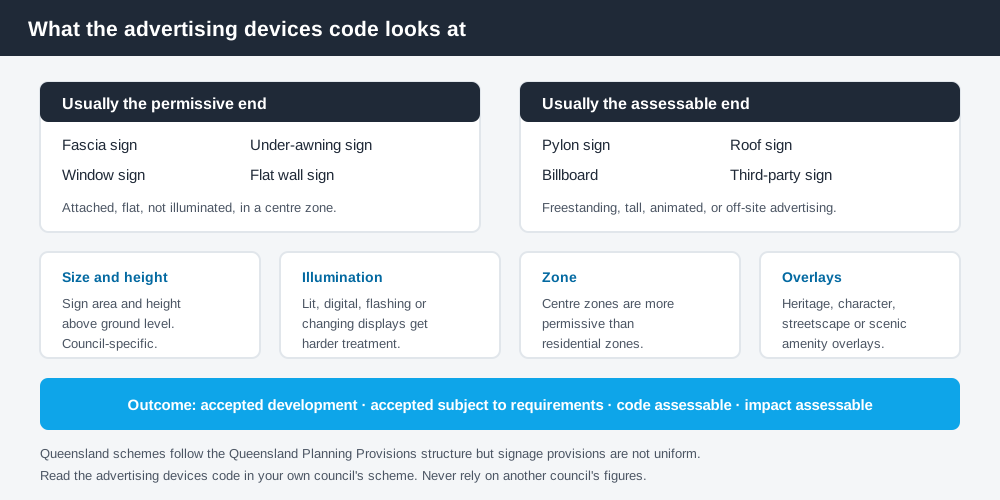
Figure 2: What the code looks at when it sorts your sign.
One distinction runs through most codes: changing the sign face on an existing lawfully approved structure is commonly treated permissively, because the structure and its impacts are unchanged. Changing the structure — taller, wider, illuminated or animated — is assessed as a new proposal.
When a sign needs building approval as well
Building approval sits under the Building Act 1975 and is granted by a building certifier, not by council as assessment manager. It is a separate system, and a sign can need both, either, or neither.
Schedule 1 of the Building Regulation 2021 lists work that is accepted development for building approval purposes. Section 6 covers signs, and erecting a sign detached from a building, no higher than 2m and no wider than 1.2m, falls inside it.
Above that, a freestanding or pylon sign is a structure. It needs footings, it needs to resist wind loading for its region and terrain category, and it will generally need engineering certification as part of a building approval. A painted wall sign, a vinyl window graphic or a flat fascia panel usually does not. Signs bolted onto an awning are the middle case, so ask a certifier.
Footpath signs, A-frames and the road reserve
This is where small businesses come unstuck. The footpath outside your shop is not your land. It is road reserve, and putting anything on it — an A-frame, a banner, a flag, a display of goods — is regulated separately from anything on your own title.
Councils control this through local laws, and almost all require a permit, usually with conditions about clear pedestrian width, placement relative to the shopfront, one device per business and removal outside trading hours. A shop can hold a perfectly valid planning approval for its building signage and still be fined for the A-frame.
Signs on or visible from a state-controlled road
If your frontage is a highway or another state-controlled road, the Department of Transport and Main Roads is in the picture as well as council.
Section 50 of the Transport Infrastructure Act 1994 prohibits anyone other than the chief executive from constructing, maintaining or operating ancillary works and encroachments on a state-controlled road without written approval or an equivalent authorisation, with a maximum penalty of 200 penalty units. The Act's dictionary expressly gives an advertising device and an A-frame board as examples. In practice a sign in the corridor needs a road corridor permit from Transport and Main Roads.
Signs outside the corridor can still be caught. Under section 43, a local government must obtain the chief executive's written approval before approving a sign visible from a motorway, beyond the motorway boundaries, and reasonably likely to create a traffic hazard. Whether a sign near a non-motorway state-controlled road triggers a departmental referral depends on the scheme and the department's roadside advertising guidance, so confirm with the local Transport and Main Roads office.
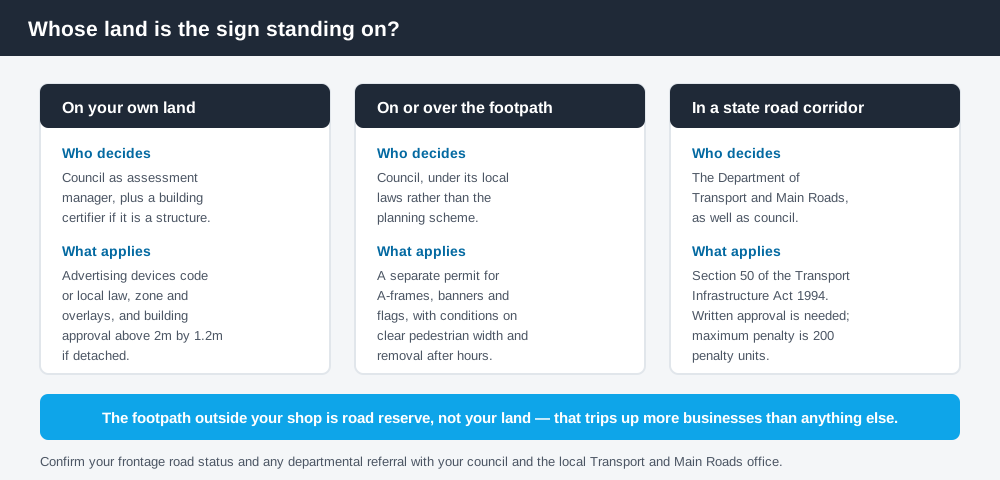
Figure 3: Who regulates the sign depends on whose land it stands on.
Illumination, overlays and the home-based business trap
Illuminated and digital signs get harder treatment almost everywhere. Codes and conditions commonly address luminance, light spill onto residential land and onto the road, hours of illumination, and whether the display may change, flash, scroll or animate. Animated and high-brightness electronic displays are prohibited outright in some locations. A static illuminated sign is a much easier proposition than a changing one.
Overlays layer on further. A heritage overlay, a character or neighbourhood plan, a centre or streetscape code, or a scenic amenity overlay can each pull an otherwise routine sign into assessment. Check the mapping for your address before you order anything.
Home-based businesses are the most common enforcement trigger of the lot. Schemes typically permit only a single small, non-illuminated sign, and anything larger reads as a shopfront in a residential street. Home-based business approval in QLD covers the wider limits that apply.
What to do next
An unapproved sign is unlawful development. Council can issue a show cause notice and then an enforcement notice requiring removal or alteration, and non-compliance is an offence that can end up in the Planning and Environment Court. On a state-controlled road the department can require removal and recover its costs. Applying afterwards is possible — retrospective approval in QLD explains how that runs — but it is slower and less certain than asking first.
Start by identifying the zone, the overlays and the codes that apply to your address, then match your proposed sign type against the advertising devices provisions. If you would rather see that in one document than work through a planning scheme yourself, an instantDA planning report does it for your address for $169 — against the $800–$1,500 a town planner typically charges for a preliminary opinion. You can start a report in a few minutes.
Then confirm with your council, and with Transport and Main Roads if the road is state-controlled, before the sign is fabricated. Signage is cheap to change on paper and expensive in aluminium.
Frequently asked questions
Do I need council approval for a business sign in Queensland?
Do I need building approval for a sign in QLD?
Do I need a permit for an A-frame sign on the footpath?
Can I put a sign facing a highway in Queensland?
What happens if I put up a sign without approval?
Ready to generate your report?
Skip the writing. Get a council-ready planning report in 5 minutes.
Get your report