Key takeaways
- ✓The driveway on your land and the crossover in the road reserve are two different things with two different approvals.
- ✓Works on a road need the local government's written approval under section 75 of the Local Government Act 2009.
- ✓If your frontage is a state-controlled road, the Department of Transport and Main Roads decides, not council.
- ✓The crossover must be built to the council's standard drawing, at the owner's cost, and the owner usually carries the maintenance liability.
- ✓Cut or fill deeper than 1m for a steep driveway takes the earthworks outside the accepted development exemption.
Do You Need Council Approval for a Driveway or Crossover in QLD?
You'll usually hear this called a development application, or DA — that's the formal name for council approval under the Planning Act 2016. A domestic driveway rarely needs one. What it almost always needs is something else entirely: a permit to build the crossover, because the strip of concrete between the kerb and your boundary is not on your land.
Get a council-ready planning report in 5 minutes — no planner, no waiting.
Get your report →The short answer
The driveway on your own land is usually outside building approval. The crossover between the kerb and your boundary is work in the road reserve and needs the council's written approval — or the Department of Transport and Main Roads' approval where your frontage is a state-controlled road.
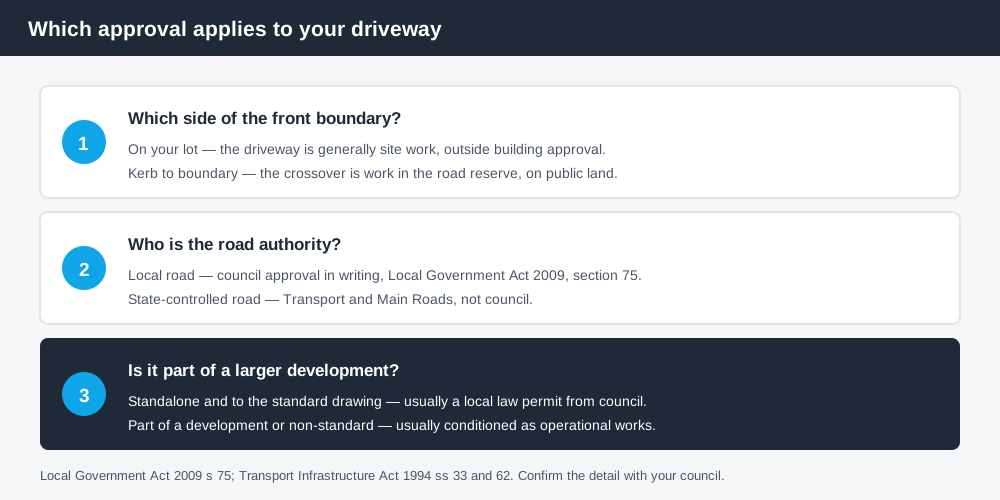
Figure 1: Two pieces of concrete, two different approval systems.
Two pieces of concrete, two systems
Draw a line at your front boundary. Everything behind it — the slab, the gradient, the turning area, the garage apron — is on your lot. Everything in front of it, out to the kerb, is road reserve: public land under the control of a road authority.
That line explains most of the confusion. On your side, a plain driveway slab is generally site work rather than building work, so it sits outside building approval under the Building Act 1975. On the other side, you are cutting a kerb and building on a public road, which has never been a matter for a building certifier.
Who actually approves the crossover
Spend 5 minutes, not 3 weeks
instantDA generates a council-ready planning report for Queensland development applications. No town planner. No waiting.
Get your report →For a road in a local government area, section 75 of the Local Government Act 2009 says a person must not, without lawful excuse or the written approval of the local government, carry out works on a road or interfere with a road or its operation. Approvals may be conditioned, and if works go ahead without one, the council may dismantle or alter them and recover its reasonable costs from you.
That is the legal spine under every "driveway permit", "vehicle crossover permit" or "road reserve works permit" your council advertises. The names vary between councils; the power does not. Brisbane City Council's driveway permit page shows how the process is typically presented.
If your frontage is a state-controlled road, council is not the decision-maker. Under section 33 of the Transport Infrastructure Act 1994, road works on a state-controlled road need the written approval of the chief executive — in practice, the Department of Transport and Main Roads. Section 33 also makes clear that approval for road access works may only be given where there is a permitted road access location decided under section 62, which lets the department fix where access is permitted and specify the type, standard and extent of the works. It is a different pathway, and it takes longer.
What the council checks before it says yes
Councils publish standard drawings for urban and rural vehicle crossings, commonly aligned with the Institute of Public Works Engineering Australasia Queensland standard details. Build to the drawing and assessment is usually straightforward. Depart from it and you are into a formal application.
- ✓The crossover matches the council's standard drawing for the road type
- ✓Sight lines are clear of fences, walls and vegetation
- ✓The location is clear of the intersection, street trees, poles, pits and service valves
- ✓The number of crossovers and their combined width suit the frontage
- ✓The kerb invert and channel flow line are not blocked
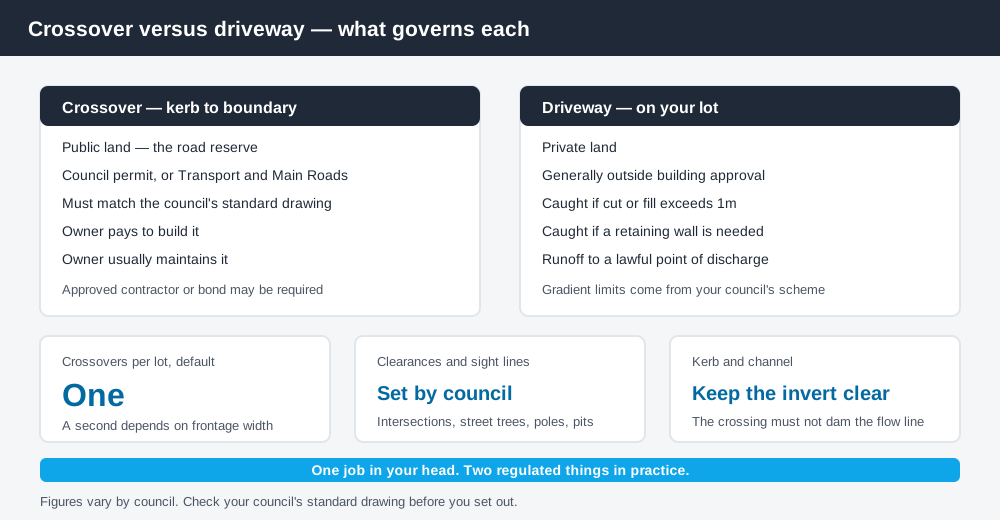
Figure 2: The two halves of the job, and what governs each.
Most councils permit one crossover per lot as the default, with a second considered only where the frontage is wide enough and the combined width stays within a stated proportion of it. Setbacks from intersections, street trees and public infrastructure are also common, but the distances are set council by council. Queensland's planning schemes follow the Queensland Planning Provisions structure, with each council layering its own codes, policies and standard drawings on top, so there is no single statewide figure to quote.
Two practical points catch people. The crossover is built at the owner's cost even though it sits on public land, and councils typically place the ongoing maintenance obligation on the owner as a permit condition. Many councils also require an approved contractor, and some require a security bond against damage to the kerb, footpath or services, refundable once the work passes inspection.
Drainage, the invert and the kerb
A crossover crosses the kerb and channel, which is the street's drainage line. It has to carry the vehicle without damming the flow, which is why the standard drawing controls the invert profile so precisely. A crossover that ponds water in the channel will not be accepted.
The same logic applies on your side of the boundary. A driveway is impervious, so the water it sheds has to reach a lawful point of discharge rather than the neighbour's yard. If you are pouring the driveway and a slab in one job, council approval for a concrete slab in QLD covers where the stormwater obligations sit.
When the driveway itself gets caught
The driveway surface is usually outside building approval, but the ground under it is not always outside the rules. Schedule 1, section 4 of the Building Regulation 2021 treats filling or excavation for a building or structure as accepted development only where the cut or fill is no deeper than 1m above or below the natural ground surface and the embankment gradients stay within the limits set by soil type. A steep driveway on a Queensland hillside routinely exceeds that.
Hold the cut back and you have a retaining wall, with its own thresholds and its own surcharge trap — a driveway sitting over the wall's zone of influence is a surcharge load, and that alone removes the exemption. Read council approval for a retaining wall before you commit to a benched driveway.
Gradient and change-of-grade limits for the driveway itself come from your council's scheme, its standard drawings and referenced design standards, and they vary. Confirm the figures with your council rather than working from a number you read elsewhere.
When it becomes operational works instead
A crossover built as part of a larger project is usually not a standalone permit at all. Where you are lodging a material change of use or reconfiguring a lot, the road access works are typically conditioned in the development approval and delivered under an operational works approval. Operational works in QLD explains how that approval sits alongside the primary DA.
The same shift happens for non-standard crossovers on a single lot. A commercial or heavy-vehicle access, an unusually wide crossing, or one that cannot meet the standard drawing is often pushed from a local law permit into operational works assessment.
What to do next
Sort out the crossover before you book concrete. Confirm whether your frontage is a council road or a state-controlled road, get your council's standard drawing, check the intersection and street tree clearances against your proposed location, and ask whether an approved contractor or a bond applies.
If you'd rather see your zone, your overlays and your likely category of assessment in one document than work through a planning scheme yourself, an instantDA planning report does that for your address for $169 — against the $800–$1,500 a town planner typically charges for a preliminary opinion. You can start a report in a few minutes.
Then confirm with your council. A crossover built to the wrong drawing can be ordered out at your expense — a bad way to learn where your land ends.
Frequently asked questions
Do I need council approval for a driveway in QLD?
Who approves a crossover on a main road in Queensland?
Can I have two driveways on one block in Queensland?
Who pays for and maintains a vehicle crossover in QLD?
Does a new driveway need operational works approval?
Ready to generate your report?
Skip the writing. Get a council-ready planning report in 5 minutes.
Get your report