Key takeaways
- ✓Installing panels on the roof of a building is accepted development under Schedule 1, section 15 of the Building Regulation 2021 — no building approval.
- ✓Section 13 excludes solar from the small class 10 structures exemption, but only because section 15 already covers it.
- ✓The approval that decides whether your system proceeds is the network connection from Energex or Ergon Energy, applied for by your installer.
- ✓A ground-mounted array is not on a roof, so section 15 does not reach it and section 13 will not rescue it.
- ✓Batteries are governed by AS/NZS 5139 siting rules, not by council — including restrictions near habitable rooms.
- ✓Body corporate consent is still needed for a common-property roof, but the grounds for refusal are narrow.
Do You Need Council Approval for Solar or a Home Battery in QLD?
You'll usually hear this called a development application, or DA — that's the formal name for council approval under the Planning Act 2016. For rooftop solar on an ordinary suburban house, a DA almost never comes into it, and neither does building approval. The approval that decides whether your system goes ahead sits somewhere most homeowners never look: with the electricity distributor.
Get a council-ready planning report in 5 minutes — no planner, no waiting.
Get your report →The short answer
For a standard rooftop retrofit on a house, no. Installing solar panels on the roof of a building is accepted development under the Building Regulation 2021, so no building or council approval is needed. Your real approval is the network connection, and your installer applies for it.
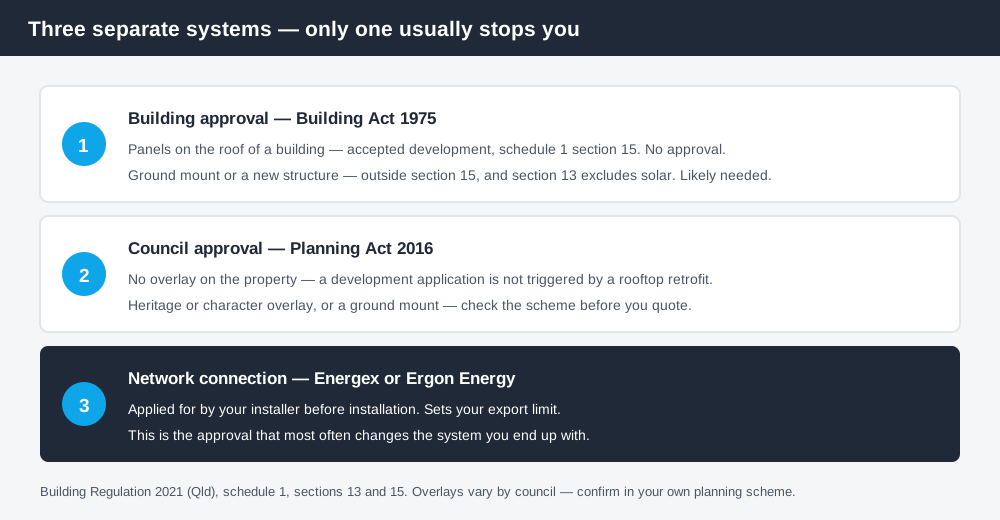
Figure 1: Where solar sits across the three separate approval systems.
Why solar sits outside building approval
There is a genuine trap in the legislation here, and it catches people who read only half of it.
Schedule 1 of the Building Regulation 2021 lists building work that is accepted development (self assessable) — work needing no building development approval, though it must still comply with the relevant building assessment provisions. Section 13 is the familiar small-structures exemption for a class 10 building or structure no more than 10m² in plan area, and section 13(1)(e) expressly carves out work "for a solar hot water system or photovoltaic solar panel". Read that in isolation and you would conclude solar is caught.
It is not, because solar has a provision of its own. Section 15 makes the installation of a solar hot water system or photovoltaic solar panel on the roof of a building accepted development in its own right, along with repairs and alterations to an existing roof-attached system. The carve-out in section 13 exists because section 15 already covers the ground.
Two consequences follow, and both matter.
- ✓A standard retrofit onto an existing roof needs no building approval
- ✓A ground-mounted array or panels on a new structure fall outside section 15, and section 13 will not rescue them
- ✓Accepted development still has to comply with the relevant provisions, wind loading included
That last point is the one most often skipped. "No approval needed" is not "no rules apply". Nobody assesses your roof fixings in advance, so the quality of the installer does the work a certifier would otherwise do. If the roof structure is being altered — new purlins, a re-pitched section, a frame carrying substantially more load — that is separate building work and a certifier should be involved. If you are unsure where accepted development ends, accepted vs assessable development in QLD sets out the categories.
The approval that actually matters is your network connection
Spend 5 minutes, not 3 weeks
instantDA generates a council-ready planning report for Queensland development applications. No town planner. No waiting.
Get your report →This is the one that stops installations, and council has nothing to do with it.
Before a system is installed, a connection application goes to your distributor — Energex in south-east Queensland, Ergon Energy elsewhere. Your installer normally lodges it for you, using an approved inverter model. The distributor decides how much you may export, and that decision is made against local network conditions, not the size of the system you would like.
A basic connection currently carries a static export limit of 5kW per phase. You can install a larger array behind a smaller or export-limited inverter and still consume everything you generate on site. A dynamic connection, which Energex and Ergon call flexible exports, allows up to 10kW per phase by letting the network vary your limit through the day, with a floor below which you are not curtailed except in a genuine emergency. Both distributors also operate an emergency backstop mechanism that can reduce generation remotely in rare system events.
Confirm current limits and lead times with your distributor before you sign anything — these arrangements are revised more often than legislation is.
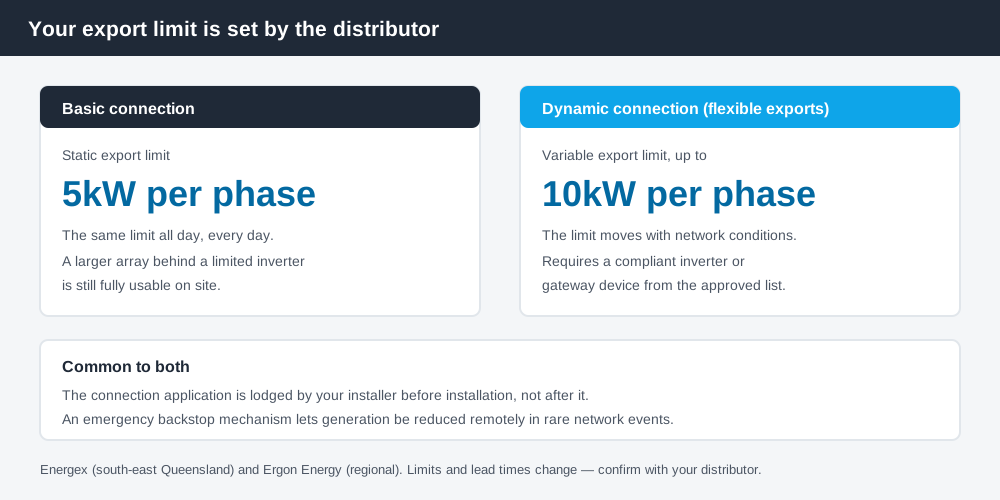
Figure 2: The connection approval, not the council, sets your export limit.
Who is allowed to do the work
In Queensland, electrical work on a solar or battery system must be done by a licensed electrician. The Electrical Safety Office is clear that a competent person may clean or visually inspect panels, but any electrical installation is licensed work.
Separately, to earn small-scale technology certificates under the Clean Energy Regulator's small-scale renewable energy scheme, the system must be designed and installed by a person accredited by Solar Accreditation Australia, who must also hold an unrestricted electrical licence in the state of installation. That is a condition of the certificates, not a council requirement — but since almost every quoted system assumes them, it functions as one.
Where a planning scheme does bite
Queensland's planning schemes follow the Queensland Planning Provisions structure, with each council layering its own codes and overlays on top. They are not uniform, so the answer for your address is the one in your own scheme.
Two overlays matter. On a local heritage place, changes generally require a development application unless an exemption applies, and a street-visible array on a listed building is exactly what gets scrutinised — heritage overlays in QLD explains the exemption pathway. Character provisions can also reach street-facing roof planes in older suburbs, though they target form and materials rather than solar specifically. State-heritage places are administered separately under the Queensland Heritage Act 1992.
The other real gate is a body corporate. Where the roof is common property you need consent — but Queensland has narrowed the grounds heavily. Under the "ban the banners" provisions in chapter 8A, part 2 of the Building Act 1975, explained on Business Queensland, consent may only be withheld to preserve structural integrity, where there is insufficient roof space for every other unit to do the same, or for noise from solar hot water piping. Appearance alone is not a lawful reason, and covenants cannot ban panels either. Body corporate approval in QLD covers the consent process and the dispute path if you are refused.
Batteries, ground mounts and cyclone country
A home battery is an electrical-safety and standards question, not a council one. Installations must comply with AS/NZS 5139 and the wiring rules, and the siting restrictions are strict: a battery generally cannot sit on a wall shared with a habitable room, or within a set distance of one, unless a compliant non-combustible barrier is fitted. Restricted locations include ceiling spaces, under stairs and escape routes. Most batteries end up in a garage or on an external wall.
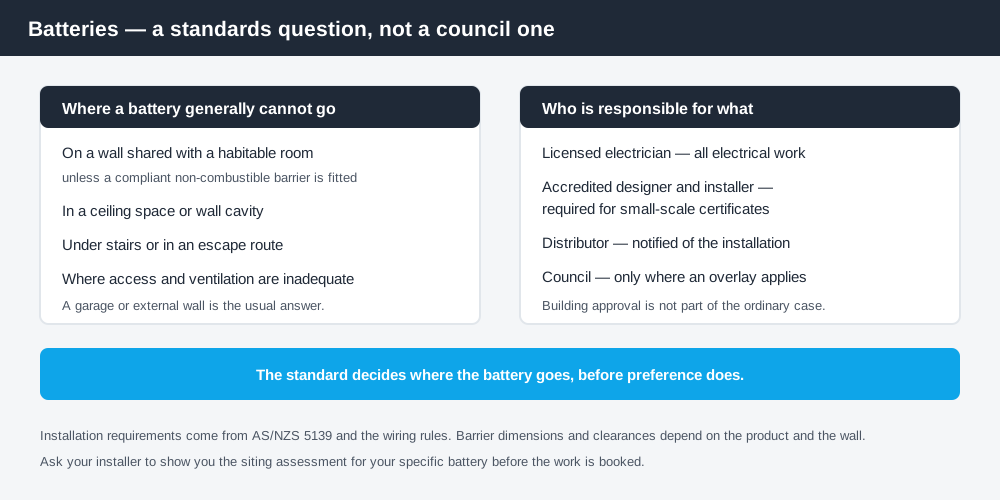
Figure 3: Battery siting is settled by the standard, not the planning scheme.
Ground-mounted arrays are different again. A ground mount is a structure, it is not on the roof of a building, and section 13 excludes it — so building approval is likely, and it may also engage scheme provisions such as setbacks or site cover. Treat a ground mount as a build, not an install.
Finally, cyclone regions. Section 15 has no wind-region carve-out, so a retrofit in far north Queensland is still accepted development — but the relevant provisions, including wind actions, apply in full and fixing requirements are far more demanding. Tell your insurer once the system is commissioned, and if you rent, get the owner's written agreement first.
What to do next
Ask three questions: is the array going on an existing roof, is the property affected by a heritage or character overlay, and has the distributor approved the connection. If the answers are yes, no and yes, you are clear.
If you would rather see your zone, your overlays and your likely category of assessment in one document than work through a planning scheme yourself, an instantDA planning report does that for your address for $169 — against the $800–$1,500 a town planner typically charges for a preliminary opinion. You can start a report in a few minutes.
Then confirm with your council before you commit, particularly if anything about your roof, overlay or title is unusual.
Frequently asked questions
Do I need council approval for solar panels in QLD?
Does a ground-mounted solar array need building approval in Queensland?
Do I need Energex or Ergon approval before installing solar?
Do I need approval to install a home battery in Queensland?
Can my body corporate refuse solar panels?
Can I install solar on a heritage-listed house in QLD?
Ready to generate your report?
Skip the writing. Get a council-ready planning report in 5 minutes.
Get your report