Key takeaways
- ✓Body corporate approval, development approval and building approval are three separate systems. A renovation can need one, two or all three.
- ✓The first question is whether the work is inside your lot only, touches common property, or permanently occupies common property.
- ✓Improvements to common property are approved at committee, ordinary resolution or special resolution level depending on cost and the regulation module.
- ✓Permanently occupying common property usually needs an exclusive use arrangement, not just an improvement approval.
- ✓Where the body corporate owns the land affected, a development application generally needs its owner's consent as landowner.
Body Corporate vs Council Approval in QLD
You'll usually hear this called a development application, or DA — that's the formal name for council approval under the Planning Act 2016. If you own a lot in a Queensland community titles scheme, that is only one of three approvals your renovation might need, and getting one does nothing about the other two.
Owners regularly discover this halfway through a job. The body corporate said yes, so the work started, and then a certifier asked for a building approval that was never obtained — or council asked why an enclosed balcony appeared without an application.
Get a council-ready planning report in 5 minutes — no planner, no waiting.
Get your report →The short answer
Body corporate approval, development approval and building approval are three separate systems in Queensland. Body corporate approval deals with common property and by-laws under the Body Corporate and Community Management Act 1997. Council approval deals with land use. Building approval deals with construction standards. A renovation can need all three.
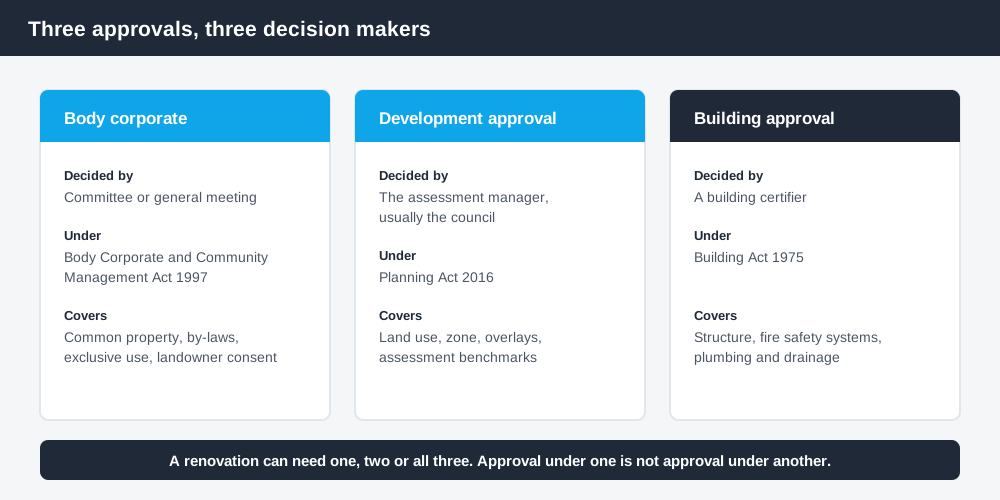
Figure 1: One "yes" does not stand in for the others.
Where the boundary sits
The first question is not legal, it is spatial: is the work inside your lot, does it touch common property, or does it permanently occupy common property?
Inside your lot only. Repainting an internal wall, replacing a kitchen, relaying internal flooring. Body corporate approval is generally not required as an improvement to common property, though the by-laws may still bite if the work affects noise transmission, external appearance or services. What can still apply is building approval, and sometimes a development approval — council approval for internal renovations in QLD covers where the building side of that line falls.
Touches common property. Anything anchored to, penetrating, or drawing from common property: a screen fixed to an external wall, new services routed through common areas, changes to the external appearance of the building. This is where body corporate approval is usually needed.
Permanently occupies common property. Enclosing a balcony that is common property, building a deck onto common land, converting a common storage area to your exclusive use. This is not just an improvement question — it is an exclusive use question, which is a higher bar.
What the body corporate is deciding
Spend 5 minutes, not 3 weeks
instantDA generates a council-ready planning report for Queensland development applications. No town planner. No waiting.
Get your report →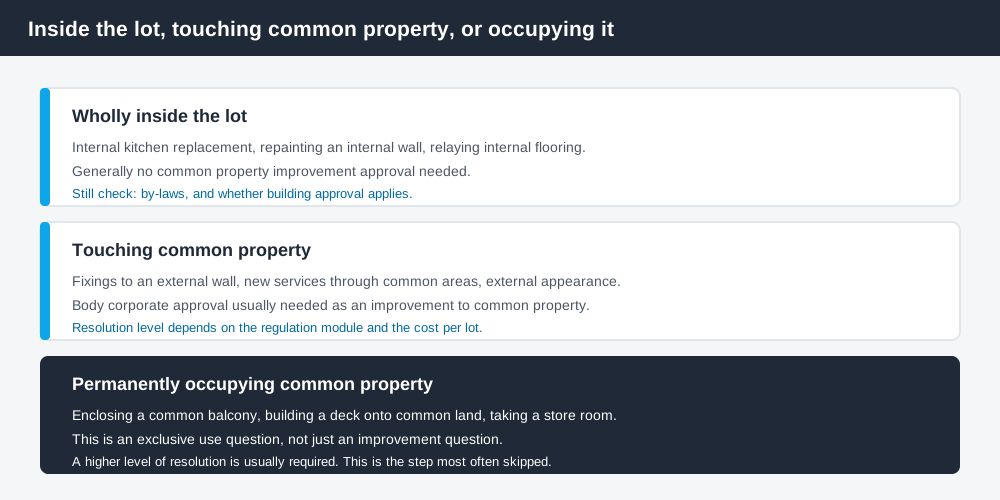
Figure 2: The same renovation can sit on both sides of this line at once.
The Body Corporate and Community Management Act 1997 is supplemented by a regulation module that applies to the scheme — the Standard, Accommodation, Commercial, Small Schemes or Specified Two-lot Schemes modules. The module you are under changes the decision-making pathway, so the first thing to establish is which one governs your scheme. It is recorded in the scheme's community management statement.
For improvements to common property, Queensland Government guidance describes a tiered approach where the level of approval scales with cost: a committee resolution for smaller improvements up to a per-lot threshold and within the committee's spending limit, an ordinary resolution at a general meeting for a middle band with a limit on how often it can be used in a year, and a special resolution above that. The published figures are expressed per lot, so the same dollar amount lands in different tiers depending on the size of the scheme. Because the thresholds and the tiers differ between modules and have changed over time, take the numbers from the current module and the current Queensland Government guidance rather than from a figure quoted in an article.
For exclusive use — a permanent right to occupy part of the common property — the pathway is different and stronger again, commonly requiring the grant of an exclusive use by-law. Practitioner guidance in Queensland points to a resolution without dissent for grants of exclusive use in many circumstances. This is the step people skip, because enclosing a balcony feels like a renovation rather than a land grant.
- ✓Which regulation module applies to the scheme?
- ✓Is the work inside the lot, touching common property, or occupying it?
- ✓What resolution level does the module require?
- ✓Is an exclusive use by-law needed?
- ✓Does the body corporate need to consent as landowner to a development application?
When council is involved
A development approval under the Planning Act 2016 is a land use question, and it is decided by the assessment manager — usually the council — not by the body corporate. Whether your renovation needs one depends on the planning scheme, the zone, and any overlays over the site. A character or heritage overlay, for example, can make external work to a unit block assessable that would otherwise not be.
Building approval under the Building Act 1975 is a different question again, assessed against the building standards by a building certifier. Structural change, changes to fire safety systems, and plumbing work are the usual triggers, and they apply regardless of what the body corporate resolved.
Owner's consent when the body corporate owns the land
If a development application affects land owned by the body corporate — common property — the applicant generally needs the body corporate's consent as landowner. This is a planning requirement, separate from any improvement or exclusive use resolution, and the person signing must be authorised to sign for the body corporate.
That authorisation runs back through the module's decision-making rules, which is why the sequence matters: sort out the body corporate position first, get the consent in the right form, then lodge. Applications lodged without valid owner's consent do not progress.
If the body corporate refuses or delays, or imposes conditions you consider unreasonable, the Commissioner for Body Corporate and Community Management provides a statutory dispute resolution service including conciliation and adjudication. A body corporate decision is not automatically the end of the matter.
What to do next
Get the community management statement and identify the regulation module. Work out precisely where your work sits relative to the lot boundary. Ask the committee, in writing, what resolution level they consider is required and whether an exclusive use by-law is in issue.
In parallel, check the zone and any overlays for the address on your council's planning scheme mapping and on the Queensland Globe, and ask a building certifier whether the work needs building approval.
If you'd rather see the zone, the overlays and the likely category of assessment for an address than work through a planning scheme yourself, an instantDA planning report does that for $169 — against the $800–$1,500 a town planner typically charges for a preliminary opinion. You can start a report in a few minutes.
If work has already been done without one of the three approvals, deal with it before you sell. Unapproved work and conveyancing in QLD explains how it surfaces at contract stage and what it costs then.
Frequently asked questions
Does body corporate approval replace council approval in Queensland?
Do I need body corporate approval to renovate inside my own lot?
What is an exclusive use by-law?
Who approves an improvement to common property?
Does the body corporate have to consent to my development application?
What can I do if the body corporate refuses?
Ready to generate your report?
Skip the writing. Get a council-ready planning report in 5 minutes.
Get your report