Key takeaways
- ✓There are two separate heritage systems — the state Queensland Heritage Register and each council's local heritage register.
- ✓State-listed places are protected under the Queensland Heritage Act 1992, with development assessed against State Code 14 in the State Development Assessment Provisions.
- ✓Local heritage places are controlled through the council's planning scheme heritage overlay.
- ✓An exemption certificate can allow certain maintenance and minor works to proceed without the usual development approval.
- ✓Heritage listing does not freeze a building. It controls change so that significance is not lost.
Building on a Heritage-Listed QLD Property
Owning a heritage-listed property in Queensland is more workable than its reputation suggests, and more procedurally involved than most owners expect. The reputation says you cannot touch it. The reality is that you can do a great deal, provided you go through the right process with the right body.
The first thing to establish is which of the two heritage systems you are in, because they run under different legislation and involve different decision-makers.
Get a council-ready planning report in 5 minutes — no planner, no waiting.
Get your report →The short answer
Queensland has two heritage systems. A place on the Queensland Heritage Register is protected under the Queensland Heritage Act 1992, with development assessed at state level. A local heritage place is protected through the council's planning scheme heritage overlay. Some maintenance and minor works can proceed under an exemption certificate.
Which system you are in changes who assesses your application, what it is assessed against, and how long it takes.
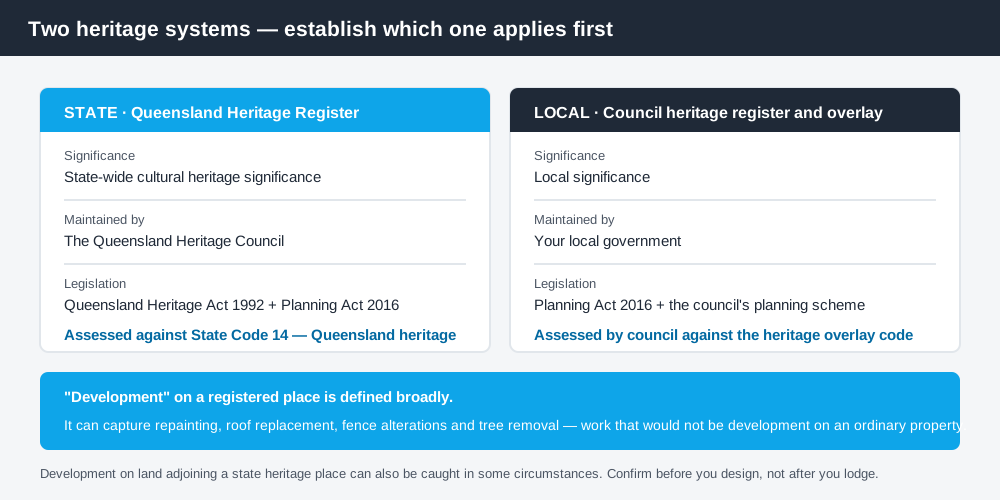
Figure 1: Two systems, two decision-makers.
State heritage — the Queensland Heritage Register
The Queensland Heritage Register is the statutory list of places of cultural heritage significance to the people of Queensland, protected under the Queensland Heritage Act 1992 and maintained by the Queensland Heritage Council.
Development affecting a place entered in the register is generally assessable development under the Planning Act 2016, with a state referral. It is assessed against State Code 14 — Queensland heritage in the State Development Assessment Provisions.
The definition of development is broad here, and that is where owners are most often caught out. It covers building work, operational work, a material change of use and reconfiguring a lot — including work that would not normally be thought of as development at all on an ordinary property. Repainting, replacing a roof, altering a fence or removing a tree can all fall within it.
Development on land adjoining a state heritage place can also be caught in some circumstances, which surprises neighbours who assumed the listing was somebody else's problem.
Local heritage — the council's register
Spend 5 minutes, not 3 weeks
instantDA generates a council-ready planning report for Queensland development applications. No town planner. No waiting.
Get your report →The Queensland Heritage Act 1992 requires local governments to keep a local heritage register, and councils also identify local heritage places through a heritage overlay in the planning scheme.
A local heritage place is one whose significance is local rather than state-wide. Assessment is by your council as assessment manager, against the heritage overlay code in the planning scheme, rather than by the state against State Code 14.
Queensland's planning schemes follow the Queensland Planning Provisions structure, but each council layers its own codes and heritage mapping on top. They are not uniform, and the heritage overlay code in one council tells you little about the next.
Heritage is not character
Heritage listing and character protection are separate instruments, and Brisbane owners in particular conflate them.
Heritage applies to individually identified places, assessed for their own significance, under the Queensland Heritage Act 1992 or a council's local heritage register. Character protection is a planning scheme overlay applying across mapped areas, concerned with the contribution buildings make to a traditional streetscape rather than the significance of any one of them.
A property can be in a character overlay, heritage listed, or both. Brisbane character housing and the traditional building character overlay covers the character side.
Exemption certificates and minor works
Not everything requires a full development approval. An exemption certificate under the Queensland Heritage Act 1992 allows certain works to proceed on a registered place without the usual approval pathway.
General exemption certificates are designed to cover ongoing maintenance and minor work needed to keep heritage places in active use and good repair — low-impact work that does not diminish heritage values. Place-specific exemption certificates can also be issued for particular works.
Where an exemption certificate applies, the works are not treated as assessable development for heritage purposes to the extent of the exemption, and a building certifier can proceed without a heritage concurrence response, provided the works are in accordance with the certificate.
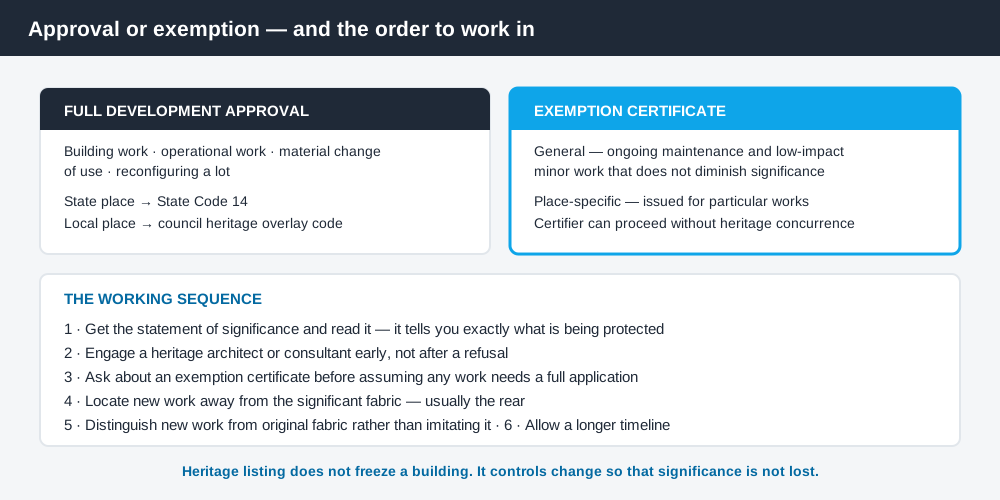
Figure 2: Approval, exemption, and the order to work in.
Councils also issue general exemption certificates for local heritage places in some cases. Ask your council before assuming any work is too minor to matter.
What it means for a renovation
Heritage listing does not freeze a building. It controls change so that what makes the place significant is not lost, and that framing is what makes applications succeed.
- ✓Get the statement of significance for your place and read it — it tells you what is actually being protected
- ✓Engage a heritage architect or consultant early rather than after a refusal
- ✓Locate new work where it does not compete with the significant fabric — usually the rear
- ✓Distinguish clearly between conservation of original fabric and new work, rather than imitating
- ✓Ask about an exemption certificate before assuming any work needs a full application
- ✓Allow for a longer approval timeline and build it into your programme
The statement of significance is the single most useful document you will read. It identifies the elements that carry the heritage value, which tells you where you have latitude and where you do not. A renovation that leaves the significant fabric alone and adds distinguishable new work at the rear is a well-trodden path.
Timeframes and cost, realistically
Heritage applications take longer than equivalent non-heritage ones, and the reason is structural rather than obstructive. A state-listed place involves a referral to a different level of government, and both the local and the state assessments run their own information request and decision stages.
Cost follows the same pattern. A heritage architect or consultant is an additional professional fee, and conservation work on original fabric is more labour-intensive than replacement — matching a profile, repairing rather than replacing a window, sourcing compatible timber. Owners who plan on ordinary renovation rates and timelines are the ones who end up frustrated.
The offsetting point is that the work is usually approvable. Refusals in this space tend to follow proposals that treat the listing as an obstacle to be minimised rather than a constraint to design around. An application that engages the statement of significance seriously, and locates its ambition where the significance is not, has a much better run.
If you are buying rather than already own, do this work before contract. Buying a heritage property in QLD sets out what to check, and council approval for an extension in QLD covers the ordinary constraints that apply on top of the heritage ones.
Check your own position
Search the Queensland Heritage Register for the property, check your council's local heritage register and its planning scheme heritage overlay mapping, and check the Queensland Globe for general property information. For the wider process of identifying every overlay on a property, how to check overlays on a QLD property walks through it.
If you would rather see your zone, your overlays and your likely category of assessment in one document before you commission a design, an instantDA planning report does that for your address for $169 — against the $800–$1,500 a town planner typically charges for a preliminary opinion. You can start a report in a few minutes.
Then confirm the position with your council and, for a state-listed place, with the relevant state department before you commit to a design.
Frequently asked questions
What is the Queensland Heritage Register?
What is the difference between state and local heritage listing?
Can I renovate a heritage-listed house in Queensland?
What is a heritage exemption certificate?
Does painting or a new roof need approval on a heritage place?
Am I affected if my neighbour's property is heritage listed?
Ready to generate your report?
Skip the writing. Get a council-ready planning report in 5 minutes.
Get your report