Key takeaways
- ✓State heritage listing, local heritage listing and a character overlay are three different controls with three different consequences.
- ✓The Queensland Heritage Register is decided by the Queensland Heritage Council under the Queensland Heritage Act 1992.
- ✓Heritage listing generally does not appear on a standard title search. You have to search the registers and the planning scheme separately.
- ✓Some minor work at a state heritage place can proceed under an exemption certificate rather than a development application.
- ✓In Brisbane, a house can be heavily constrained by the traditional building character overlay without being heritage listed at all.
Buying a Heritage-Listed QLD Property
You'll usually hear this called a development application, or DA — that's the formal name for council approval under the Planning Act 2016. When a Queensland property carries heritage protection, that application becomes harder, slower and sometimes unavailable for the thing you wanted to do.
The confusion that costs buyers money is that "heritage listed" is not one thing. There are three separate controls in Queensland, they are administered by different bodies, and a property can carry one, two or all three.
Get a council-ready planning report in 5 minutes — no planner, no waiting.
Get your report →The short answer
Queensland has three separate heritage controls: state listing on the Queensland Heritage Register under the Queensland Heritage Act 1992, local heritage listing by a council, and character or traditional building character overlays in a planning scheme. They are decided by different bodies and restrict different things.
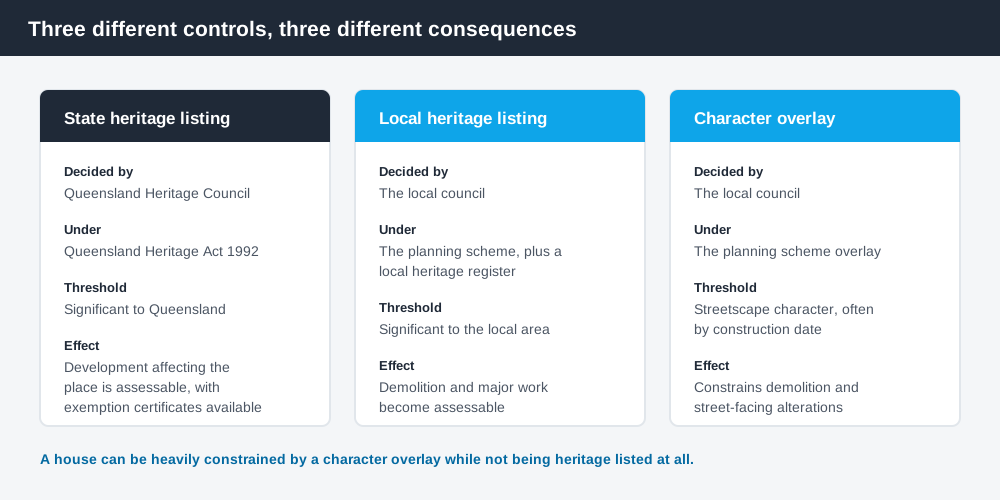
Figure 1: A property can carry one, two or all three at once.
State listing: the Queensland Heritage Register
The Queensland Heritage Act 1992 is the framework for protecting places of cultural heritage significance to the state. The Queensland Heritage Register is the statutory list, and entries include state heritage places and protected areas. Each entry carries a description, a history and a statement of significance explaining why the place meets the criteria.
Entries are decided by the Queensland Heritage Council, an independent statutory body. The register itself is maintained by the state department responsible for heritage, currently the Department of the Environment, Tourism, Science and Innovation.
The consequence of state listing is substantial. Development affecting a place on the register is assessable development under the Planning Act 2016 and generally requires approval, with the state involved in the assessment. Damaging or interfering with the place is separately prohibited. Approvals typically come with conditions directed at conserving the heritage fabric.
Local heritage listing and heritage overlays
Spend 5 minutes, not 3 weeks
instantDA generates a council-ready planning report for Queensland development applications. No town planner. No waiting.
Get your report →Councils can keep their own local heritage register, and they identify heritage places in their planning schemes through a heritage overlay. These places are significant to a city, town or shire rather than to Queensland as a whole.
The mechanism is different: the control operates through the planning scheme and the table of assessment rather than through state referral. Demolition, new building work and significant alteration typically become code assessable or impact assessable, assessed against the scheme's heritage code. Heritage overlays in QLD covers how the overlay codes are structured and what they usually require.
Local listing is easy to miss because it does not appear on the state register. You have to look at the council's own register and the planning scheme mapping.
Character overlays are not heritage listing
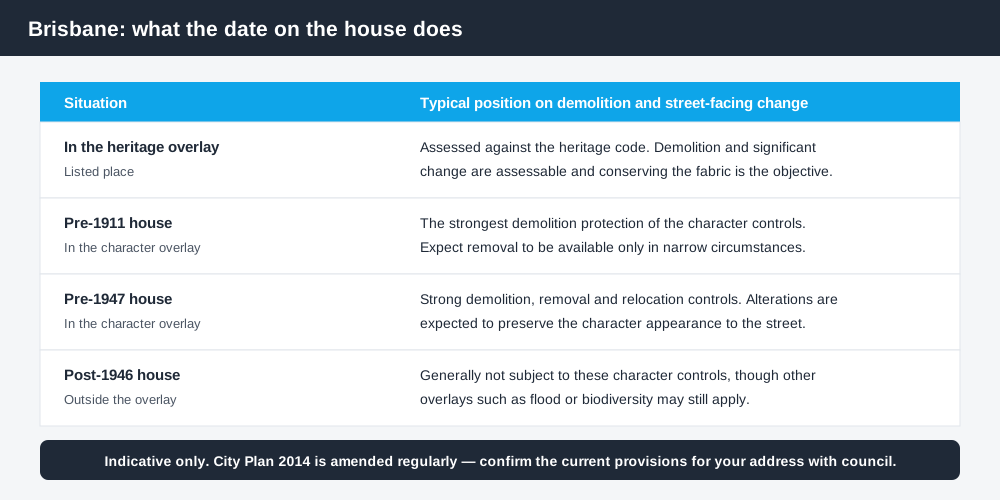
Figure 2: Confirm the current provisions with council — City Plan is amended regularly.
This is where most Brisbane buyers get caught. Brisbane City Plan 2014 runs a traditional building character overlay across areas with concentrations of pre-war timber-and-tin housing. The purpose is to preserve streetscape character — form, scale, roof shape, materials — in streets where individual houses are not heritage listed at all.
The overlay uses construction-date triggers. Houses built before 1947 in the overlay carry strong demolition controls, and pre-1911 houses attract the strongest protection of all. Extensions and alterations are generally expected to preserve the character appearance to the street, which in practice pushes new work to the rear and constrains what can be done to the front elevation.
A buyer who plans to knock down and rebuild, or to raise and build under with a modern street presentation, needs to know this before the contract, not after. Character overlays in QLD covers how these overlays work across Queensland councils, not only Brisbane.
Working on a state heritage place
Not everything needs a full development application. The Queensland Heritage Act 1992 provides for exemption certificates, administered by the state heritage department, which allow specified works to proceed without a heritage development approval where the department is satisfied they will not adversely affect the cultural heritage significance of the place.
There are also general exemption certificates, which cover standard classes of routine work so owners do not have to lodge an application for each one, provided the published conditions are met.
Beyond what an exemption can cover — demolition, major additions, substantial alteration to significant fabric — a development application addressing heritage impacts is required, with the department and the Heritage Council involved.
- ✓Search the Queensland Heritage Register for the address
- ✓Check the council's local heritage register
- ✓Check the planning scheme for heritage and character overlays
- ✓Ask council for the property's approval history
- ✓Get an exemption certificate position in writing before relying on one
Why the title search will not save you
Heritage listing under the Queensland Heritage Act 1992 does not ordinarily appear as a notation on the freehold title. A standard title search shows ownership, easements, mortgages and registered encumbrances — statutory controls like heritage listing and planning scheme overlays operate through separate registers and instruments.
The practical consequence is that heritage due diligence is a separate exercise from the conveyancing searches, and it is on the buyer to do it. Agents are not always aware, and a listing that says "character home" is a description, not a disclosure.
Search the Queensland Heritage Register online for the address or the lot on plan, check the council's local heritage register, and pull the planning scheme overlay mapping for the site. How to check overlays in QLD walks through the mapping step. Cross-check the address on the Queensland Globe as well, which carries state-supplied layers alongside the council mapping.
What to do next
Do the three searches before you sign, or make the contract conditional on them. If you intend to demolish, extend or substantially alter, get council's position on the specific proposal in writing rather than relying on a general reading of the code.
If you'd rather see the zone, the overlays and the likely category of assessment for an address than work through a planning scheme yourself, an instantDA planning report does that for $169 — against the $800–$1,500 a town planner typically charges for a preliminary opinion. You can start a report in a few minutes.
Then confirm with your council, and with the state heritage department if the property is on the Queensland Heritage Register. Heritage assessment is judgement-heavy, and a duty planner's read on your specific proposal is worth more than any general rule.
Frequently asked questions
Does heritage listing show up on a title search in Queensland?
Who decides what goes on the Queensland Heritage Register?
What is the difference between state and local heritage listing?
Can I demolish a pre-1947 house in Brisbane?
Do I need approval for repairs to a state heritage place?
How do I check if a property is heritage listed before I buy?
Ready to generate your report?
Skip the writing. Get a council-ready planning report in 5 minutes.
Get your report