Key takeaways
- ✓A small retrofit tank on an existing house is accepted development if it stays inside the plan area, height and side length limits.
- ✓A tank installed for a new building is expressly excluded — it belongs to that building's approval.
- ✓The 2.1m mean height test that catches other small structures does not apply to a rainwater tank.
- ✓Plumbing the tank into a toilet, laundry or hot water service is regulated plumbing work, and that approval is separate from building approval.
- ✓Taking water from a bore, dam or watercourse is a licensing matter under the Water Act 2000, not council approval.
Do You Need Council Approval for a Water Tank in QLD?
You'll usually hear this called a development application, or DA — that's the formal name for council approval under the Planning Act 2016. For a rainwater tank, a DA is rarely the issue. Two other layers are, and they run on different rules: building approval under the Building Act 1975, and plumbing approval under the Plumbing and Drainage Act 2018.
Get a council-ready planning report in 5 minutes — no planner, no waiting.
Get your report →The short answer
Usually not. A tank on an existing house is accepted development if it is no more than 10m² in plan area, no more than 2.4m high and has no side longer than 5m. A tank for a new building is excluded, and internal plumbing connections are a separate approval.
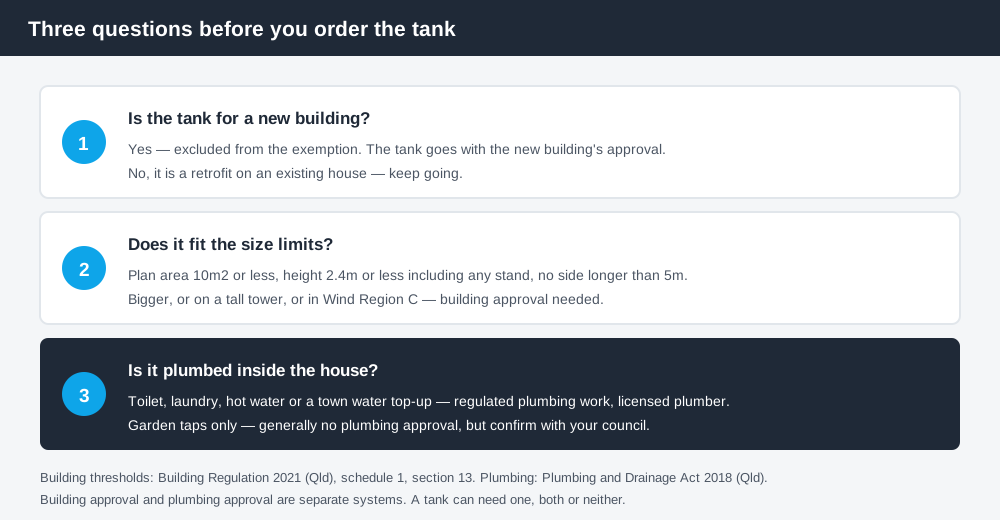
Figure 1: Three questions decide whether a tank is caught.
Where the exemption actually lives
A rainwater tank is a class 10 structure. Section 13 of schedule 1 to the Building Regulation 2021 makes building work for particular class 10 structures accepted development, provided the structure meets three dimensional requirements — a plan area of no more than 10m², a height above natural ground surface of no more than 2.4m, and no side longer than 5m.
Two details in that section decide most cases. The first is a concession. Section 13(2)(b)(ii) imposes a mean height limit of 2.1m — but only "if the class 10 building or structure is not a rainwater tank". A garden shed of the same footprint has to satisfy both height tests; a tank only has to satisfy the 2.4m overall height.
The second is an exclusion, and it works the other way. Section 13(1)(b) takes building work "for a rainwater tank for a new building" outside the exemption altogether. Section 13(1)(a) does the same for anything in Wind Region C, the tropical cyclone area defined in AS 1170.2, which covers a long stretch of the Queensland coast. Section 13 also defines a rainwater tank to include any stand supporting it, so a modest tank on a tall tower will usually breach the 2.4m height.
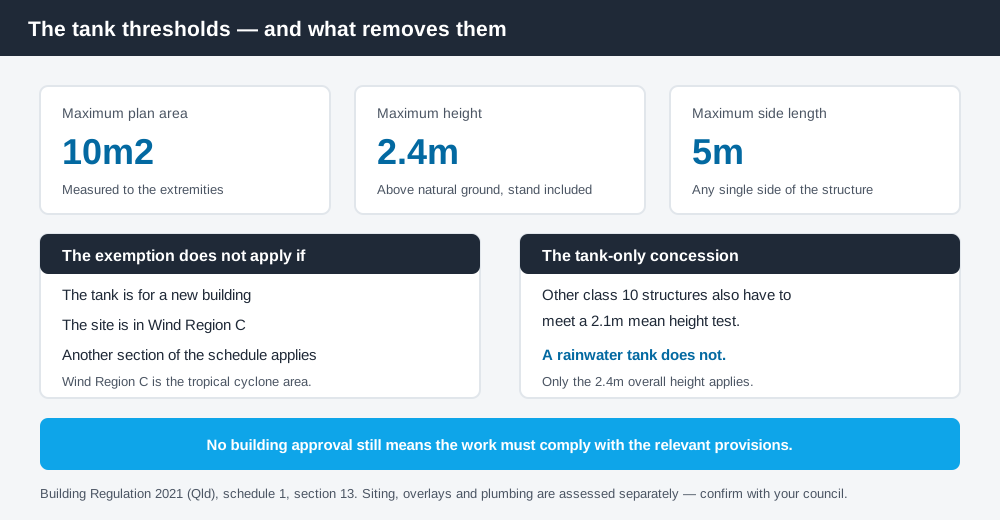
Figure 2: The section 13 numbers, and the four things that switch them off.
Retrofit versus new build
Spend 5 minutes, not 3 weeks
instantDA generates a council-ready planning report for Queensland development applications. No town planner. No waiting.
Get your report →If you are adding a tank to a house that already exists, and it fits inside those limits, you are generally in accepted development territory and no building approval is required. That covers most slimline tanks tucked down a side boundary and most round poly tanks on their own pad.
If the tank is going in as part of a new house, shed or other new building, the exemption does not apply. That is less a trap than an accounting rule — the tank forms part of the building work being certified, so the private building certifier assesses it inside that approval rather than you seeking a second one.
At the other end, a large rural or bulk-storage tank outgrows the numbers. A tank holding tens of thousands of litres will usually exceed both the 10m² plan area and the 5m side length, so it needs building approval even though nothing about it is controversial. If it is going up alongside a farm building, the thresholds in council approval for a shed in QLD work the same way.
One caveat. Schedule 1 work is accepted development (self assessable) — no approval is needed, but the work must still comply with the relevant provisions. Exempt from approval is not exempt from the standard.
The plumbing layer, where most people go wrong
This is the part homeowners do not expect. Connecting a tank to the internal supply — toilet cisterns, the cold laundry tap, a hot water service — is regulated plumbing work under the Plumbing and Drainage Act 2018. It must be carried out by a licensed plumber, and in many council areas it needs a plumbing approval before it starts.
- ✓Internal connections done by a licensed plumber
- ✓Backflow prevention where the tank interacts with the town water supply
- ✓Rainwater identification labelling on pipework, taps and outlets
- ✓Council plumbing approval where the council requires one
Backflow prevention is the non-negotiable one. Any arrangement where a tank and the reticulated supply can meet — a town water top-up, a switching device — risks contaminating the mains, so cross-connection has to be prevented and devices are registered and tested. Brisbane City Council's rainwater tank guidance sets out a typical version of these requirements, including labelling rules for internally connected tanks.
A tank plumbed only to garden taps and hoses generally does not attract the same requirements. That is the practical dividing line — the moment tank water can reach a fixture inside the house, you are in a different system.
Do new houses still have to have a tank?
Queensland's requirements for water supply to new dwellings have changed more than once. Statewide water savings targets were introduced, then wound back, and what applies now is a combination of the Queensland Development Code and whatever your council's scheme requires. Queensland's schemes follow the Queensland Planning Provisions structure but each council layers its own codes on top, so they are not uniform. Check the current position with your council or certifier rather than relying on a rule quoted to you a decade ago.
Siting, overlays and what's underground
Even an exempt tank has to go somewhere lawful. Boundary setbacks apply, and councils commonly require a minimum clearance to a property boundary. Character, heritage and neighbourhood overlays matter where a tank would sit street-facing — a large tank in front of a pre-war house is what a character overlay is written to control.
Check what is under the pad as well. Building over or near a sewer main is controlled by the water service provider and can require an assessment or a build-over approval, and a full tank is a serious load. Building over a sewer in QLD covers that process.
Then think about overflow. A tank fills and then it spills, usually in the same downpour that flooded everything else. The overflow has to reach a lawful point of discharge — the kerb and channel, an inter-allotment drainage line or an easement where council permits it — and must not be turned onto the neighbour. Downstream owners accept natural overland flow, not flow you have concentrated at one corner of the fence.
Bore, dam and creek water is a different question
Collecting rain off your own roof is yours. Taking water from a bore, a dam on a watercourse, or the watercourse itself is regulated under the Water Act 2000 as a licensing and allocation matter, administered by the state rather than your council. Building approval has nothing to say about it. If that is your plan, water licences and bores in QLD is the article you want.
What to do next
Measure the tank, including its stand, before you buy it. Then ask whether it is going onto an existing building or a new one, and whether anything is being plumbed inside. Those three answers resolve nearly every case. The Queensland Government's guidance on when you don't need building approval sets out the state position.
If you'd rather see your zone, your overlays and your likely category of assessment in one document than work through a planning scheme yourself, an instantDA planning report does that for your address for $169 — against the $800–$1,500 a town planner typically charges for a preliminary opinion. You can start a report in a few minutes.
Then confirm with your council. Plumbing rules vary between council areas more than the building thresholds do.
Frequently asked questions
Do I need council approval for a water tank in QLD?
Does a rainwater tank for a new house need approval?
Do I need a plumber to connect a rainwater tank in Queensland?
Does a tank on a stand need building approval?
Do I need approval to pump water from my dam or bore?
Ready to generate your report?
Skip the writing. Get a council-ready planning report in 5 minutes.
Get your report